
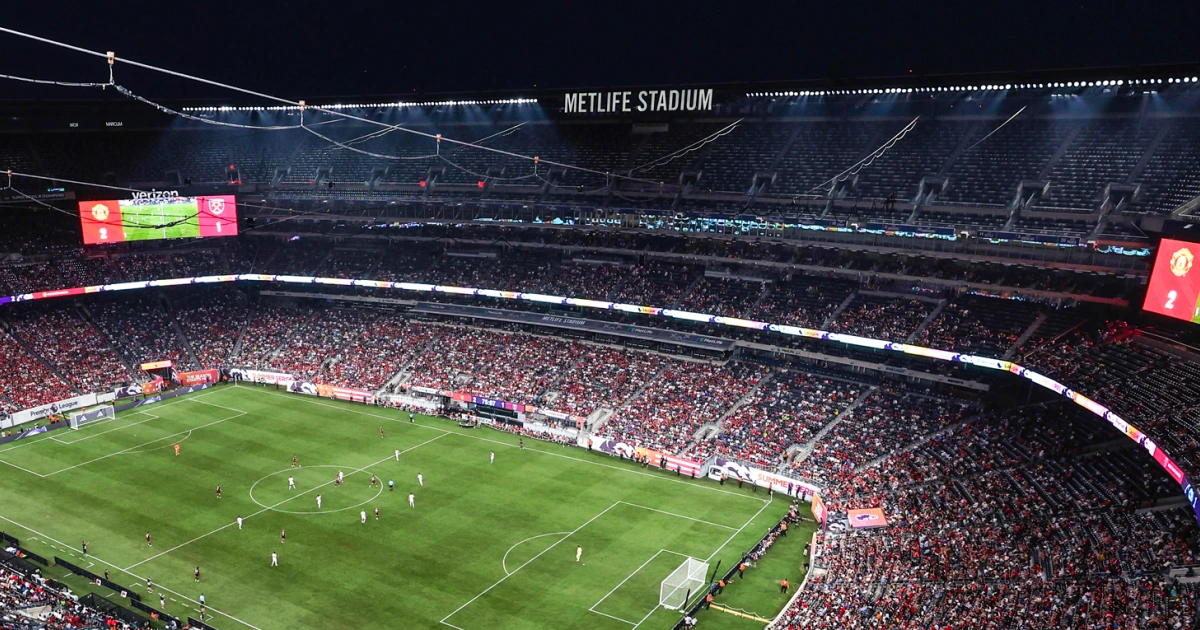
The 2026 Soccer World Cup poses a very particular challenge for American public officials focused on health: in the following weeks, dozens of teams, and many of their followers, will arrive in different cities from places all over the planet.
It will be the largest World Cup in FIFA history by number of teams, and 39 of them will have their training bases in the United States. There will be soccer fans in different parts of the country from the first game to be played in the United States, on June 12 in California, and until the last, the final on July 19 at MetLife Stadium in New Jersey.
“If we do our job (prevention) well, people won’t even notice.”
ethan booker, head of telehealth at medstar health
It’s considerably larger in scale than any Super Bowl or even the Olympics, events that typically are concentrated in a single city and last fewer days.
Considering that certain football fans tend to follow their teams wherever they go, it is foreseeable that some of them will get sick during the journey.
In recent days there has been some concern about Ebola, with the outbreak in the Democratic Republic of the Congo resulting in increased screening at certain airports in the United States.
However, experts say it is very low possibility of transmissionebola on during World Cup matches or events to watch those sporting events.
Ebola is not transmitted through the respiratory route, but through direct contact with bodily fluids or emissions from someone who has the virus, and that puts hospital staff or caregivers at greater risk.
Instead, experts are concerned about another virus: the highly contagious measles, of which there are already several outbreaks in the United States.
A “somewhat complicated” virus
“I wouldn’t be surprised to see a measles outbreak linked to the World Cup”said Andrew Pekosz, a virologist at the Johns Hopkins University school of public health. “Crowds provide the perfect opportunity for the virus to spread.”
It takes approximately 14 days for the clearest symptoms of measles, such as a rash, to become noticeable, so it is possible that the outbreak begins before the last goal to be played. And since incubation can last up to three weeks, it is possible that those who visit to watch a game are exposed to measles while in the United States and return to their countries as potential sources of contagion.
(From Texas to Chihuahua: how a measles outbreak originated in Mexico that left at least 14 dead)
There will also be games in Mexico and Canada, where local authorities are facing other measles outbreaks.
The Pan American Health Organization (PAHO) is urging health authorities in all host cities to take precautions to monitor possible infections before the games begin.
Marcus Plescia, director of the Fulton County health board (part of Georgia that includes Atlanta), said his team has been preparing for months. Among other things, they have sought to ensure they have enough vaccines and immunoglobulin injections, which are sometimes appropriate to give when someone has been exposed. “I’ve asked my staff to have a measles-specific plan just in case,” Plescia said.
That team in Georgia has explored several possible scenarios: What happens if a visitor tests positive for measles? How then can public health officials ensure that that person and those who traveled with them stay in their hotel rooms, especially if they are not US citizens over whom they have jurisdiction?
“Measles is a complicated thing,” Plescia said. “And it is feasible that people who come for the World Cup will be exposed, but return to their countries before showing signs of the disease.”
Sources for other infections
Since it is summer, influenza and COVID are at lower levels than they were a few months ago in the United States. However, in parts of the southern hemisphere it is currently winter. “There are chances that there will be people with the flu or influenza visiting from those regions and then we will see respiratory diseases that do not usually occur here during the summer,” said Pekosz, of Johns Hopkins.
And what happens if among the travelers there are people carrying diseases rarely seen in the United States, such as malaria or dengue?
“It may take us longer to diagnose it” if that is the case, Pekosz said. “And in that case the treatments would not be applied as quickly.”
Other diseases at the top of the list of possible outbreaks are bugs that affect the digestive system, such as norovirus or rotavirus, which can be easily spread even through contaminated or expired food.
(A mosquito hope: how mosquitoes can help in the fight against dengue, Zika and chikungunya)
“Public health agencies in cities hosting the World Cup must take charge to ensure that the food that is served is done so safely,” Plescia said.
His team in Georgia has scheduled daily inspections of street vendors and food trucks that will be at World Cup festivals or that supply community soccer events. “I think that is what we are going to dedicate the most time to,” said the official.
The Centers for Disease Control and Prevention (CDC) is finishing organizing a database designed so that health officials at the local and state levels can have better monitoring.
To this end, the CDC has assigned more than 30 officers to review bacterial or virus samples in wastewater and to support local authorities. An additional 170 CDC officers are assigned to deploy as needed to assist in the event of an outbreak or other public health issue during the FIFA Cup.
There are also initiatives of this type from the private sector. Georgetown University and MedStarHealth in Washington DC this week launched an operational center called Health Security to collect and analyze health data in all host cities in the United States, including information on the presence of viruses in wastewater and last-minute reports made by emergency personnel.
(They warn that the measles outbreak in a Texas ICE center could become an epidemic: “Viruses are not political”)
“If suddenly you have a group of people coming to an emergency room because they have nausea, vomiting and diarrhea, then that will allow us to quickly review the data to see if there could be norovirus in the drain,” said Ethan Booker, chief medical officer of telehealth for MedStar Health.
Rebecca Katz, director of Georgetown’s Center for Science and Global Health Security, added that the team will also be reviewing mobility data, such as whether a large group of fans moves from one city to another, to keep a daily record that can be accessed by the public.
Booker said that the fact that there are all these preparations is something that they intend to be comforting for people.
“I want people to come and have fun and support their teams, to feel that community spirit,” he said. “And if we do our job well, people won’t even notice, and that will be a success for us.”
