
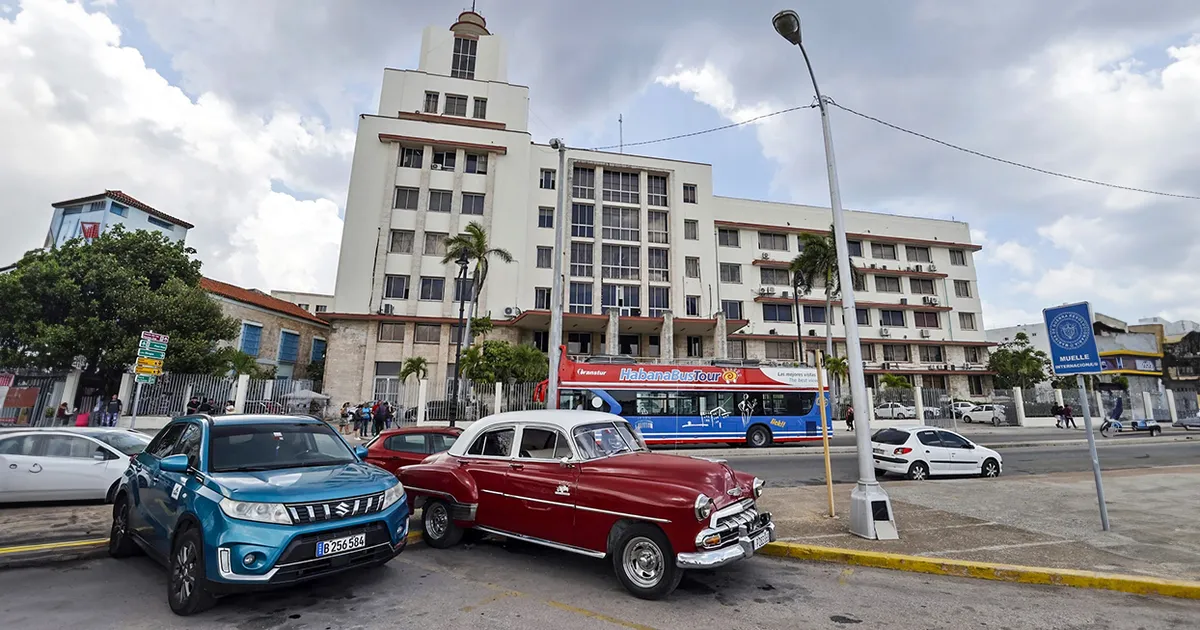
It was built in the 1950s. Near the property are the Trade Exchange, the San Francisco de Asís Church and a new five-star hotel, Real Aduana, soon to open, has been built in the old Customs House, another hotel from the military holding company GAESA.
With the coming to power of the dictator Fidel Castro in 1959, the General Staff of the Revolutionary War Navy was located in the Navy Building, today the headquarters of GAESA. A former GAESA employee tells DLA that at “the end of 1995, due to its strategic location and thinking about the development of tourism in this old area of Havana, it was decided to transfer those offices to the military emporium.”
By then, taking advantage of the success of the HABAGUANEX company, directed by the city historian Eusebio Leal, GAESA’s master plan was to reconvert the old port and its surroundings into a tourist attraction site. In 2016, according to the former employee, “GAESA brazenly carried out a coup d’état against Eusebio Leal and absorbed HABAGUANEX with the pretext of corruption. And the entire perimeter, from the National Capitol to the port of Havana, became the property of GAESA. They put the architect Perla Rosales, daughter of General Ulises Rosales del Toro, a trusted man of Raúl Castro and one of the important guys in the military empire.”
But GAESA’s history goes back decades. Several sources consulted assure that its origin dates back to the mid-eighties. “It emerged as a company without great pretensions. It was a bit out of necessity and a bit out of envy on the part of Raúl and senior FAR commanders who felt an open inferiority complex due to the facilities and concessions granted by Fidel to the MININT,” says a retired former military officer.
“The MININT managed a million-dollar account in foreign currency. They had front companies such as CIMEX, Cubalse and others that together with Fidel managed the dollars that entered the country from abroad for medical missions, tourism and the provision of services to diplomatic personnel accredited in Cuba.”
“The MC division also operated, directed by Tony de la Guardia, in charge of obtaining dollars through different means and purchasing the equipment and cutting-edge technology that the country needed. The MININT was the brain of the gold and silver operation, which at a bargain price, exchanged jewelry, works of art and valuable paintings belonging to the population for cheap ones and appliances.”
“Any whim of Fidel, from a state-of-the-art computer or equipment for the nascent biotechnology industry, was obtained by those MININT companies managed by Cuban intelligence through legal companies in Panama, Mexico, Canada and other cities. They even ran a bank in London.”
“This ability to obtain hundreds of millions of dollars allowed many MININT officers to have access to homes, cars and things that were considered a luxury at that time. It was then that, to modernize communications and computer equipment and some weapons, Raúl Castro asked his brother Fidel for permission to create parallel companies that would be in charge of obtaining foreign currency.”
“There were already incipient military companies, which repaired the weapons that the former USSR gave away for free. But while the MININT assembled cars with VW engines, its officers wore Levi’s, Rolex watches, Ray-Ban glasses and had first-class clinics and recreational villas, the FAR officers seemed like rude peasants,” says the former official.
After the execution of Arnaldo Ochoa, in July 1989, the dismantling of the MC division and the imprisonment of the all-powerful MININT minister José Abrantes, Raúl Castro, with the approval of Fidel, took advantage of the bloody scenario and began a deep purge within the Ministry of the Interior.
By 1990, those military companies that would later be the genesis of GAESA, had a mechanism designed to operate currencies in the midst of the economic crisis – the well-known Special Period – after the fall of communism in the Soviet Union.
The former FAR officer states that “Raúl and the Casas Regueiro brothers, together with a group of economists and experts, had been studying economic development in Japan since the 1970s. And they came to have very good contacts with Japanese companies. They tried to copy the business success of the Zaibatsu. Then, as a result of a certain corruption scandal in tourism, Raúl, an eternal conspirator, spoke with Fidel to create Gaviota, a parallel company to the Ministry of Tourism that “It monitored the real cost of each dollar invested and its profits. Then what we know happened: GAESA absorbed all the companies that managed foreign exchange, from the export of medical services, Habaguanex, ETECSA, CUPEX and many others,” says the former military man.
According to documents leaked by El Nuevo Herald, the holding company had assets in 2024 of at least 17.9 billion dollars, including more than 14 billion in bank accounts. The power of GAESA today is brutal. It is not accountable to any state institution or to citizens.
“They probably don’t even pay taxes. Their finances and businesses are a real mystery. The closest thing to a James Bond movie,” says a local economist. The former official of the military company expresses that “this opacity allows him to carry out any financial operation and investments without the approval of the government or parliament. The group that controls GAESA, and therefore the country, does not exceed ten: three or four generals and relatives or associates of Raúl Castro.”
GAESA manages more than 60 thousand hotel rooms, the only telecommunications company, ETECSA, hundreds of gas stations, wholesale warehouses, retail stores, hospitals, the International Financial Bank, a fleet of four oil tankers and the Port of Mariel, among other lucrative businesses.
Emilio Morales, president of the Havana Consulting Group that studies the Cuban economy, in a report on the BBC stated that by “taking over CIMEX, GAESA acquired its entire network of companies inside and outside Cuba: corporations located in tax havens in Panama, exports, wholesale imports and real estate businesses.”
For the former official of the military company, the battery of sanctions approved by the Trump administration, “first in 2016, by including several GAESA businesses on a blacklist, which despite some relaxation was maintained with the Biden government, was a first warning that impunity had ended. But strong pressure is being applied now. Especially after the capture of Nicolás Maduro on January 3. The closure of front businesses in Florida and the corresponding investigations, as well as the arrests of the sister of Ana Guillermina Lastre, president of GAESA, and the daughter of General Ulises Rosales, suspected of managing businesses with GAESA capital, it is a significant blow to Raúl Castro’s military company.”
“It is evident that from the leaks to the press it was known about the more than twenty trips of the Crab whose objective was to acquire properties in Panama and his negotiations with the Trump administration, it is a sign that the CIA and Marco Rubio know exactly where to press to derail and reduce the power of GAESA,” says the former official.
Gustavo, an economist, considers that “after the pandemic and with the closure of Western Union in Cuba, GAESA lost hegemonic control of the remittances sent to the island. With the opening of more than ten thousand MYPIMES starting in September 2021, an important part of those millions of dollars were diverted towards the retail purchase of food for those who receive dollars, for a compelling reason: they are much cheaper than the products sold in stores for foreign currency. GAESA”.
“Thanks to the consolidation of the informal market for the purchase and sale of foreign currency, it is more profitable for people with access to the dollar than selling it to the state banking system. Also the rise of private agencies dedicated to remitting foreign currency in Florida has taken away the supremacy of the traditional way of sending money through transfers to branches in Cuba,” highlights the economist.
Gustavo believes that in the last five years, “a lethal combination of multi-systemic crisis plus United States sanctions has been the perfect storm that has eroded the immense power of the GAESA empire. These sanctions have brought about a drastic decrease in tourism. From four million in 2016 to one million and a little, which is the forecast when 2026 ends.”
A diplomatic official in Havana asserts that “the day after January 3, the real blockade of the Cuban regime began, and especially of GAESA. The director of the CIA did not visit the Island to exchange greetings or ask about the political prisoners. His function, in addition to a message from Trump, was to be direct. To make the special services, who know in detail the electronic espionage of China and Russia, see that, if they do not initiate a political transition and radical changes in the economy, the deadline was running out. Washington has the capacity “to block the financial operations of GAESA and dismantle the network created in the United States to obtain millions of dollars by profiting from the misery of the Cuban people.”
The perception of some experts is that they can no longer even bet on a more or less beneficial deal with the White House. Important companies such as the Canadian Sherrit have canceled their businesses in Cuba and sold 55% of their shares to an American group. And several Spanish hotel companies also plan to withdraw from the Island. The dictatorship’s allies, Russia, China, Mexico, donate a few tons of food or a ship of fuel. But their support is merely symbolic.
With multi-day blackouts in deep Cuba, collapsed basic services and increasing protests in the country, the regime’s only smart option is to negotiate a deal with the Trump administration.
The choice is simple: preserve billions of dollars and property or try to screw himself into power at the risk of losing his fortune and the threat of a military operation. The Castro dictatorship cannot be understood logically. Anything is possible. But no one accumulates so much money and then not be able to enjoy it.
