
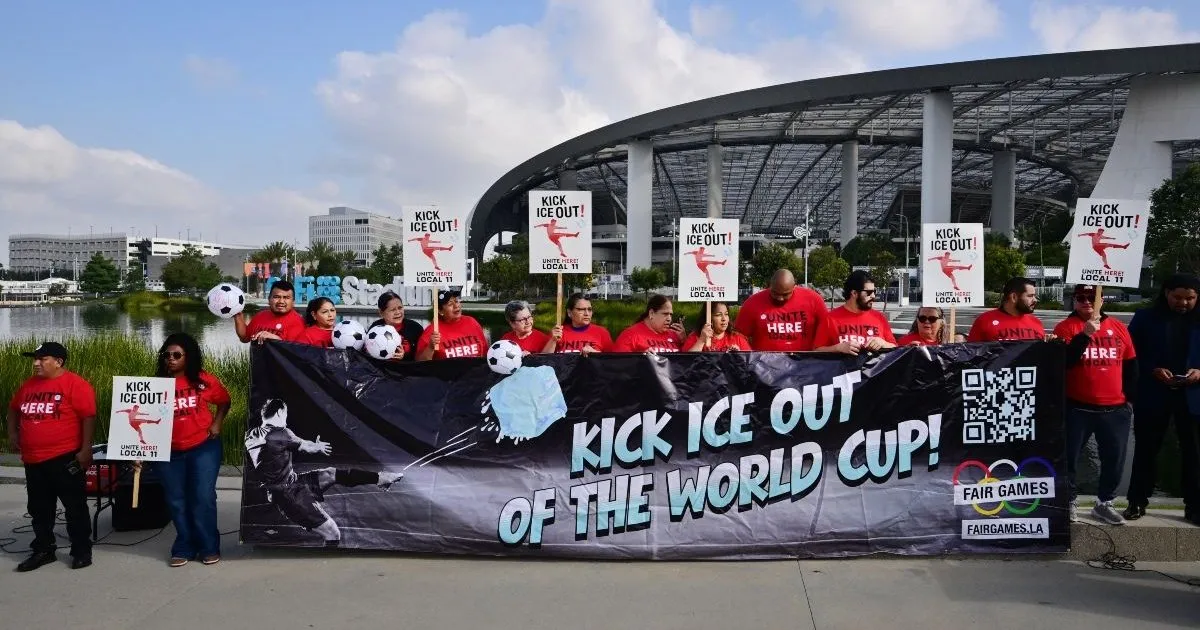
WASHINGTON.- The first participation of Haiti in one World Cup since 1974 makes us very proud Emilea Haitian resident in Ohio; However, he is afraid to go and encourage his team due to the anti-immigration measures promoted by the American president. Donald Trump.
“Singing my country’s national anthem in a stadium, in front of everyone, is a historic moment that no one would want to miss,” the 40-year-old truck driver, who preferred not to give his last name, told AFP.
“But at the same time, I think twice. I don’t want the ICE stop me,” he added, referring to the agents of the Immigration and Customs Enforcement (ICE), whose mission is to arrest and deport undocumented foreign citizens.
“My lawyer advised me not to travel by plane to avoid being intercepted at the airport,” he said.
Emile’s concerns are shared by many members of the migrant community. They have seen firsthand how hooded and heavily armed ICE agents operate, frequently using brutal methods in several cities across the country. USA.
The peak of outrage over ICE came in January, when immigration agents shot and killed two American protesters in Minneapolis.
“Now people are very attentive to what (the authorities) are doing and they no longer feel safe,” he told AFP. Monica Sarmientoof the Virginia Coalition for Immigrant Rights.
“They are afraid. We have seen very aggressive tactics by ICE, directed not only against undocumented communities, but also against people who have protected status.”
Sarmiento pointed out that “70% of the people arrested, detained and deported have no criminal record.”
“Many of them have been living here for decades and paying taxes,” he added, and denounced the existence of “a climate of fear and hostility throughout the country; a situation that is not limited to the World Cup, but is experienced day after day.”
Restless Haitian community
Of the 104 games of the World Cup78 will be disputed in USAco-organizing country of the tournament – scheduled for June 11 to July 19 – together with Canada and Mexico.
The possibility that ICE may intensify its activity by taking advantage of parties in the United States has raised concerns in the heart of the Hispanic community in the United States, which represents 20% of the national population and is mainly concentrated in California, Texas and Florida.
Its presence is especially significant in large cities such as Miami, Los Angeles, dallas and New Yorkall World Cup venues.
The Haitian community – some 850,000 people in 2024, largely concentrated in Miami and New York – is also under threat from the Trump administration’s attempt to end the Temporary Protected Status (TPS), from which migrants like Emile benefit.
This status prevents them from being deported to their country of origin, which in the Haitian case is a ticket to one of the poorest nations in the world and a territory devastated by political instability, the economic crisis and gang violence.
“Serious rights violations”
Fears intensify after reports from organizations such as Human Rights Watchwhich cited the case of an asylum seeker who was detained by ICE and deported to his home country after attending the final of the Club World Cuplast year, in East Rutherford (New Jersey).
Some human rights organizations fear that ICE will target foreign tourists who are in the vicinity of stadiums or in the numerous “Fan Zones”, where thousands of fans will congregate.
More than 120 US civil rights organizations – including the influential American Civil Liberties Union (ACLU) – issued a “travel warning” in April warning of the “risk of serious rights violations” for fans, players, journalists and other visitors.
According to the signatories, “individuals traveling to the United States could be at risk of being denied entry, being detained, imprisoned and/or deported; being subjected to racial profiling or receiving “cruel, inhuman or degrading treatment – and even dying – while in ICE detention or custody.”
ICE, one of the many agencies that make up the Department of Homeland Security (DHS), has been involved for a long time in the security devices of major sporting events, such as the Super Bowl.
“International visitors who enter the United States legally to attend the World Cup have nothing to worry about,” a DHS spokesperson told AFP.
“What makes a person a target for immigration control authorities is whether or not they are in the United States illegally.”
FIFA responded to an AFP query by stating that it “is committed to respecting all internationally recognized human rights and strives to promote the protection of such rights.”
