
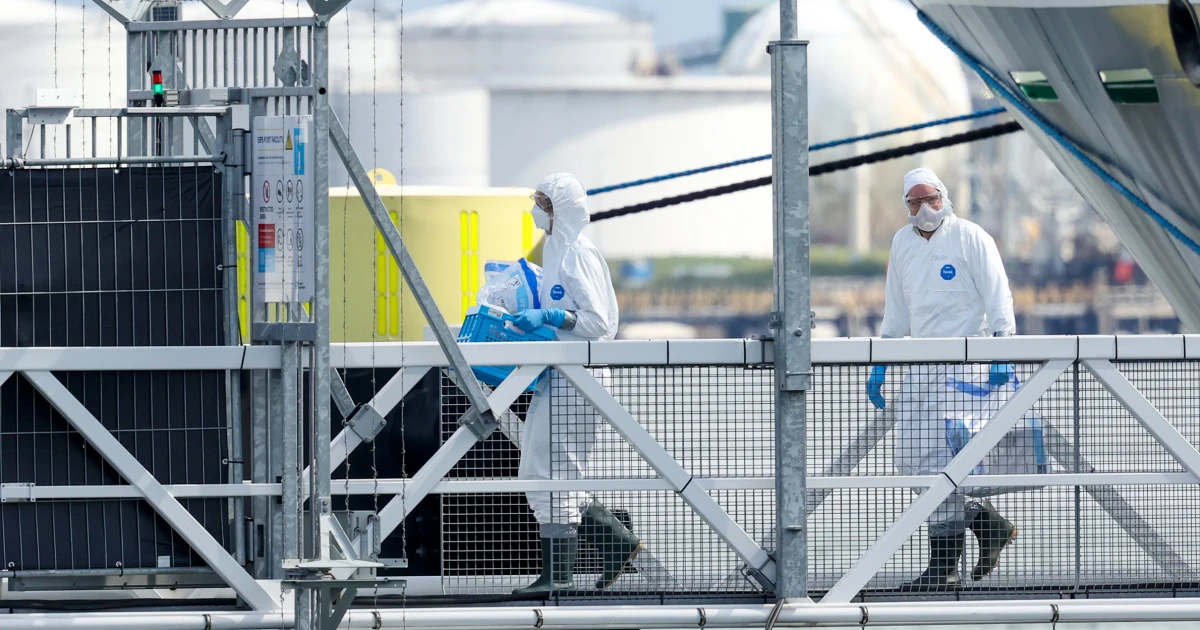
The Spanish Government announced this Monday that a new case of hantavirus had been confirmed related to the MV Hondius cruise ship, which was the epicenter of an outbreak that caused the death of three people earlier this month.
A Spanish citizen who was in preventive quarantine in a hospital in Madrid tested positive for the virus, according to the Ministry of Health in a statement.
The new case is a “close contact” of a person related to the initial outbreak. The patient who tested positive has been under clinical surveillance and isolation at the Gómez Ulla hospital, according to the Ministry of Health.
The patient’s positive case was detected during periodic tests carried out on contacts of people related to the outbreak. After the positive result, The patient was transferred to the isolation unit from the Gómez Ulla hospital and placed under specialized medical supervision, the statement continues.
(This Argentine passenger told us everything he experienced on the cruise with hantavirus)
Hantavirus is endemic in some parts of South America, but remains very rare among humans and has never before been recorded on a cruise ship. Global and U.S. health authorities have consistently tried to calm fears of a broader outbreak.
The Spanish Ministry of Health stated that the last recorded case does not modify the risk for the general population, nor the current epidemiological response measures, since the case affected a person who was already inside its isolation system.
The incubation period for hantavirus is up to six weeks. No new deaths have been recorded since May 2, when the outbreak was first reported to the World Health Organization (WHO).
(An epidemiologist explains why asymptomatic hantavirus patients should remain in quarantine)
Twenty crew members and two medical staff disembarked from the cruise ship in the Netherlands last week, Oceanwide Expeditions reported. The arrival of the cruise ship ended a seven-week, 8,500-mile voyage in which up to 11 infections and three deaths were recorded from this rare disease.
The majority of passengers including 18 Americansare in quarantine in their countries of origin.
