
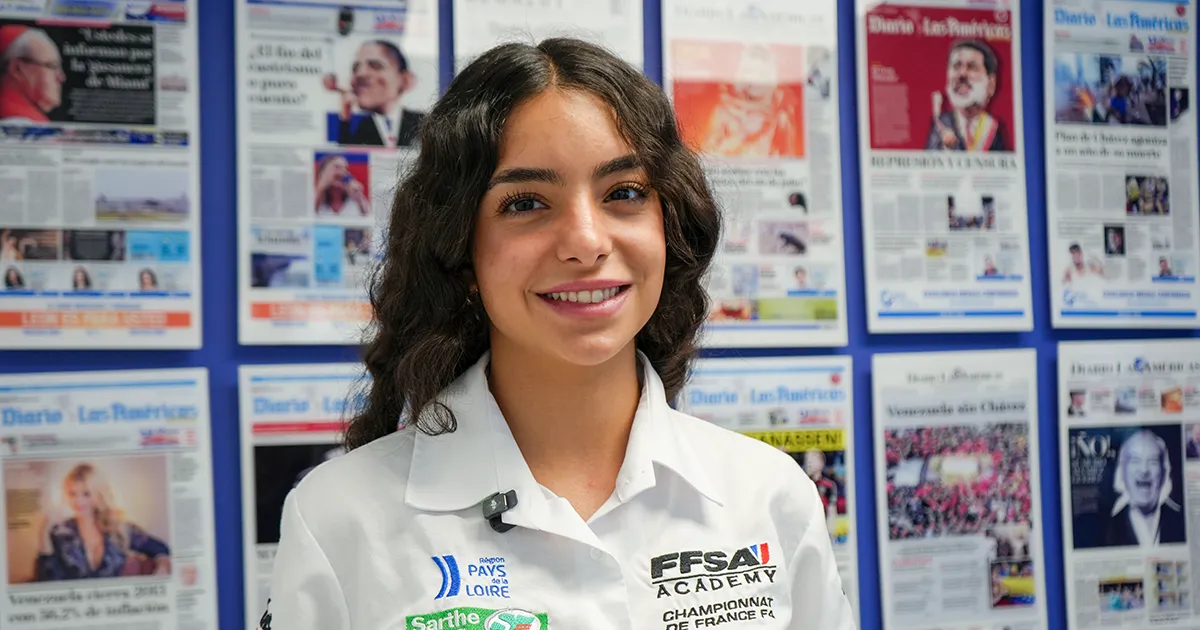
The young woman, born in the eastern province of Holguín and based in Miami, competes in the season at the wheel of a Mygale M21-F4 with a Renault turbo engine, identified with the number 11, alluding to the popular uprising that occurred in Cuba on July 11, 2021, and with the Cuban flag visible on the car.
His jump to Europe occurred after several years of career in karting in Florida and in tourism categoriesF, and responds to a double objective: to enter the F1 Academy and give international visibility to Cuba, in a sport in which the island had never been represented.
From Holguín to European circuits
Abreu’s career began far from any kart track. He was born in Holguín in 2004 and at the age of five he left Cuba with his parents for Tenerife, Spain, where the family lived until their arrival in the United States in 2011.
On the island, his first contact with engines came in his father’s improvised workshop, who kept a Packard from the 1950s running by dint of ingenuity.
That early familiarity with grease and mechanics led to a vocation that took definitive shape in Spain, when he discovered Formula 1 through the racing of Fernando Alonso.
Once settled in Miami, she began competing in karting at the Homestead circuit. His first kart, purchased “fifth-hand” for about $2,500, marked the beginning of a career sustained with family effort and without the usual financial support in the discipline.
After several years in touring categories—including the Spec Miata series and FARA Formula championships in Miami—Abreu made the final leap to European single-seaters.
Love for your flag
Abreu initially competed under the United States flag, but decided to change the record and represent Cuba in each official presentation.
For the driver, the change responds to an identity issue that she considers non-negotiable and the desire to serve as a reference for a Cuban community that has rarely had representation in international motorsports.
“I did not feel represented. I was born in Cuba, I am Cuban, even if they kill me. It is a platform to show that Cuban athletes can, even if the circumstances are not the best,” declared the pilot during a visit granted to DIARIO LAS AMÉRICAS.
The Cuban presence in its sports image is not limited to the flag. The number 11 that appears on the car has, according to what he said, a double meaning: it is the lucky number that his mother associates with favorable moments and, at the same time, a reference to the 11J protests on the island.
The popular uprising lasting several days is remembered as the largest set of anti-government demonstrations recorded in Cuba since the establishment of the totalitarian system imposed by Fidel Castro after his rise to power in 1959.
Thousands of Cubans spontaneously took to the streets in more than forty towns on the island – from San Antonio de los Baños, where they originated, to Havana, Matanzas, Villa Clara, Camagüey, Santiago de Cuba, Holguín, Baracoa and others – shouting “homeland and life”, “freedom” and “down with the dictatorship.”
At that time, when she was training in Homestead at just 17 years old, she wore the hashtag ‘SOSCuba’ on her helmet and earned the nickname ‘the SOSCuba girl’ among the diaspora.
His training car in France received the name ‘Palmiche’ by popular vote, in homage to the horse of the animated character Elpidio Valdés, an icon of the Cuban cartoon that marked a generation.
A single Cuban
The 2026 season of the French Formula 4 Championship, organized by the FFSA Academy, brings together 32 drivers from 15 countries. Abreu is the only Cuban in the competition and the first from her country to compete in a European Formula category, according to official records.
In the opening held in April at the Paul Armagnac circuit in Nogaro, the Cuban finished seventh with 20 points in the newly created F4 Women’s Championship certified by the FIA, a parallel classification that brings together the record group of ten female drivers registered this year.
Abreu recognized that maintaining this level requires a disproportionate financial effort for a family without heritage in motor sports. The discipline itself, dominated by European payrolls with million-dollar budgets, has posed additional obstacles due to its origin.
“95% of those who get to where I am are multimillionaires or from multimillionaire families. I came from nothing, so between my family and I we fought as much as we could,” Abreu explained.
Talk about Cuba in Europe
The pilot maintained that each European circuit is presented as an opportunity to explain the Cuban situation to interlocutors who are unaware of it.
He assured that in countries such as France, Belgium or Germany he has frequently had to answer basic questions about the island and considers that this dissemination work is part of his responsibility as a reference.
“I have always dreamed of a free Cuba. I greatly support the freedom of our island because we have suffered a lot for 67 years. In Europe I have to explain the situation a lot because they don’t know what is really happening,” he added.
Abreu confirmed that his career has also been followed from the island and that he appeared on Cuban television, although he stressed that the authorities do not support those who maintain a critical stance towards the political system.
He also stated that the lack of official support has been compensated by the support of the Cuban community in South Florida and by a growing network of followers on social networks.
“Have hope”
Beyond the sports calendar, Abreu insisted on directing a political and emotional message to those who reside on the island. The pilot asserted that hers belongs to the generation called to witness a “big change in Cuba” and that sport serves as a vehicle to transmit that conviction.
“Have hope. We have all the patience in the world. I have faith that we are the generation that will see a free Cuba, that’s why I always have a smile on my face,” he expressed.
Abreu’s European season will extend until October and will combine trips between France and Miami. After Nogaro, the next commitments on the calendar will take her to the Belgian circuit of Spa-Francorchamps and the French circuits of Dijon, Magny-Cours, Lédenon and Le Castellet.
The driver pointed out that her final goal is to enter the F1 Academy, the women’s training program promoted by Formula 1, and is keeping the search open for sponsors to sustain the continuity of her career.
Meanwhile, the Cuban flag will continue to be visible in every official image taking, in every track conference and in every step on the championship podium. “Because I am Cuban, and I carry Cuba in my heart,” she emphasized.
