
The Spanish Minister of Health, Mónica García, announced that the ship must arrive in the Canary Islands “between 04:00 and 06:00 local time (03:00 and 05:00 GMT).
The director general of the WHO, Tedros Adhanom Ghebreyesus, will coordinate the evacuation on site.
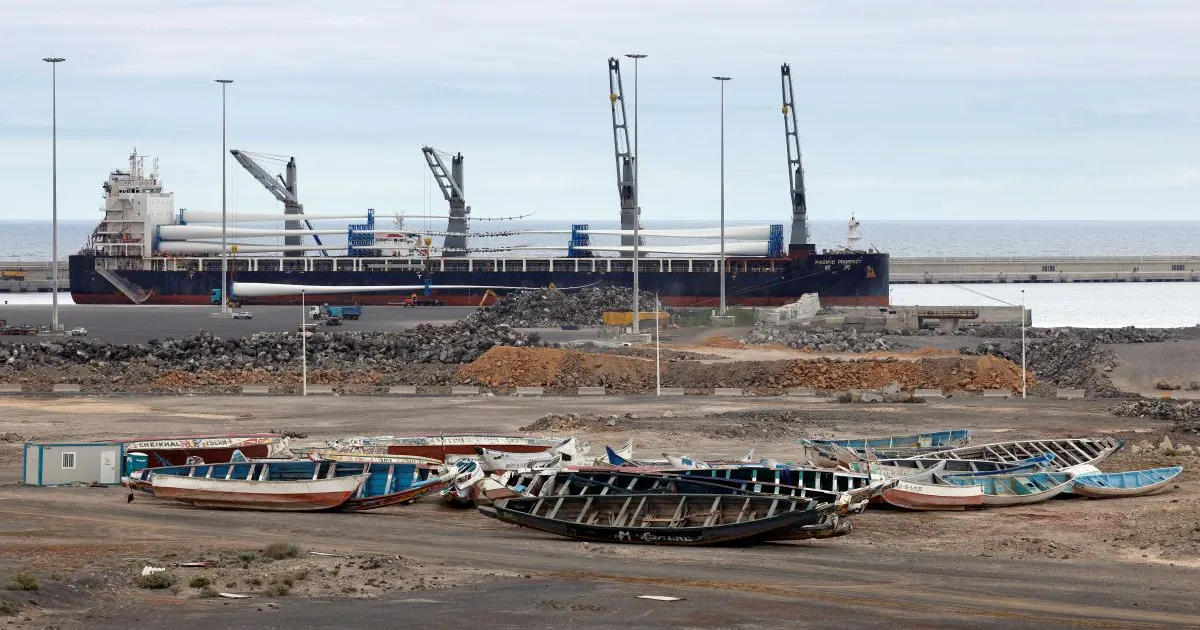
At the site, in the small industrial port of Granadilla de Abona, its inhabitants expressed their “concern”, six years after the global COVID pandemic that disrupted the planet.
“It’s serious”
This Saturday, Ghebreyesus published an open letter to the inhabitants of the Canary Islands, where he stated that the risks posed by the ship’s arrival are “low.”
“I need you to hear me clearly: this is not another COVID. The current risk to public health from hantavirus remains low,” the WHO chief wrote.
However, he acknowledged that the hantavirus strain recorded on the cruise “is serious”.
“Three people lost their lives, and our hearts go out to their families. The risk for you, in your daily life in Tenerife, is low,” he said.
“This is the WHO’s assessment, and we do not do it lightly,” he said.
Agreements
At the beginning of the afternoon and before traveling to the Canary Islands, Ghebreyesus held a meeting with the head of the Spanish government, Pedro Sánchez.
After that meeting, Sánchez stated in X that accepting the WHO’s request and offering the cruise ship “a safe port is a moral and legal duty towards our citizens, Europe and international law.”
The Canary Islands authorities strongly opposed the docking of the MV Hondius, which will eventually anchor off the coast before evacuations.
In Geneva, the WHO director for epidemic and pandemic preparedness and prevention, Maria Van Kerkhove, detailed that “we classify all people on board as what we call high-risk contact.”
Expectation in the port
Granadilla watched his prominence in the news with some disbelief, while keeping his eyes focused on the port.
Although the local press echoes the “highest global expectation with the arrival of the cruise ship to Granadilla”, a few kilometers from the port the usual scenes of a Saturday could be seen: bathers, street markets and meals on the terraces along the promenade.
“We follow the news because we have the boat here three kilometers away. I work in several areas of Granadilla and there is concern that there is some danger, more than anything for some workers, but I don’t see people very worried, honestly,” explained David Parada, a street lottery vendor, amazed at the number of journalists in the area.
Confirmed cases
The latest WHO report, released on Friday, records a total of six confirmed cases among eight suspects, which include a couple of Dutch passengers and a German woman who died of this known but rare virus, for which there is no vaccine or treatment.
This disease can cause, in particular, acute respiratory syndrome.
Three people were already disembarked in Cape Verde on Wednesday.
An “unprecedented” operation
The MV Hondius, from the Dutch operator Oceanwide Expeditions, set sail on April 1 from Ushuaia, in the extreme south of Argentina.
“The possibility of contagion in Ushuaia is practically zero,” said Juan Petrina, director of Epidemiology and Environmental Health of the province of Tierra del Fuego, on Friday.
The ship will continue to the Netherlands, where the government of that country and the shipowner will be in charge of the complete disinfection process, confirmed the Minister of the Interior, Fernando Grande Marlaska.
Spanish authorities explained that passengers would first be examined aboard the cruise ship, which will drop anchor off the coast.
Then the army will transfer them to the mainland in a smaller boat, and in buses “isolated from the local population” to the Tenerife South airport, located about ten minutes away, to then be repatriated by plane to their countries of origin.
The Minister of the Interior specified that the Spaniards will disembark first, and then they will continue by nationality groups, as long as the plane is ready to repatriate them on scheduled flights to the United States, United Kingdom, France, Germany, Belgium, Ireland and the Netherlands.
For passengers from countries “that are not part of the EU and do not have air means to guarantee the repatriation of their citizens”, the Spanish authorities “are preparing a plan” in coordination with the Netherlands, the ship’s owner and insurer, Fernando Grande Marlaska said in a press conference.
The designed mechanism “prevents any contact with the civilian population,” “there will be no contact with civilian personnel,” the minister stressed.
Meanwhile, the United Kingdom’s public health system, the NHS, announced that around twenty Britons who are on the cruise ship will be quarantined in a hospital near Liverpool, England.
