
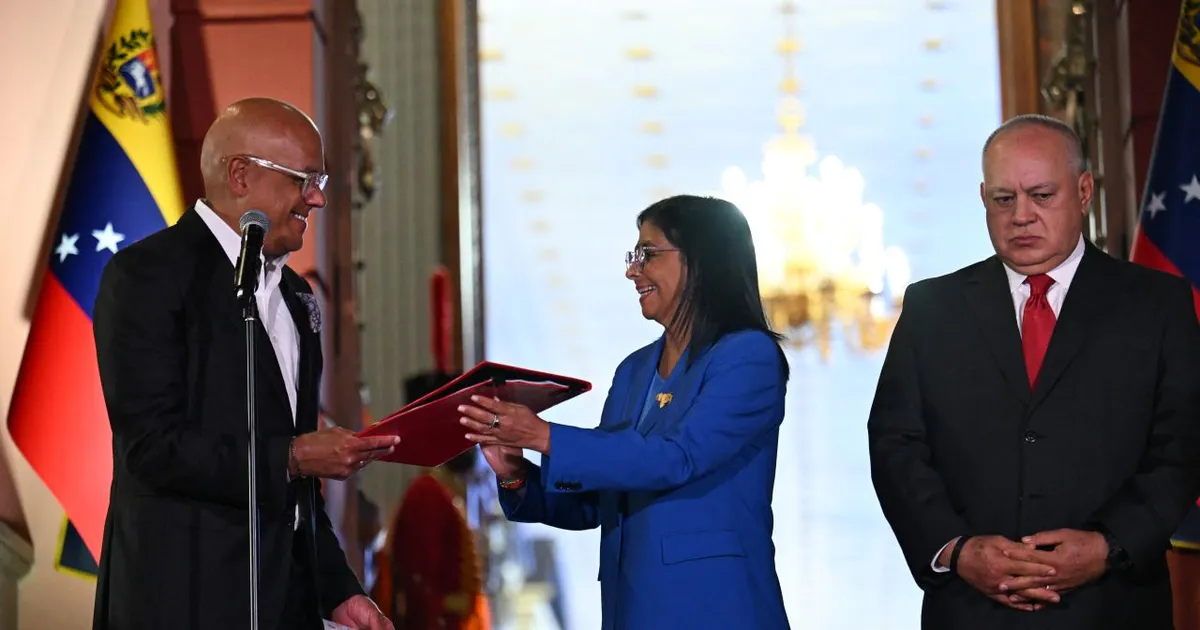
Which Delcy Rodriguez promotes as head in charge of Venezuela after the transfer of Maduro to the justice of USA It is a “gatopardian” simulation of changes carried out in the economy and in his cabinet, mainly, so that everything continues as it is going, according to analysts.
And they cite the paradox: “If we want everything to remain as it is, it is necessary for everything to change”, by Giuseppe Tomasi di Lampedusa in his novel The Leopard (1957).
Rodríguez does so with “fresh” figures, of proven trust and assigned to key tasks, with which he seeks to shield his power at the national and international level, hand in hand with his brother Jorge Rodríguez, president of the Legislature, while he continues to be in the crosshairs of the US government.
Jihad M. Smaili, an American lawyer registered under the US Foreign Agents Registration Act as a lobbyist and legal representative of Rodríguez; Félix Plasencia, Venezuelan diplomat; and Calixto Ortega Sánchez, engineer and economist, have been placed in charge of positions that involve managing complex scenarios in Washington.
At the internal level, Larry Devoe Márquez, lawyer and expert in the management of international law, in the attorney general’s office; Paula Henao, petroleum engineer at the Ministry of Hydrocarbons; and Luis Pérez González, economist at the Central Bank of Venezuela, have the management of fundamental areas for its management and its image, two factors that it has dedicated itself to managing with a view to the possible presidential elections.
Delcy Rodríguez and favorable conditions
Since Maduro’s departure, successive events on the economic level with the coordination of the Trump government have marked a different path for the nation immersed for years in a severe crisis and paralysis, now under the command of the Chavista lawyer, about to turn 57 years old, who held diplomatic positions in the times of Hugo Chávez, but far from the red dome that she now tries to imitate.
Since January, OFAC licenses have boosted stagnant oil production and encouraged investments worth billions of dollars, with legal reforms; and last April it also issued new licenses (GL 56 and 57) that authorized financial operations with the BCV and state banks.
This month it was reported that Venezuela resumed its membership in the IMF and other multilateral financial organizations, such as the World Bank. On May 4, the 5W License was issued for operations related to the PDVSA bond valid until June 19, 2026 and another for the respite of the Citgo case.
Within the framework of understanding with the US, Rodríguez also gave entry to the Amnesty Law that allowed pressure to be lowered on the thousands of political prisoners with complaints of torture, and to which he imposed unilateral and illegal termination, according to lawyers, while more than 400 detainees remain isolated. In this context, parliament appointed the new prosecutor Lavoe and the Ombudsman Eglée González Lobato.
No transition
“These actions point to an effort not only to govern, but to consolidate power under new conditions,” Professor Benigno Alarcón, an expert in political issues, told a specialized magazine. “Every week that economic normalization advances without political conditions, Rodríguez becomes stronger and Washington’s influence decreases,” he warned.
“The greatest risk is not simply the absence of a transition, but its simulation,” he pointed out.
Although Rodríguez has tacitly accepted the Trump government’s three-step plan, Venezuela is not in a democratic transition, says political scientist John Magdaleno.
“A real transition requires full political, and not necessarily economic, liberalization as a prior condition to any legitimate electoral process. And that means restoring the violated guarantees, starting for civil liberties,” he emphasizes.
The analyst and expert in transition processes maintains that changes are being exhibited in the country, “but the political regime remains the same.”
“We are at a time when there are some changes in economic policy and foreign policy and we could say that there are changes among those who govern, but the political regime continues to be an autocracy that before January 3 was approaching a closed autocracy, which is the worst of all of them. And fortunately we did not get there,” he clarifies. “But it seems to me that there is no democratic transition,” he remarks.
Key figures in the US
*Jihad M. Smaili. Lawyer and civil rights defender from California, as described in his social media profile, was appointed by Delcy Rodríguez as his legal representative in the US under the Foreign Agent Registration (FARA) system, a requirement established by US laws for “lobbyists” who work in the country for foreign people or governments.
Rodríguez entrusted her not only with representing him in Washington as a possible candidate in Venezuelan elections, as reported, but also in State litigation in the US justice system, such as the case of Citgo, a subsidiary of PDVSA, in response to the claim of creditors.
The closeness of this Muslim lawyer with Rodríguez is attributed to the fact that he assisted Yussef Nassif, Lebanese and Rodríguez’s romantic partner, in a DEA investigation that has not been specified and from which Smaili dissociated himself in 2025.
*Felix Plasencia. A career diplomat, 56 years old, he is the head of the Venezuelan Diplomatic Mission in the United States, a highly complex task after the capture of Maduro. Although he was chancellor and vice minister in the previous regime, his connection with Rodríguez dates back several decades.
According to what they say, after studying at the University of Oxford in the United Kingdom and before working in the Venezuelan Foreign Ministry in the 90s, he was the second secretary of the Venezuelan embassy in that country during the first years of Hugo Chávez’s government, where he coincided with Rodríguez, assigned there without being a career civil servant. This caused her harsh criticism since it was a highly respected condition, and Plascencia since then became her protector.
Upon his arrival in Venezuela, Plasencia, who is described as a critic of many Chavistas, worked in the CNE then chaired by Jorge Rodríguez, among other positions, according to acquaintances who define him as a man more operational than intellectual.
*Calixto Ortega González. An economist specializing in Economic Policy, 42 years old, he was assigned as governor of Venezuela for the International Monetary Fund (IMF), a key organization for credit programs that would allow the country to finance its external debt, a commitment that Rodríguez handles with caution due to his ideological positions.
He was president of the Central Bank of Venezuela (2018-2025) and previously served as vice president of Finance of the company Citgo, advisor at PDVSA and consul general of Venezuela in Houston and New York, among other positions.
He is the son of the Chavista lawyer and politician Calixto Ortega Ríos, a member of the Constitutional Chamber of the Supreme Court since 2020 and of the Venezuelan delegation to the International Criminal Court (ICC) endorsed by Maduro.
Key figures in Venezuela
*Larry Devoe Marquez. Venezuelan lawyer and politician, he is the attorney general appointed in April by the National Assembly with a Chavista majority chaired by Jorge Rodríguez, of whom he is a trusted man and consequently also of Delcy Rodríguez.
Davoe was the only lawyer in the official delegation led by Congressman Rodríguez in the days of dialogue with the opposition and US representatives to seek solutions to the political crisis. He ensured the legal aspects that were handled during those conversations with a view to free elections, an objective that was not met.
He is recognized as having good legal training and has held public positions that involve the management of international issues such as Essequibo, banking, restructuring of state companies and, above all, the area of human rights, which makes him a necessary pillar for the head in charge of the country.
*Paula Henao. A petroleum engineer, she was appointed by Rodríguez as the new Minister of Hydrocarbons in March 2026, after having been vice minister of the office that was headed by Delcy Rodríguez for several years under the Maduro regime.
Now it is up to her to strengthen the “sovereign” development of the national oil, gas and petrochemical industry, according to the head in charge. “I fully trust that, with your professionalism, extensive experience and many years of experience within this Ministry, we will advance in the recovery of the energy sector,” he said about the essential area for the oil industry.
*Luis Pérez González. Economist and new president of the Central Bank of Venezuela (BCV) replacing Laura Guerra, sister of Maduro’s first wife and whom Rodríguez dismissed.
Pérez, who served as vice president of the institution, assumes the position of the financial entity in charge of currency management and control, and monetary policy, a sensitive area in times of social crisis in the country.
