
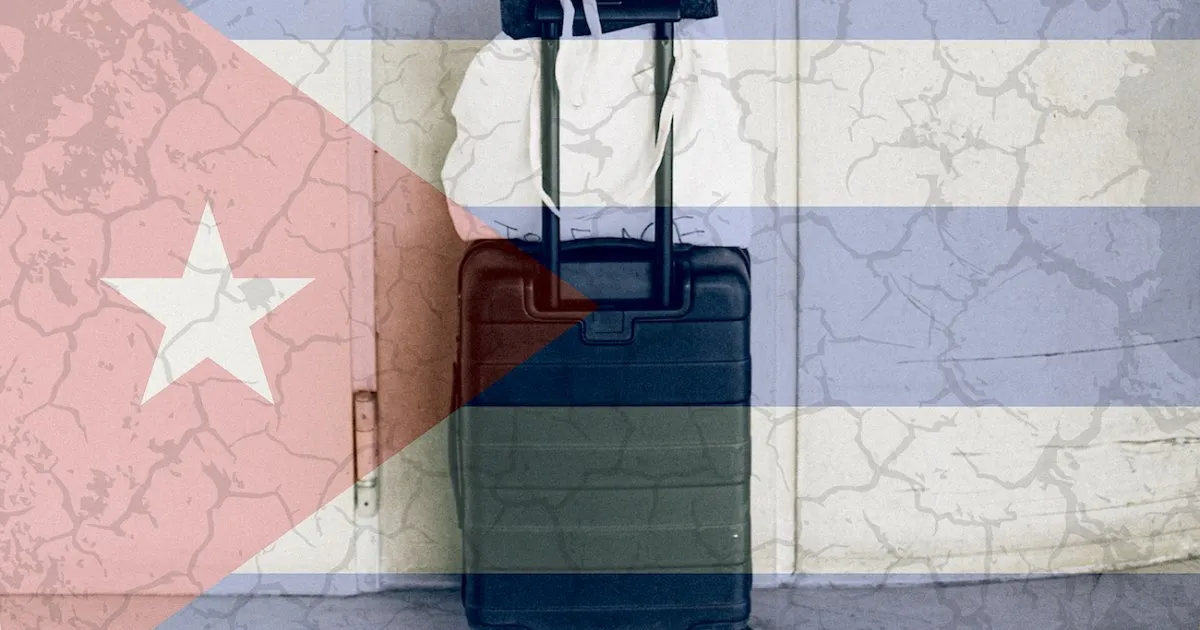
Havana, April 4, 1980. An event shakes the city: a bus attacks the wall of the Peruvian embassy. A guard dies in crossfire and suddenly, one of the most chaotic immigration crises in Cuba begins.
Tonito, a boy of only ten years old, watches the news on the national news. Days later, his uncle Felo becomes one of the more than 10,000 Cubans who seek asylum in that embassy. After several months, he manages to go to the United States. Upon finding out, the boy asks his father:
—Why did guy leave?
“Because he’s a worm, he betrayed his country,” the father responds, visibly upset.
The child does not understand, his young age does not allow him to process that language. He only knows that he loves his father and he loves his uncle, and that suddenly it seems that that love cannot coexist.
Forty-three years later, Tonito crosses the Mayan jungle with part of his family. He leaves behind a married daughter, who in turn is expecting a child: another farewell, another tear that repeats itself. His journey began with a flight from Havana to Managua and from there, he embarked on a journey that lasted for weeks until he reached the border with the United States.
Finally, he emigrates to the same city where his uncle once lived. Because despite the passage of time, he never managed to erase from his memory that separation that fractured his family and split the lives of two brothers in two. However, fate imposes its final irony on him: the absence of his uncle, who had already died years before. She was never able to hug him again, nor tell him in person how much she loved him.
That is one of the saddest pictures of Cubans. But there is something even more painful: seeing how love can transform into distance, and distance into judgment. Those who left were marked for years; and from the outside, those who decided to stay are often looked at harshly, as if resisting daily life on the island were not already a challenge enough.
When talking about culture, that same logic seems to fade.
Who dares to judge Benny Moré? Who would think of pigeonholing his life within a political stance, after having returned to Cuba in 1952, a country that had been taken by a coup d’état that same year? No one thinks of saying that they supported Batista; His legacy transcends any circumstance. If we think about Enrique Jorrín, creator of cha-cha-chá, his work began before 1959 and continued afterwards, until his death in 1987, without this being a reason to reduce his musical importance, without defaming his character.
The same happens with Israel López Cachao and Orestes López, both are the creators of the mambo. One emigrated, the other remained on the island. However, their creations remain one, indivisible, unrelated to the geographical decisions they made in life. And what can we say about those artists who transcended, made a career and decided to live in Cuba? Others left. In all cases, his legacy surpasses his personal decisions.
A very important figure in Cuba in the 19th and early 20th centuries, the great composer and violinist Claudio Brindis de Salas Garrido, received the title of “Baron de Salas” from the hands of Kaiser Wilhelm II. This honorary recognition, however, does not imply that he bears the historical responsibilities of the emperor, who years later led Germany during the First World War.
We could also mention the members of Buena Vista Social Club, of whom we are proud as an expression of Cuban identity. All of them, now retired, restarted a new stage in their artistic life, already fully successful, none of them decided to leave the country. Their value does not depend on the political context in which they lived; From the island, they conquered the world and stayed there.
Disqualification not only appears in the arts, but also when we transfer that same analysis to ordinary people. When you criticize the one who left or the one who stayed, you lose sight of something essential: each story responds to different circumstances: political, economic, personal, religious, in short, countless of them.
If we broaden the context, the contradiction stops being subtle and becomes uncomfortably obvious. Nobody dares to judge Joseph Haydn for having served Nikolaus I, Prince Esterházy, an active soldier in the Seven Years’ War, nor Wolfgang Amadeus Mozart or Antonio Salieri for having orbited the court of Joseph II, Holy Roman Emperor, in a Europe crossed by conflicts such as the War of the Bavarian Succession. We know, although we prefer not to say it out loud, that these systems of power were sustained by violence. And yet, we never reduce these composers to the blood that surrounded their patrons.
Years before, Johann Sebastian Bach did the same: he worked for courts such as Prince Leopold of Cöthen, Duke William Ernest of Saxe-Weimar and Count Keyserling, all inserted in the political and military machinery of his time. Nobody questions his music for it. His work not only survived that context: it transcended it with such force that today we prefer to forget where his livelihood came from.
So the question is not historical, it is moral: why do we demand ideological purity from ordinary people (those who leave, those who stay) when we do not even dare to apply it to the giants we venerate? Maybe there is a pending lesson there.
The kilometers of distance hurt, yes, but in that pain also lives love. It hurts those who leave and it hurts those who stay, as if both were carrying the same cross, different in shape, but equal in weight. And yet, in the midst of that shared wound, there is something that does not break: the invisible bond that continues to unite us.
Let us not forget that true love does not understand borders or ideologies. That like faith, is sustained even when everything seems to separate us. We remain part of the same body, of the same story. Because in the end, as in every sincere prayer, the only thing we ask for, even if we don’t always know it, is to meet again.
Jalil Guerra, Ph.D.
