
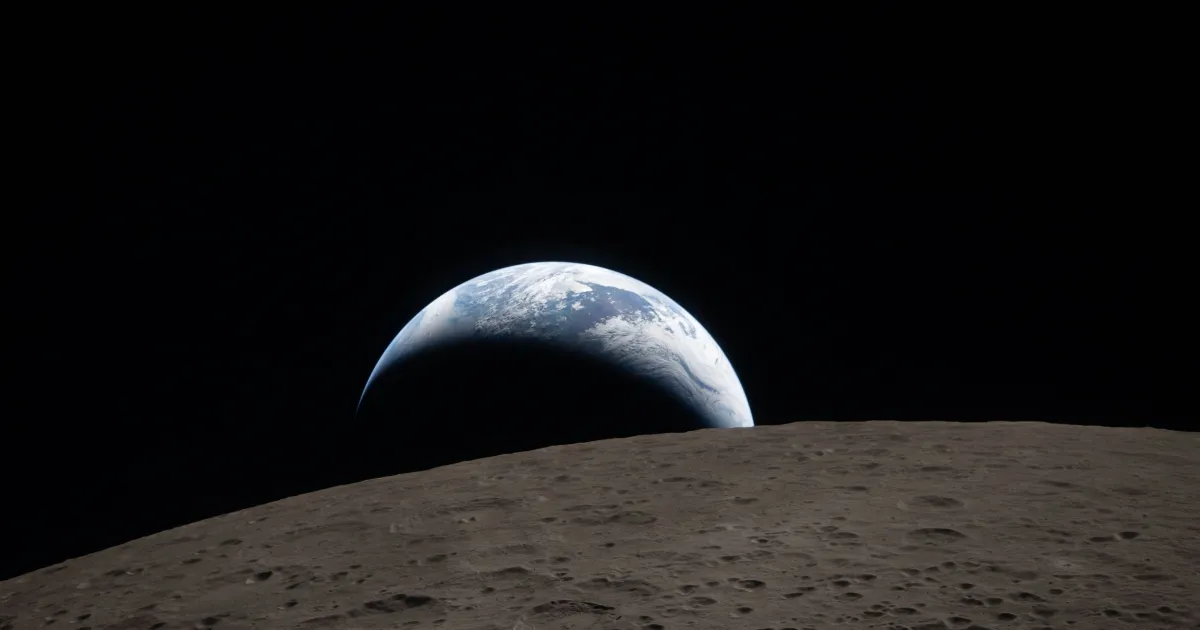
The Orion ship, manned by Reid Wiseman, its commander; Victor Glover, Christina Koch and Jeremy Hansen, reached the most distant point ever reached from Earth on April 6 and approached the hidden side of the Earth. Moonachieving the record for closest approach to the satellite. In addition, he entered a solar eclipse.
The significance of the trip captured in unpublished photographs was certified by US President Donald Trump during his conversation with the NASA mission team in one of the most significant moments. “They have made history,” he said.
With this unprecedented approach to the Moon, the crew aboard Orion surpassed the distance record from Earth set by Apollo 13 in 1970.
The ship used precisely the lunar gravity to redirect its trajectory, in a key maneuver for the return and whose splashdown off the coast of San Diego, California, is expected to be successful as the trip was.
Crew spoke with Trump
During their navigation on the darkest side of the Moon, the astronauts and Trump spoke in direct and emotional communication, due to the historical achievements obtained by the mission up to that moment, after the loss of communication for more than 40 minutes.
Trump thanked the team for the bravery shown from the beginning of their trip, after their flawless takeoff from Cape Canaveral, Florida, on April 1, and also spoke words of praise to NASA for its new mission, the sixth space project.
During their conversation, the president asked the crew what they felt when passing through the dark side of the moon and being left without communication, to which astronaut Glover responded: “I said a little prayer, but then I continued recording.”
Trump also asked the crew what was “the most unforgettable part of this historic day,” and Commander Weisman responded emotionally: “We saw things that no human being had ever seen before, not even in the Apollo program.”
The president took the opportunity to remember that the US flag will return to the Moon to leave “not only footprints” but also to establish “a permanent mission,” according to what he said in a message replicated by the White House networks.
The Artemis program consists of NASA’s deep lunar exploration, which began with Artemis I, the first uncrewed lunar orbit mission with which the Apollo project ended.
Artemis II makes history
The Artemis II crew traveled more than 400,000 kilometers (248,548 miles) aboard Orion, setting deep space distance records for humanity.
It managed to move exactly 406,771 kilometers (252,760 miles) from Earth, according to NASA, and become the most distant human team on the planet.
At the same time, the spacecraft made the closest approach to the Moon ever achieved, up to 6,545 kilometers (4,067 miles), which allowed navigation on the darkest side of the satellite for about seven hours.
When it reached the farthest point from planet Earth on April 6, the crew shared a photograph with the message “Humanity, from the other side,” a historic image that the White House reproduced on its networks.
In the case of Apollo 8, the first manned mission that sailed around the Moon in 1968 and known as Earthrise, a distance of approximately 384,000 kilometers from Earth’s orbit was achieved.
During that phase, the Orion spacecraft lost communication with the team on Earth, as expected, prompting Glover to send the message before losing contact. “We love you, from the Moon,” he said.
“It’s so great to hear you from Earth again. To Asia, Africa and Oceania: we are looking at you. You can look up and see the Moon right now. We see you too,” Koch said in his first message after the restoration of communications.
No incidents were reported during the trip that made history, except for NASA’s recommendation to the crew not to use the toilet on board the Orion capsule, because it had given them “problems” from the first day of the mission.
Both Artemis II experiences represent a significant advance for research, the US space agency said.
NASA Mission Milestones
This mission constitutes the second flight of the Space Launch System (SLS), which is a non-recoverable NASA rocket and essential for its lunar explorations.
But it is also the first to lay the foundations for future lunar landings of the Artemis program.
The trip also brings together other notable facts in the history of aerospace flights, in addition to the distances reached, which translate into milestones for humanity. One of them is the solar eclipse.
During its approach to the Moon, Orion entered a total solar eclipse that occurred when seeing the star behind the satellite, in a dimension seven times longer than those that have been seen from Earth, but that was not visible to people from the planet.
According to data shared by NASA, the rescheduling of the mission that had originally been scheduled for last February allowed the team of astronauts to observe the phenomenon for 53 minutes, a unique astronomical fact.
Astronauts experienced it because of its unique position around the Moon, NASA explained.
And he explained that the crew was thus able to see the darkest satellite, which was used to analyze the solar corona, the outermost atmosphere of the Sun. They also looked for meteorite impacts on the surface for study.
Total solar eclipse
A photograph of the total solar eclipse, which had never been achieved from space, was shared by the White House on its networks as “a point of view that few in human history have witnessed.”
NASA also highlighted, as another milestone, the fact that it is the first most diverse crew to travel to the Moon.
The team is made up of three American astronauts, that is, Wiseman, Koch and Glover, and the first to be foreign as Hansen is Canadian.
Additionally, Koch is the first woman to reach lunar orbit, while Glover is the first African-American to do so.
“Artemis II with Reid, Victor, Christina, and Jeremy have now traveled further from Earth than any other human in history and now begin their journey home,” said NASA Administrator Jared Isaacman on the X social network.
In his message he pointed out that the lunar observation of about seven hours is “a significant advance” for research.
