
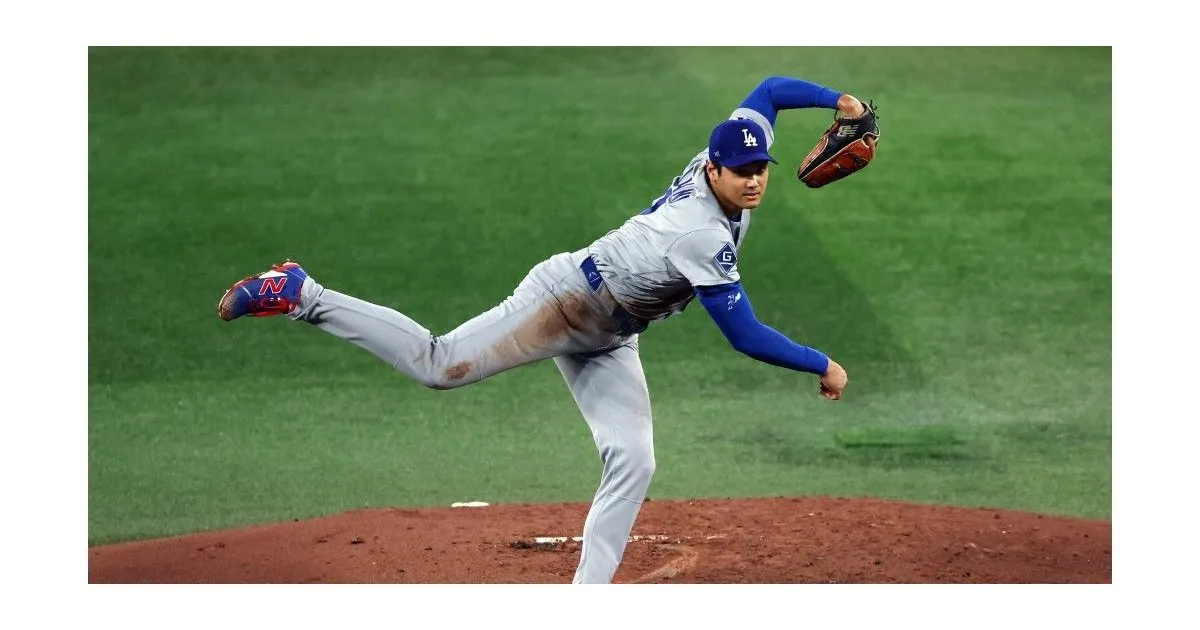
Shohei Ohtani was once again a protagonist in MLBbut this time not only because of his impact as a two-way player, but also because of a new controversy with the Toronto Blue Jays . During Wednesday’s game between the Los Angeles Dodgers and the Blue Jays, several members of the Canadian team showed their frustration over the extra warm-up time that the Japanese received before pitching an inning, reopening a discussion that had previously generated tension between both clubs.
The scene caught attention from the first innings. Ohtani, who had finished the offensive portion of the inning as a runner on base, needed more time to prepare before returning to the mound. This caused visible gestures of discontent from Toronto players, especially George Springer, as well as manager John Schneider and star Vladimir Guerrero Jr., who made clear their disagreement with the situation.
The play that lit up Toronto
It all started when Shohei Ohtani had to quickly return to his pitching role after having actively participated in the Dodgers’ offense. As often happens in his case, the Japanese needed additional margin to change pace, return to the dugout, prepare and go out to the mound.
Toronto’s annoyance occurred because the team understood that this process took longer than usual. From the field it was possible to notice how George Springer exchanged words with the main umpire, while expressions of frustration multiplied from the Blue Jays bench. On the Dodgers side, Dave Roberts reacted with evident disapproval to rival protests.
What does the rule say about Ohtani’s warm-up time?
The controversy revolves around the pitch clock, one of the rules that has changed the pace of games the most since its implementation in the Major Leagues. In the regular season, breaks between innings are limited to a specific time, and pitchers must complete their preparation within that window.
However, the regulation contemplates an important exception: if the pitcher finishes the previous inning on base, at bat or waiting to turn, the time count for his preparation in the next inning begins when he leaves the dugout towards the mound, not when the inning ends.
That point is key in Ohtani’s case. As a dual-purpose player, he is constantly exposed to a situation that almost no other pitcher faces. And although the norm contemplates it, the debate appears in the interpretation and in how much additional margin is granted in practice.
Dave Roberts: “He’s different”
After the game, Dodgers manager Dave Roberts defended his star and left a phrase that perfectly summarizes the substance of the discussion: “The truth is that he is different.”
Roberts argued that if a player like Ohtani is running the bases or participating offensively at the end of an inning, there must be some flexibility to allow him to return to the mound under reasonable conditions. In his vision, it is not about giving him an unfair advantage, but about recognizing an exceptional circumstance within the modern game.
At the same time, the leader also admitted that he understands why the rival is upset. From Toronto’s perspective, any extra second can be interpreted as a competitive advantage. But for Roberts, Ohtani’s background makes it impossible to treat him exactly the same as any other pitcher.
It is not the first time that Toronto has been uncomfortable with Ohtani
The Blue Jays’ discomfort with this situation is not new. The issue had already generated tension in a previous matchup between the two teams, when Ohtani also received additional time between innings by combining his offensive and defensive responsibilities.
For this reason, what happened this Wednesday did not feel like an isolated event, but rather like a new chapter in a recent rivalry where every detail around the figure of Ohtani seems to be amplified more than necessary. In Toronto, the perception is that the Japanese receives a margin that other players would not have. In Los Angeles, however, the view is that a logical exception is simply being applied for a single case.
Shohei Ohtani tests MLB rules again
Beyond the result of the game, the sequence once again left a feeling that is repeated every time Ohtani plays as a batter and pitcher in the same game: baseball continues to adapt to a player who breaks traditional molds.
What is extraordinary about Ohtani is not only that he can pitch and hit at the highest level, but that he forces the rules, umpires and opponents to face unusual situations. And that’s where friction arises.
This Wednesday’s case shows that the figure of the Japanese not only impacts because of his talent, but also because of how he alters the usual logic of the game. As long as it continues to function as a true two-way phenomenon, these discussions will continue to arise.
A controversy that will surely continue
Toronto’s reaction makes it clear that this will not be the last episode of tension around Shohei Ohtani and the time he needs to fulfill his two functions. Every time the Japanese is on base at the end of an inning and must return to the mound, the discussion will repeat itself.
And even if the rule exists to support it, the debate will continue as long as its rivals consider that the margin it receives can alter the pace of the match. In short, the controversy does not arise only from the regulations, but from something simpler: Shohei Ohtani plays a different sport even within the same baseball.
