
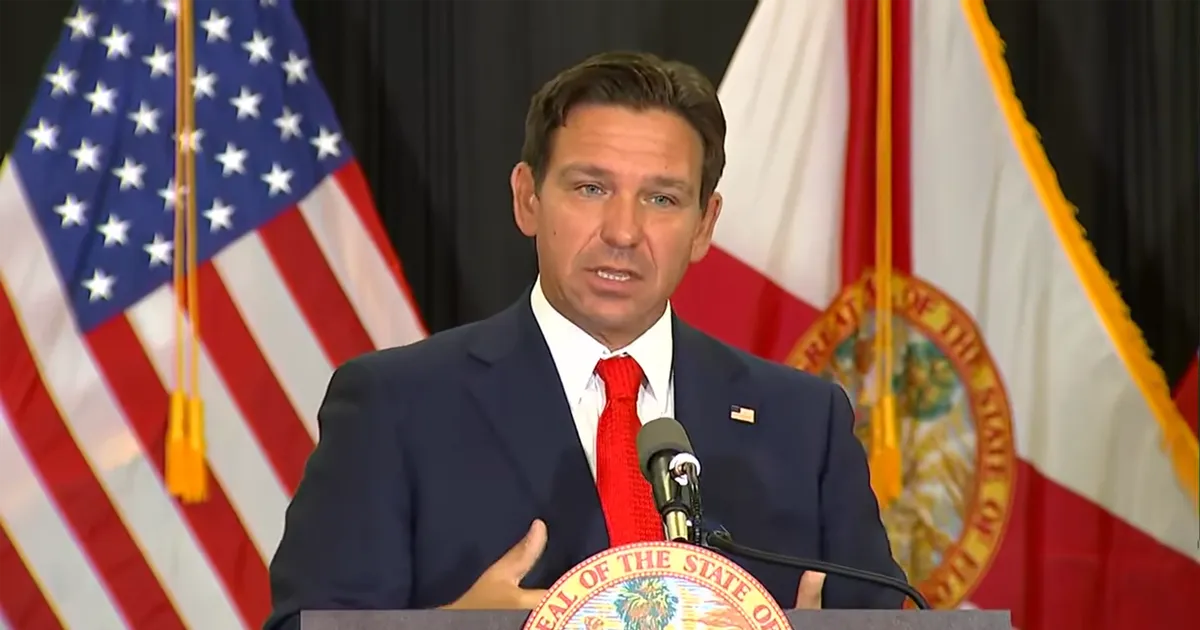
MIAMI.– Florida Governor Ron DeSantis signed HB 1471 into law, which empowers the state to designate groups as domestic or foreign terrorist organizations, in a ceremony held on the campus of the University of South Florida in Tampa.
The measure, approved by the House of Representatives with 80 votes in favor and 25 against, and by the Senate with 25 against 11, responds to an executive order issued in December with which the Republican president declared the Council on American-Islamic Relations (CAIR) and the Muslim Brotherhood terrorists, a decision that a federal judge blocked in March on the grounds that it violated constitutional rights.
“To defend the rule of law, our state must operate under a single legal system, the Constitution must remain the law of the land, and we must defend our institutions from those who seek to harm us, especially terrorist organizations that seek to infiltrate and subvert our educational system,” DeSantis declared.
A mechanism in the hands of the executive branch
The new legislation establishes that the state’s head of Homeland Security – a position held by Florida Department of Law Enforcement (FDLE) Commissioner Mark Glass – may propose the designation of a group as a terrorist organization.
The final decision will rest with the governor and the other three elected members of the Cabinet: the attorney general, the chief financial officer and the commissioner of Agriculture, according to the legislation.
In the case of foreign organizations, the state may only act against those that already appear on the federal list of terrorist groups. For domestic organizations, the designation will proceed when the group engages in what the law defines as “terrorist activity” and poses an ongoing threat to Florida or the United States.
Consequences: dissolution, expulsion and penalty
Once a group is labeled a terrorist organization, authorities can order its dissolution and cut off all state funding through school districts or government agencies.
From that moment on, material support, whether money, weapons or military training to a designated organization will become a serious crime (felony).
The rule also reaches the university level: higher education institutions must expel students who demonstrate support for designated groups and report to the Immigration and Customs Enforcement Service (ICE) the immigration status of those who are in the country with a visa.
Additionally, the law prohibits Florida courts from applying provisions of religious or foreign laws, a clause explicitly aimed at preventing the application of Islamic law known as ‘Sharia’.
Security and protection of values
DeSantis defended the measure as the strongest action taken by Florida to protect its citizens. In his speech, he assured that the law will serve to protect the population and taxpayers’ money from threats that, according to him, should have no place in the United States.
In turn, Lt. Governor Jay Collins went further and warned that the state will persecute, defund and disband those who do not share Florida values.
For her part, Republican Congresswoman Hillary Cassel, sponsor of the initiative, described those who voted against the project as complicit in terrorism.
Fear of political persecution
The criticism was immediate. Hiba Rahim, executive director of CAIR-Florida, denounced that her organization has already been unfairly singled out by the governor and described the new legal framework as a defective tool that can be used to attack any organization that dares to dissent.
CAIR, the nation’s largest Muslim civil rights group, is pursuing a lawsuit against the December executive order.
Meanwhile, PEN America, an organization that defends freedom of expression, warned that the “vague language” of the law could restrict educational programs and target students who protest or criticize state officials.
William Johnson, director of PEN America in Florida, said the rule could inhibit education at all levels. The representative of the state chapter, Sophia Brown, stated that the true purpose of the measure is to instill fear to silence dissenting voices.
