
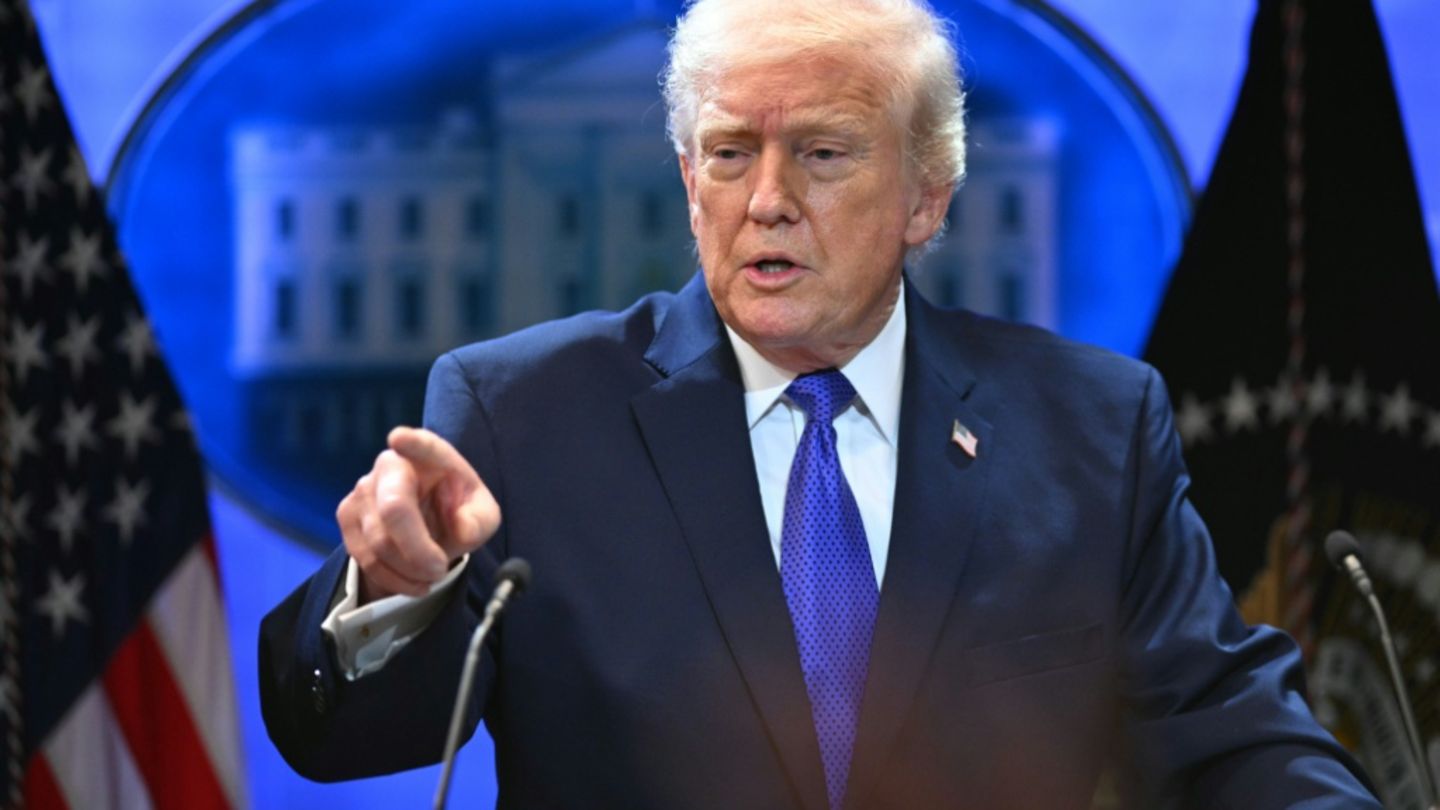
Trump wrote on his online service Truth Social on Saturday that he set the new tariff rate of 15 percent after a “thorough, detailed and complete” review of the Supreme Court ruling on his tariff policy on Friday. This will come into force “immediately”.
The Republican explained that raising the new import tariffs to 15 percent was “fully permissible and legally examined.” His government also wants to set new tariffs in the coming months. The US President described the Supreme Court’s decision against his tariff policy as “ridiculous” and “extraordinarily anti-American.”
In a spectacular ruling on Friday, the United States Supreme Court invalidated most of the tariffs imposed by Trump. The emergency law sought by Trump does not authorize the president to impose tariffs, the judges declared with a majority of six to three judges. Congress is responsible for this.
The judge’s vote overturned the 15 percent base tariff for most goods imported from the EU as well as the US import tariffs for numerous other countries. However, sector-specific tariffs on cars, steel and aluminum are not affected.
The verdict was the biggest legal defeat for the president in his second term. It is also notable because the Supreme Court, in which the conservative camp has six of the nine judges, mostly ruled in favor of the right-wing populist in Trump’s second term in office.
In an initial reaction to the Supreme Court’s decision, Trump imposed a new global tariff rate of ten percent on Friday, which was to apply from Tuesday. This is based on a different legal basis than the tariffs that the Supreme Court invalidated and can last for a maximum of 150 days without an extension by Congress.
On Saturday, Trump raised this tariff rate from ten to 15 percent. According to the White House, exemptions are planned for various sectors such as the pharmaceutical industry.
The Supreme Court ruling and Trump’s new special tariff caused a lot of international reaction. “We have to talk to the American government,” said Chancellor Friedrich Merz (CDU) in the ARD special program “Report from the Party Congress.” He will be in Washington “in just over a week.” There needs to be talks in advance “about a very clear European stance” – and quickly: He will “go to Washington with an agreed position.”
For him, there was “a reassuring element from this decision,” Merz continued. “The separation of powers in the US still seems to be working. And that’s good news.” French President Emmanuel Macron made similar comments. Critics accuse Trump of undermining US democracy with an increasingly authoritarian course.
Brazil’s head of state Luiz Inácio Lula da Silva called on Trump to treat all countries equally. “We don’t want a new Cold War,” said the left-wing politician during a visit to India. “We don’t want interference in another country, we want all countries to be treated equally.”
Trump’s tariff policy has caused chaos in global trade and severely damaged many countries. Investors and business associations therefore welcomed the Supreme Court’s ruling.
However, Harvard economist Kenneth Rogoff warned against expectations that are too high. “On the one hand, the judges have set limits on the president’s approach of unilaterally and unrestrictedly imposing punitive tariffs,” Rogoff told Handelsblatt. On the other hand, the court “opened the door for various other ways to introduce tariffs”. Leaders should make no mistake: “The level of US tariffs will remain high.”
The Supreme Court ruling could also lead to chaos in the USA because billions of dollars in customs revenue may have to be refunded. This could lead to years of legal disputes. Economists estimate that repayments could total $175 billion (almost €150 billion). The Supreme Court had not commented on the question of whether customs revenues already generated must be reimbursed.
Illinois Governor JB Pritzker of the opposition Democrats has already sent Trump a bill for almost $9 billion in duty refunds for families in his state. That would be around $1,700 for every household in Illinois and, according to experts, the amount an average US household paid in tariffs last year.
“Every dollar taken unlawfully must be repaid immediately – with interest,” demanded California Governor Gavin Newsom. Pennsylvania Gov. Josh Shapiro called on Trump to “listen to the Supreme Court, end messy tariffs and stop hurting farmers, small business owners and families.”
