
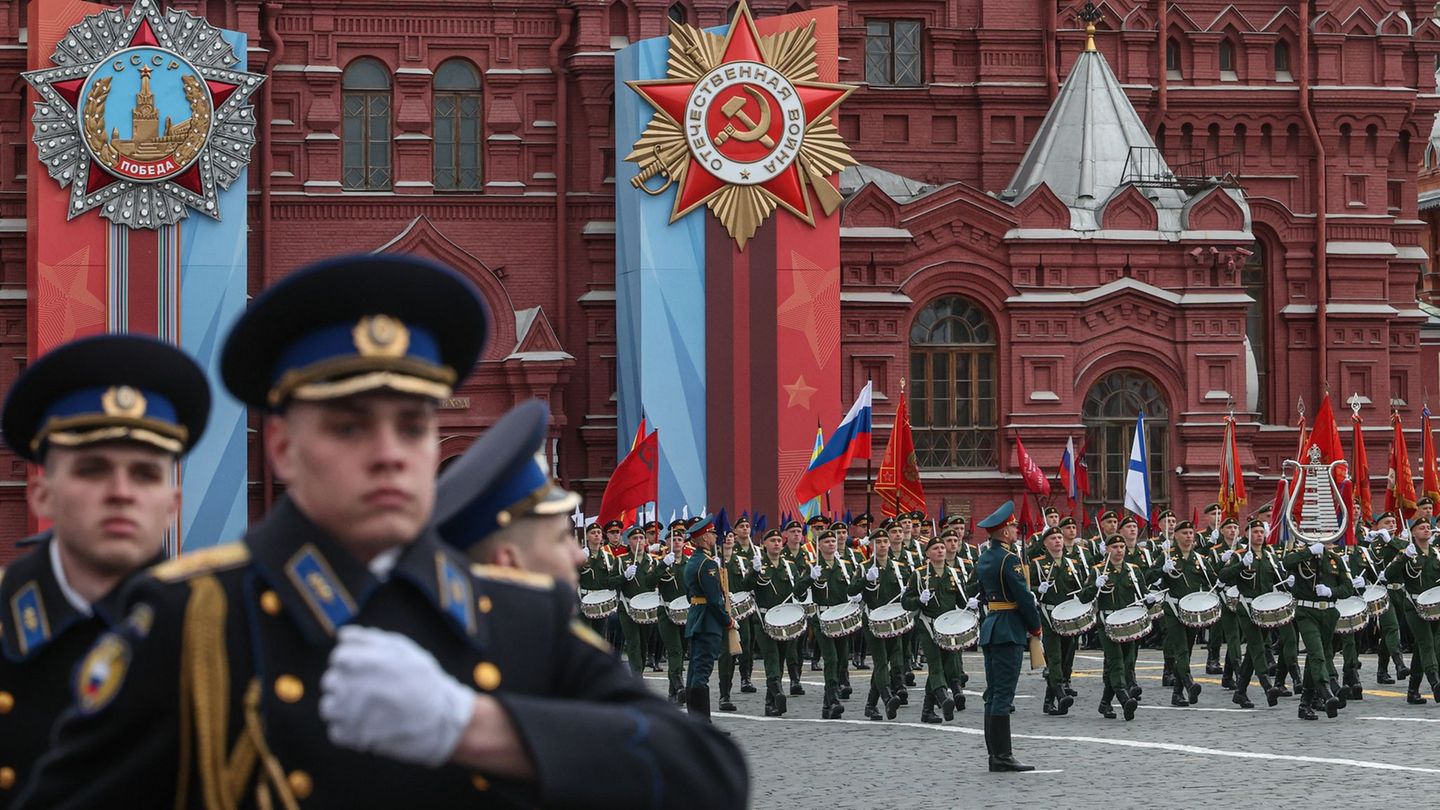
After a ceasefire brokered by US President Donald Trump in Russia’s war of aggression against Ukraine, Kremlin chief Vladimir Putin held his military parade on May 9th without any problems. The feared drone attacks from the Ukrainian side did not materialize. In his speech to thousands of soldiers and international guests, Putin expressed certainty that Moscow’s army would also win the war of aggression against Ukraine.
Russia celebrates the day of the Soviet Union’s victory over Nazi Germany on May 9th. Because of the tense security situation, this time there was no usual weapons display with tanks, rockets and other military technology.
So far, however, it is not clear how Putin will achieve his war goals in Ukraine in what is now the fifth year of the invasion. The scaled-down military parade is seen as a reflection of the situation in his war. Russian troops are under increasing pressure from resistance from Western-backed Ukraine.
Nevertheless, Putin said sharply on Red Square: “I am firmly convinced: our cause is just, we stand together, victory has always been and always will be on our side.” The Kremlin chief said that the Russian army will be inspired by the “generation of victors” in the Second World War when it deploys in Ukraine today. “You are opposing an aggressive power that is armed and supported by the entire NATO bloc,” said Putin, who began his war against Ukraine in 2022.
Doubts about the advance of Russian troops
Despite Western support, “our heroes march forward,” the president claimed. However, Russian military bloggers close to the Kremlin also doubt Putin’s statements – and suspect that the president could be misinformed by the Moscow military leadership.
Ukraine is receiving significant support from NATO states, including Germany in particular, in its defense against the large-scale Russian invasion. The fighting is considered to be deadlocked in the war – with no real movement for either of the two warring parties. With Trump’s mediation, the sides agreed on a ceasefire until May 11th. According to the Kremlin, there were no attempts to disrupt the parade.
Reports of ceasefire violations
The Russian Defense Ministry accused Ukraine of violating the ceasefire. Despite the agreement, the Ukrainian armed forces attacked Russian positions and civilian objects with drones and artillery, the ministry said. Those affected included the regions of Kaluga, Tula, Smolensk, Kursk, Bryansk and Belgorod, as well as the Chechen Republic and the Stavropol and Krasnodar regions in the south.
There was initially no confirmation of this from the Ukrainian side. However, after the ceasefire began, the Ukrainian General Staff also complained about attacks from the Russian side, especially in the contested regions in Donbass. There was talk of 45 attacks by early morning.
The information provided by the warring parties cannot be independently verified. In all previous ceasefires, Kiev and Moscow have repeatedly accused each other of massive violations.
Tense situation on Victory Day in Russia
Security measures in downtown Moscow were massive, with a presence of police and other uniformed personnel, but less than last year. At that time, large parts of the city center were blocked off with metal bars – because of the tanks and rocket vehicles driving through the streets. The mobile internet was switched off.
Many passers-by, who sometimes had to undergo bag checks because of the threat of terrorism, wore orange and black striped St. George’s Ribbons, the Russian symbol for the Soviet Army’s victory over Hitler’s Germany, clearly visible as a clip on jackets and backpacks. In some cases there was a Z on top – a letter that supporters used to express their support for the war against Ukraine.
Levada Center: Six out of ten respondents want negotiations
According to the independent polling institute Levada Center, the majority of Russians support a transition to peace negotiations. Around one in four people are still of the opinion that the fighting should continue, it said in a statement. More than 1,600 people in Russia were surveyed in personal interviews from April 22nd to 29th.
Direct negotiations between Kyiv and Moscow in the struggle to end the war are currently paused. US mediators also failed to achieve a breakthrough. There is no date for a new round in this format.
Kremlin spokesman Dmitry Peskov said Moscow was ready to receive a US delegation. Among other things, Russia is demanding that Ukraine withdraw its troops from those parts of the Donbass region that Moscow’s armed forces have not yet been able to take. The Donbass includes the Donetsk and Luhansk regions. Ukrainian President Volodymyr Zelenskyj categorically rejected giving up territories.
