
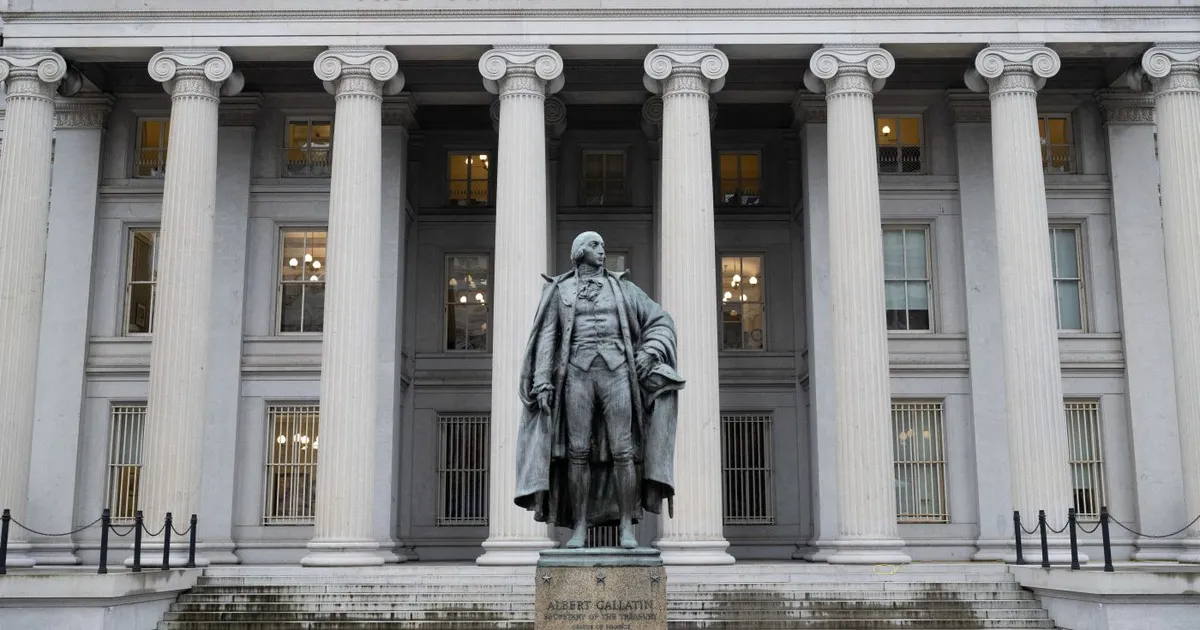
U.S. public debt surpassed $40 trillion for the first time, according to data released Wednesday by the Treasury Department.
After the latest issuance on Tuesday, the US Treasury debt now amounts to 40,047 billion dollarsafter the increase in the cost linked to health and social security along with the interests paid by the country
The figure contrasts with a previous forecast from the Congressional Budget Office, which predicted that total debt would reach $39.4 trillion by the end of fiscal year 2026, at the end of September.
Borrowing costs have skyrocketed for the United States, primarily due to inflation concerns.
Rise in debt bond yields
Long-term (30-year) Treasury yields rose on Tuesday to their highest level since 2007, reflecting growing pressure on prices due to the war in the Middle East and concerns about fiscal deficits.
The increase forces the US government to refinance debt at the highest rates since before the 2008 global financial crisis.
The U.S. Treasury Department intervened early Wednesday to stabilize the long-term bond market, pushing yields lower.
Unbridled debt in the last 40 years
The federal government operates at a deficit and borrows money to cover the gap.
But “it’s been known for some time that the U.S. government is on a pretty unsustainable deficit path,” said Jessica Riedl, a budget and tax specialist at the Brookings Institution.
The country’s debt has more than doubled since the 2008 financial crisis and now represents almost 125% of the United States’ Gross Domestic Product (GDP).
While deficits of between 3% and 4% of GDP were a concern for financial markets in the past, Riedl highlighted that these levels are now around 6% and 7% of GDP.
“This generated more nervousness in the markets,” he added.
“Congress must control its spending and BALANCE THE BUDGET. Americans deserve better,” said Republican Senator Rick Scott, also in X.
The Supreme Court ruling
President Donald Trump has cut government spending and addressed the annual deficit by imposing tariffs on global trade, but the Supreme Court’s decision to halt these levies was a major blow to the White House’s economic policy.
Treasury Secretary Scott Bessent indicated that his goal was to reduce the US deficit to 3% of GDP.
However, in recent months it has increased, due in part to the obligation to reimburse companies for tariffs, which the Supreme Court overturned in February.
Tax cuts and military spending, particularly with the war in ukraine that the US has financed and now against Iran in more than five months, with an expenditure that exceeds 20,000 million dollars but nothing comparable with the more than 350,000 million for kyiv.
Analysts point out that there is no level of debt relative to GDP that automatically triggers a crisis.
The serious financial crisis of 2007
They also remember that the debt in the hands of the public, which excludes the credits of one federal administration over another, is usually a more frequent indicator than the total debt.
“But from a psychological point of view, it is these indicators that alert financial markets to the need to pay attention again to the increase in debt,” according to Riedl.
Federal borrowing soared during the severe financial crisis of 2007-2009 and they rose sharply again during the COVID-19 recession and then the four-year waste of Joe Biden’s administration, recalls Caleb Quakenbush, budget policy director at the Bipartisan Policy Center.
According to him, neither Congress nor the American governments have addressed the trajectory of budget spending in a “significant or sustainable” manner, which would pose serious challenges in the event of a new crisis.
