
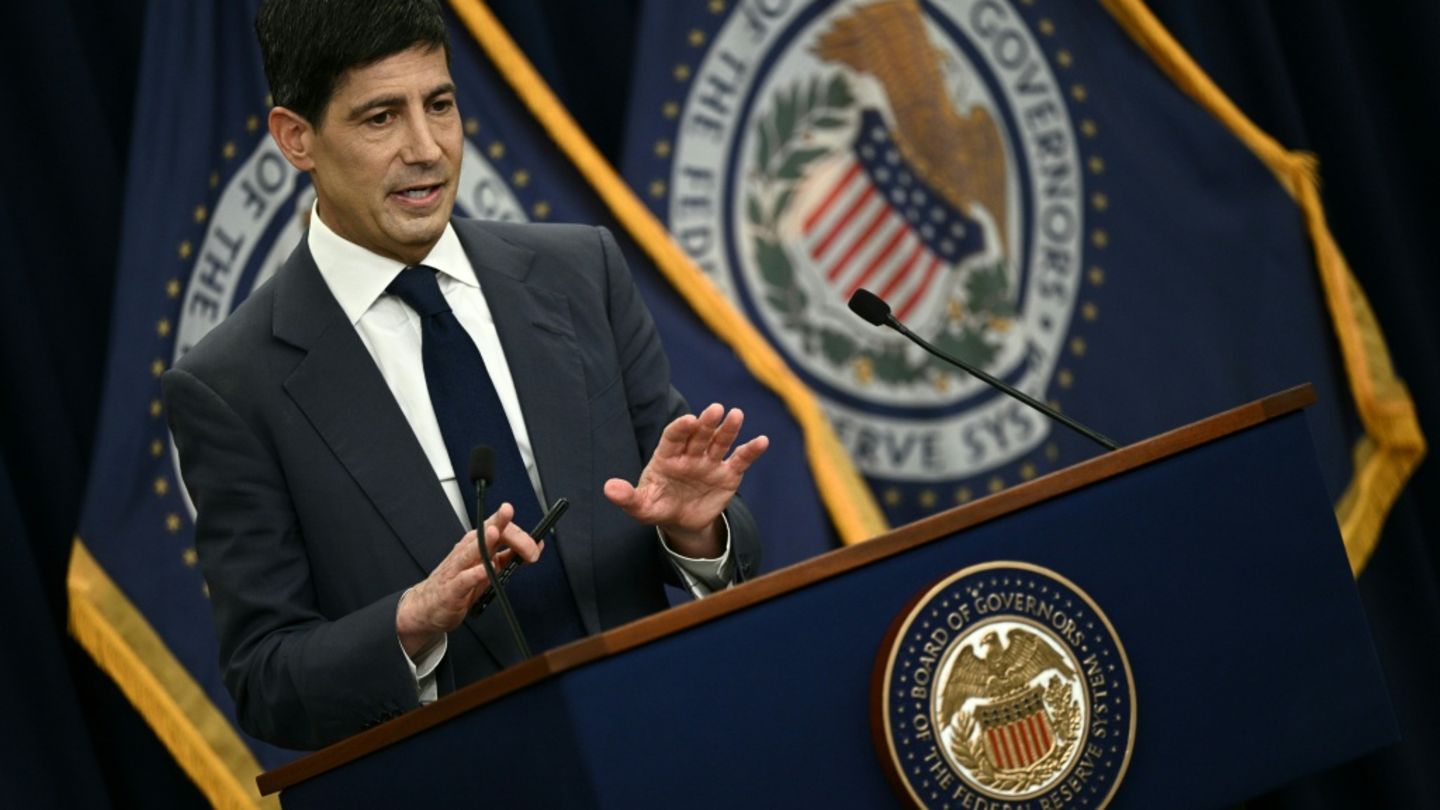
The decision of the twelve responsible central bank members to maintain a stable key interest rate was unanimous, as the statement said – this had not happened for around a year. At the same time, several Fed members indicated that they expect a key interest rate hike this year. The US dollar then rose against the euro.
Regarding maintaining the key interest rate, Trump said on Wednesday during his visit to France that it was “okay, not that important.” The Fed is now run by a “very good guy,” “so I will be guided by what he wants,” the US President added, referring to Warsh.
The Fed’s decision came in view of massive increases in consumer prices in the USA. Inflation rose to a three-year high of 4.2 percent in May due to the oil price shock in the Iran war – more than double the Fed’s recommendation of 2.0 percent. At the same time, the labor market was more robust than expected.
Warsh told reporters that the Fed’s interest rate committee will “ensure price stability,” as required by the central bank’s mandate. The 56-year-old succeeded long-time Fed Chairman Jerome Powell at the end of May. Trump had repeatedly insulted Powell as a “failure” because he did not support the desired reduction in the key interest rate. In doing so, Trump questioned the Fed’s independence.
Warsh had said he wanted to defend them. At the same time, he confirmed to journalists his intention to bring about a change of course at the central bank and to open a “new chapter”. He announced reforms in five key areas that he said needed a “fresh look.” To this end, he set up working groups that are supposed to present results by the end of the year at the latest.
The new Fed board wants to make changes, for example, in the central bank’s communication – he is relying on fewer public statements about future key interest rate decisions. Warsh also wants to reshape the Fed’s balance sheet, the use of data sources, and its handling of the issues of productivity and employment as well as inflation.
Warsh said he does not believe in the traditional view of some central bankers that higher inflation should be tolerated if necessary in order to get more people into work. The new Fed chief emphasized that he is convinced that the Fed can “combine strong growth, low prices and robust employment.”
The US Federal Reserve “still has a lot to do when it comes to price stability,” Warsh added. Trump recently drew criticism when he said he “loves inflation.” There has been anger in the US for months over the massive rise in fuel prices and other costs of living. The president’s poll numbers are therefore plummeting. Democrats have made consumer prices a key campaign issue ahead of the midterm congressional elections in early November.
Apart from Warsh, Fed members presented their new economic forecasts on Wednesday. Accordingly, the key interest rate could be raised slightly to a range of 3.75 to 4.0 percent by the end of the year. The experts therefore expect inflation to reach 3.6 percent by the end of the year. In March they had assumed 2.7 percent. According to forecasts, economic growth is likely to slow to 2.2 percent; in March, the Fed experts had still expected 2.4 percent.
Before taking office, Warsh had declared that such forecasts by Fed members were unnecessary because they then felt tied to them and it impaired their ability to respond to changing economic conditions.
