
Trump confirmed in an interview with the Bloomberg news agency that the ceasefire would end on “Wednesday evening American time.” If no agreement is reached by then, “a lot of bombs will go off,” the US President told PBS News. His demand to Tehran continues to be: “No nuclear weapons. It’s that simple.”
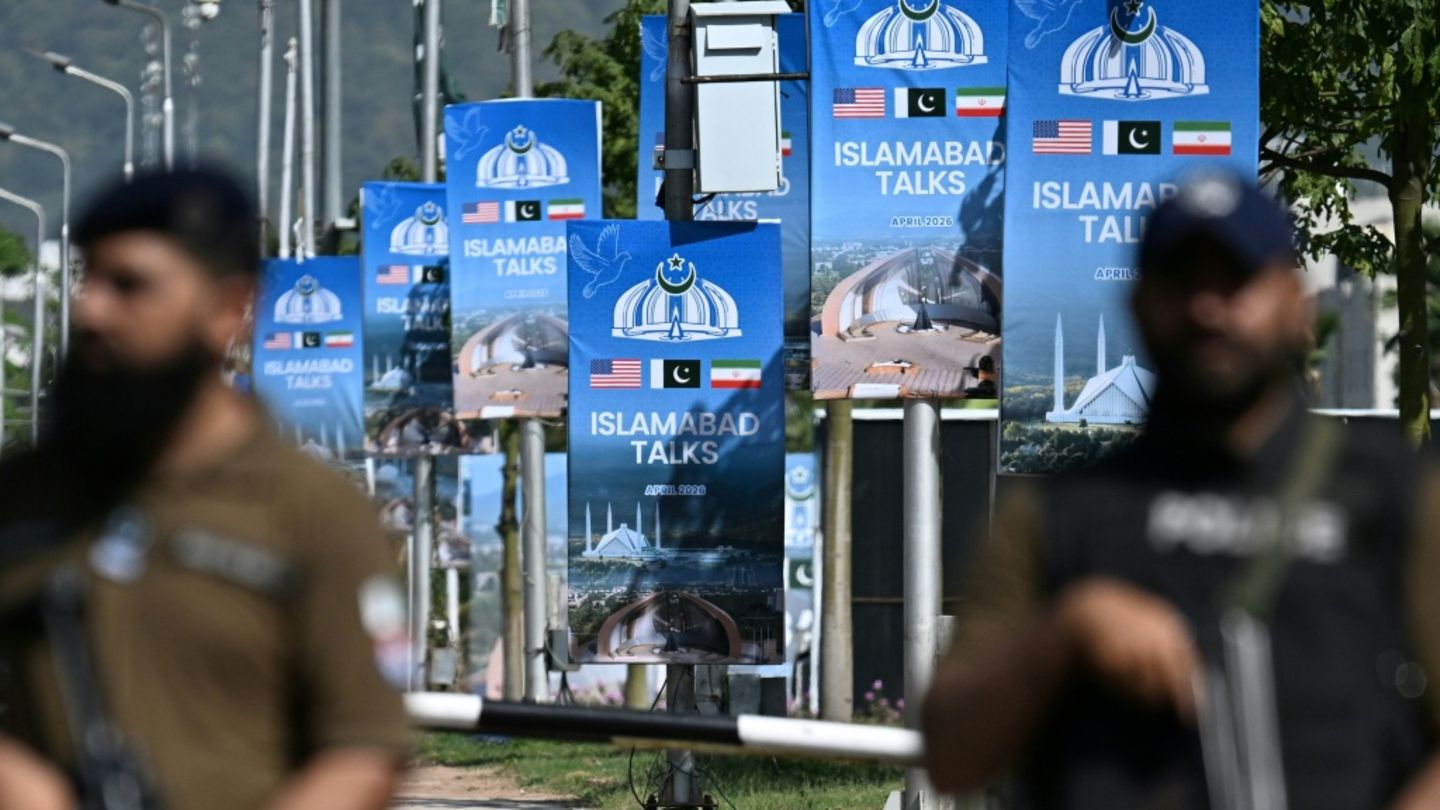
The AFP news agency learned on Monday from informed circles in Washington that a US delegation would “soon” leave for Pakistan for a planned round of negotiations with Iran. Trump, on the other hand, had recently told the New York Post that the US negotiators, led by Vice President JD Vance, were already on their way.
However, there was still uncertainty about Iran’s participation in the talks in Islamabad on Monday. “We have no plans for a second round of negotiations, but nothing has been decided on this yet,” said Iranian Foreign Ministry spokesman Esmail Bakaei. He accused the United States of not being “serious about diplomacy.”
Bakaei referred to “clear violations” by the USA of the ceasefire. Specifically, he mentioned a US attack on an Iranian cargo ship and the ongoing naval blockade of Iranian ports as well as the situation in Lebanon, where the pro-Iranian Hezbollah continues to fight with the Israeli army despite a ceasefire between Beirut and Israel that has been in effect since Friday.
The USA, for its part, accuses Iran of massive violations of the ceasefire – including attacks on Saturday, which, according to Trump, were directed against a French and a British ship, as well as the renewed blockade of the Strait of Hormuz. Iran has largely closed the strait, which is extremely important for world trade, since the beginning of the war.
During the two-week ceasefire, a lasting peace solution was to be negotiated with Pakistan’s mediation. However, the first round of talks a week ago ended without any results. Trump announced on Sunday that he would offer Iran a “reasonable deal.” If rejected, the US would destroy “every power plant and every bridge in Iran,” he threatened.
According to the White House, the US delegation in Islamabad will be led by US Vice President JD Vance, as in the first round of negotiations. The US special envoy Steve Witkoff and Trump’s son-in-law Jared Kushner are also said to be there. Trump had previously told ABC that Vance would not be there this time for security reasons.
The central sticking point in the negotiations is the Iranian nuclear program. But the efforts of mediators Pakistan, Qatar and Turkey have recently been made more difficult by the tense situation in the Strait of Hormuz: Tehran reversed its opening of the strait on Saturday after just one day. The Iranian army leadership justified this with the ongoing US blockade of Iranian ports.
Trump said on Sunday that the US Navy had fired on the Iranian-flagged and US-sanctioned freighter Touska and taken control of the ship. The freighter was trying to bypass the US blockade of Iranian ports in the Strait of Hormuz. Tehran then threatened to retaliate again. The Iranian news agency Tasnim reported on Monday that Tehran had launched drones in the direction of US military ships after the “attack” on the “Touska”.
French President Emmanuel Macron said on Monday that “a mistake had been made on both sides” regarding the situation in the Strait of Hormuz. By closing the strait again, Iran apparently responded to the US decision to maintain the blockade of Iranian ports.
Iran’s ally Russia, meanwhile, called for diplomatic efforts to end the war to continue. The ceasefire between Iran and the USA must be maintained, the Foreign Ministry in Moscow said after a telephone call between chief diplomat Sergei Lavrov and his Iranian colleague Abbas Araghchi. In addition, a “relapse into armed conflict” must be prevented.
Fears about a continuation of the war caused oil prices to skyrocket again. The prices for a barrel (159 liters) of the US reference variety WTI and the North Sea variety Brent rose by around six percent each.
Meanwhile, air traffic in the Iranian capital Tehran started again on Monday. According to the Isna news agency, the aviation authority issued approvals to reopen the Imam Khomeini and Mehrabad international airports. Passenger flights from ten other airports in Iran are scheduled to start again from Saturday. Iran’s airports were closed at the end of February after the start of the Iran war.
