
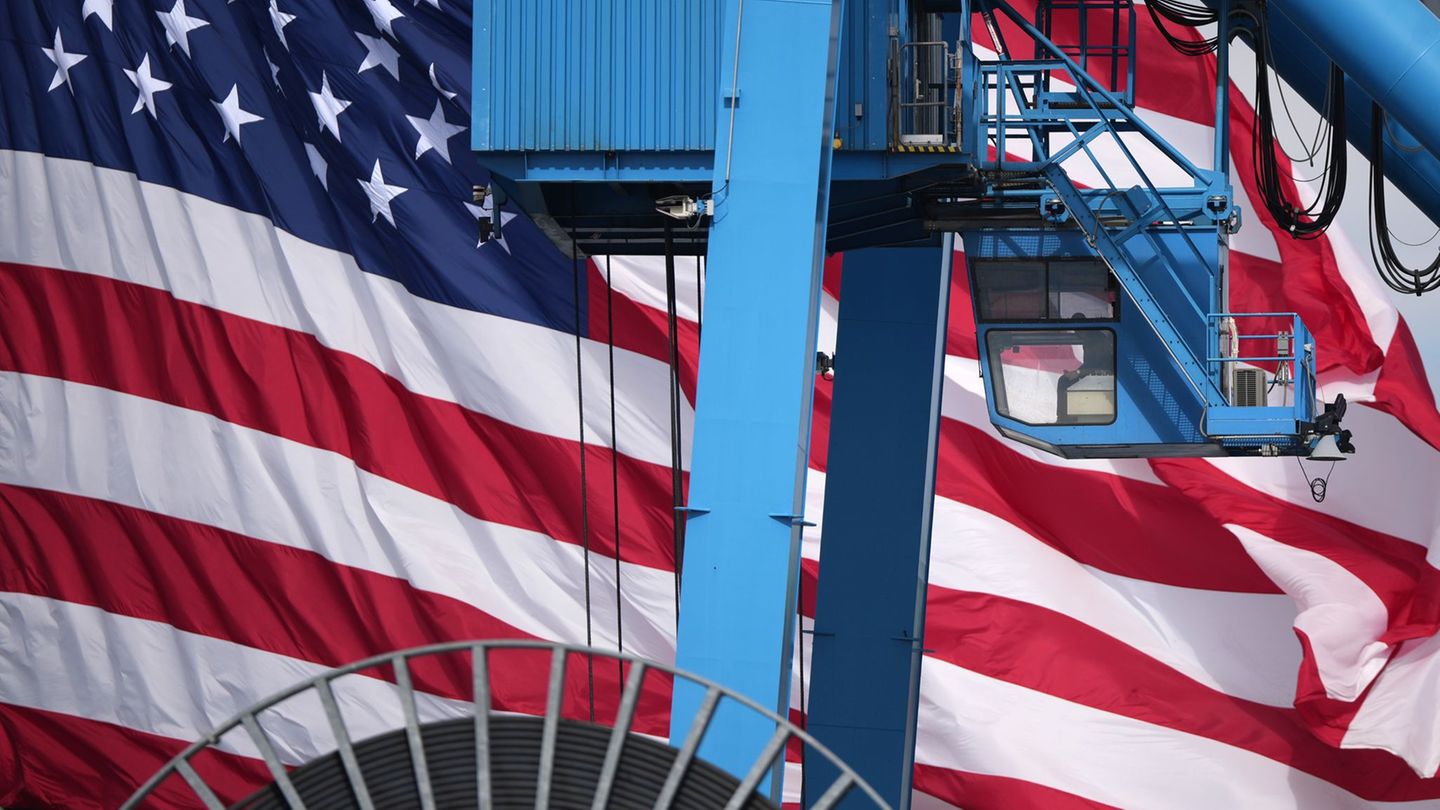
The Supreme Court is reviewing US President Donald Trump’s tariff policy. Since the beginning of his second term in office, the Republican has imposed tariffs on numerous countries, including on imported goods from the EU. Now the highest court is clarifying whether the US government’s actions were legally sound.
The oral hearing in court lasted almost three hours. The case is considered one of the most important economic and foreign policy trials in Trump’s second term in office.
What exactly is it about?
The question is less about whether such tariffs can be imposed, but rather who is allowed to do so. The focus of this case is that, according to the Constitution, the U.S. Congress – Parliament – normally has sole authority to tax and customs duties.
The US government circumvented this authority for its aggressive tariff policy by relying on a 1977 emergency law called IEEPA. Under this law, the president can issue decrees himself in the event of a crisis without having to go to parliament.
Trump saw the state of emergency in the country as fulfilled: there was an imbalance in international trade to the detriment of the USA. The USA was treated unfairly and national security was endangered as a result.
Why is the Supreme Court even hearing the case?
It’s about money – the financial newsletter
Whether it’s a building savings contract or Bitcoin – get more out of yours Money: The star In this newsletter, we show you the way through the financial jungle, compact and easy to understand, with concrete tips for everyday life. Always Fridays in your inbox. Click here to register.
Various groups, including American small businesses and US states, had taken the case to lower courts. There, it was ruled several times that Trump did not have the authority to impose broad tariffs on more than 100 countries worldwide using this special emergency law.
Trump appealed these rulings, so the tariffs remained in place for now. Then the Supreme Court came into play, the highest court in the USA, which is now supposed to decide for the first time whether Trump can actually use the IEEPA for nationwide tariff collections. A decision is expected in the coming weeks or months.
Will Trump attend the trial?
No, he was in Miami on Wednesday. Finance Minister Scott Bessent is said to have attended the hearing in his place. Nevertheless, Trump set the tone in advance: It was one of the most important cases that the Supreme Court had ever dealt with for America; he warned of “economic devastation” if the court took away his emergency powers.
How do both sides argue in court?
The government side took the view that the emergency law allows the president to “regulate” the import of goods in the event of economic emergencies – and from the government’s point of view, this also includes tariffs because they are intended to put pressure on other states and ideally do not bring in any money at all, but rather redirect trade or force foreign governments to negotiate. The fact that the tariffs generate revenue in this case is just a side effect.
The other side explained that tariffs are in fact primarily taxes – and taxes in the USA can only be decided by Congress, not the president alone. The emergency law is intended for sanctions, embargoes or licensing requirements, not for far-reaching trade taxes on dozens of countries.
Several judges critically asked why, according to the emergency law, Trump was allowed to stop trade completely, but in the opinion of Trump’s opponents he was not allowed to impose a tariff of one percent – to which their lawyers replied: A complete import ban doesn’t bring in any money, but tariffs certainly do. And precisely because they generate income, Parliament must decide on them.
At the same time, conservative judges appointed by Trump also expressed doubts about the government’s argument. They wanted to know why almost all important trading partners – from Spain and France to Switzerland – were suddenly considered a threat to national security. Judge Amy Coney Barrett asked whether it was really the government’s view that “every single country” posed a security risk. Judge Neil Gorsuch also warned of a “one-way street” in which more and more power moves from Congress to the President if such a broad definition of emergency is accepted.
What is at stake?
For Trump, tariffs have become the central element of his term in office. If he loses, the government would have to roll back its tariff policy, which could jeopardize existing trade agreements and also have an impact on the public image of his administration worldwide. The government might then also be obliged to pay back billions of dollars to importing companies. According to US media, many companies whose costs have risen rapidly due to the tariffs followed the hearing around the world.
It is still unclear what concrete consequences would follow if the Supreme Court decided in favor of the plaintiffs. The potential impact of the case on the EU and thus also the tariffs that affect German imports to the USA are also unclear. A judge even asked one of the plaintiffs’ lawyers how he thought refunds for illegal tariffs would be handled in practice, stressing that it could be “pretty messy.”
What are possible consequences?
If the court does not accept the emergency law as a legal argument, the government could try to change its argument and invoke other laws to maintain the tariffs. The question is also what happens in cases where the US government has agreed to trade agreements with other countries that include tariffs. It is also possible that the ruling could only relate to a specific period in which Trump imposed tariffs. The lower courts originally dealt with the country-specific tariffs first announced at the beginning of April, which affect dozens of US trading partners.
When is there a verdict?
That is unclear. There could be a verdict soon, but not until next year. When asked by dpa, the Supreme Court said that the court generally aims for a decision within an ongoing procedural period in which the hearing of a case is taking place. The current period began in the fall and ends next summer.
Calendar Supreme Court
