
“They made a proposal, but I rejected it,” the president responded to the press on the grounds of the White House before boarding his helicopter, Marine One.
Despite the blockade of the strait, Trump said the United States is in “complete control” of Hormuz and that “massive amounts” of oil flow through the waterway every day, 29 ships last night.
Iranian leaders “want to reach an agreement to open the strait immediately because they are losing ground dramatically,” he said. “Which is fine, I like agreements. But that agreement would not be acceptable,” he noted.
Iran announced on Friday that it had submitted a proposal to the United States to reopen Hormuz within seven days of the validation of the agreement.
“The choice now belongs to Washington,” its head of Iranian diplomacy, Abbas Araqchi, had declared from the UN headquarters in New York.
According to Araqchí, the reopening of Hormuz would occur on the sixth day of the plan’s implementation, after Washington implemented a series of measures during the first five days.
Iranian President Masud Pezeshkian had specified for his part that the proposal had been prepared “in coordination” with the supreme guide Mojtaba Khamenei, the last arbiter of the decisions of the Islamic Republic, and that a team of six members with “power to make decisions” had been created for this purpose.
What does the proposal contemplate?
The plan contemplates, among other measures, a seven-day ceasefire in the Middle East, the lifting of the US naval blockade against Iran, the end of sanctions on Iranian oil and the release of frozen Iranian assets.
Subsequently, Iran would agree to reopen Hormuz and, on the seventh day, Tehran and Washington would resume negotiations for a definitive agreement. which would include the Iranian nuclear program.
Araqchí explained that Tehran conveyed the proposal to Washington through Qatar, one of the mediators of the conflict, and stated that it could move forward if “the American side takes seriously the possibility of reaching an agreement.”
Resumption of bombing in November?
As a sign of the persistent mistrust between both countries, the American president had published on Friday on his Truth Social network a map on which Hormuz appears with the name “Trump Strait.”
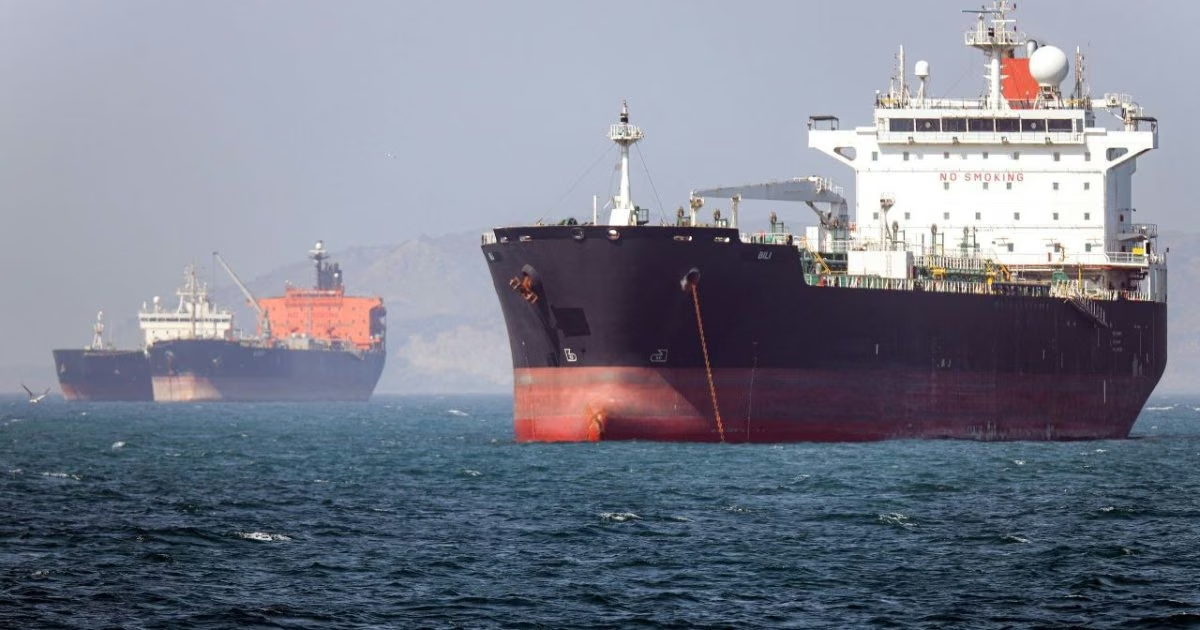
This sea route, through which a fifth of the world’s hydrocarbons used to transit, is at the center of the conflict after the attacks by the United States and Israel against the Iranian nuclear program. Since then, the Islamic Republic has claimed control of the toll, and Washington has imposed a blockade on Iranian ports in response.
Before Trump’s statement, the Wall Street Journal, with sources from US officials, had claimed that the US president had rejected the Iranian offer, considering that Tehran would not comply with its demands.
According to the newspaper, Trump mulls resumption of bombing in Iran after the midterm legislative elections in November.
Washington has not bombed Iranian territory since September 1. With the elections approaching, Trump must face the growing unpopularity of the war in the Middle East, which has skyrocketed the price of fuel.
“The stability of this vital region is directly linked to global energy security,” Saudi Foreign Minister Faisal bin Farhan recalled before the UN General Assembly on Saturday.
Saudi Arabia, the world’s largest crude oil exporter and severely hit by disruptions in the Straits of Hormuz and Bab el Mandeb, demanded countries do more to defend freedom of navigation.
“The international community has been absent in assuming its responsibilities in the face of everything that threatens international peace and security,” he said.
His Russian counterpart, Sergei Lavrov, in turn said that Moscow is willing to help stabilize the situation in the Strait of Hormuz.
“We need trust in relations between the Gulf States, the Arab States and Iran,” he told the UN.
Return to the agreement protocol
“The measures that the United States must take are not new” and “they all already appear in the protocol of agreement” signed in June with Washington, the head of Iranian diplomacy had declared when presenting his offer.
This understanding sought to put a lasting end to the conflict, reopen the Strait of Hormuz and then engage in negotiations on the sensitive issue of the Iranian nuclear program.
But it fell apart due to the conditions of passage through the sea route.
The protocol mentioned the immediate cessation of hostilities on all fronts, including Lebanon, where the Israeli army is fighting the pro-Iran terrorist group Hezbollah.
It also provided for the unblocking and payment of Iranian assets frozen as a result of the Islamic Revolution of 1979 – estimated at at least $12 billion – as well as the lifting of sanctions on Iranian oil and the end of the US naval blockade against Iran.
In an exclusive interview with AFP on Tuesday, Revolutionary Guards spokesman Hossein Mohebi also insisted on an end to the fighting in Yemen.
This country has become the new regional front since the resumption in July, after years of calm, of the conflict between the pro-Iran Houthis and the Yemeni government and its ally, Saudi Arabia.
The anti-government movement launched a deadly offensive in September, consolidating its control over the Bab el Mandeb Strait, another strategic passage for oil exports that connects Europe with Asia through the Suez Canal.
