
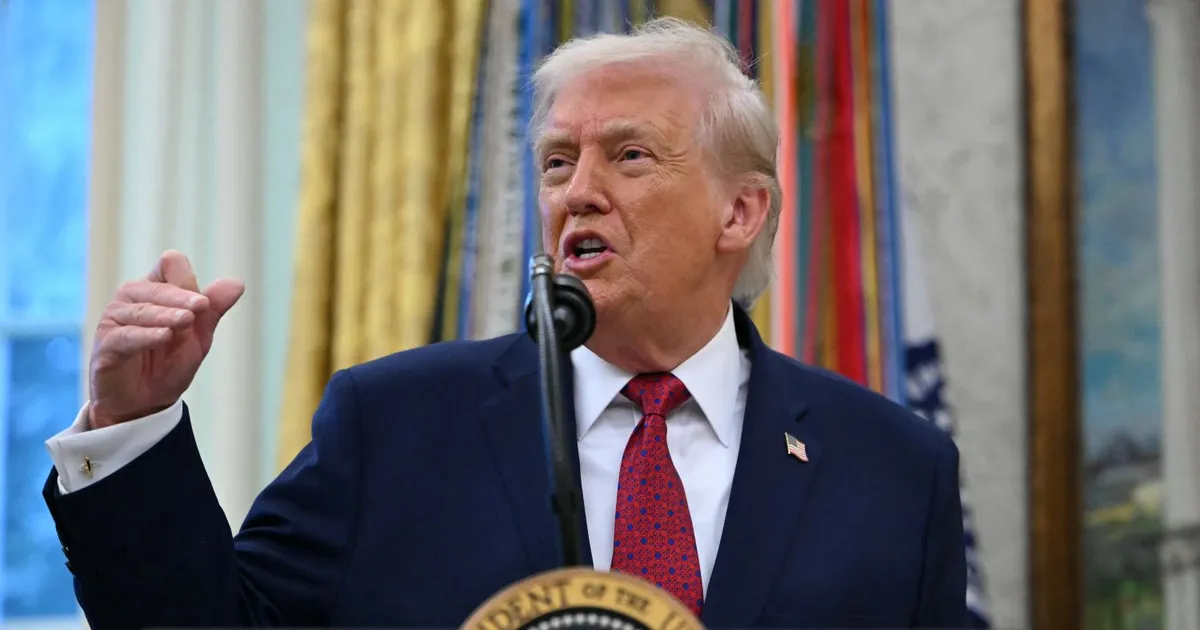
WASHINGTON.-President Donald Trump stated this Monday that the United States has postponed attacks on Iranian power plants after maintaining “very good” talks with Tehran for “a complete resolution” of the war, but the Iranian state press denied such contacts.
The announcement generated surprise after a weekend of crossed threats between both sides. However, from Tehran, several media outlets denied that there were any talks with the North American country.
“There are no talks between Tehran and Washington,” said the Mehr news agency, which cited the Iranian Foreign Ministry. The statements are part of an attempt “to reduce energy prices,” he added.
Experts point out that Iran’s denial is due to its need to demonstrate, not only within but outside its borders, that it remains a strong nation; so he does not admit his contacts with Washington.
Trump’s words caused, in effect, a collapse of more than 10% in oil prices and revived the stock markets, which have been oscillating for three weeks due to the conflict.
On his Truth Social network, Trump explained that in the last two days they had had “very good and productive conversations” with Iran for “a complete and total resolution of our hostilities in the Middle East.”
These conversations “will continue throughout the week,” Trump said.
Following these contacts, the president ordered the Pentagon to delay “any military attack against Iranian power plants and energy infrastructure for a period of five days.”
Threat crossing
The announcement came hours before the ultimatum issued on Saturday by Trump himself, which threatened to “annihilate” Iran’s power plants if it did not reopen the Strait of Hormuz within 48 hours, expired.
This maritime passage, through which a fifth of the global hydrocarbon trade previously transited, has been de facto closed since the start of the war on February 28.
Tehran, for its part, threatened to undermine “access routes and lines of communication” in the Gulf and to attack “all energy, information technology and water desalination infrastructure belonging to the United States” in the area.
Lists of possible infrastructure appeared in the Iranian state press on Monday, such as the Orot Rabin and Rutenberg plants in Israel, the country’s two main power plants.
“Say goodbye to electricity!” stated an infographic from the Mehr agency with possible targets in Saudi Arabia and other neighboring countries.
Energy crisis
The director of the International Energy Agency (IEA), Fatih Birol, warned on Monday that the war could lead to the worst global energy crisis in decades.
According to IEA estimates, the world has lost 11 million barrels of oil every day, that is, more than the daily volume eliminated during the two consecutive oil crises of the 1970s.
Freight transit through the Strait of Hormuz has plummeted by 95%, according to the analysis company Kpler. Only a small number of cargo ships and oil tankers have managed to cross that pass.
“No country will be immune to the effects of this crisis if it continues to move in this direction,” Birol warned.
