
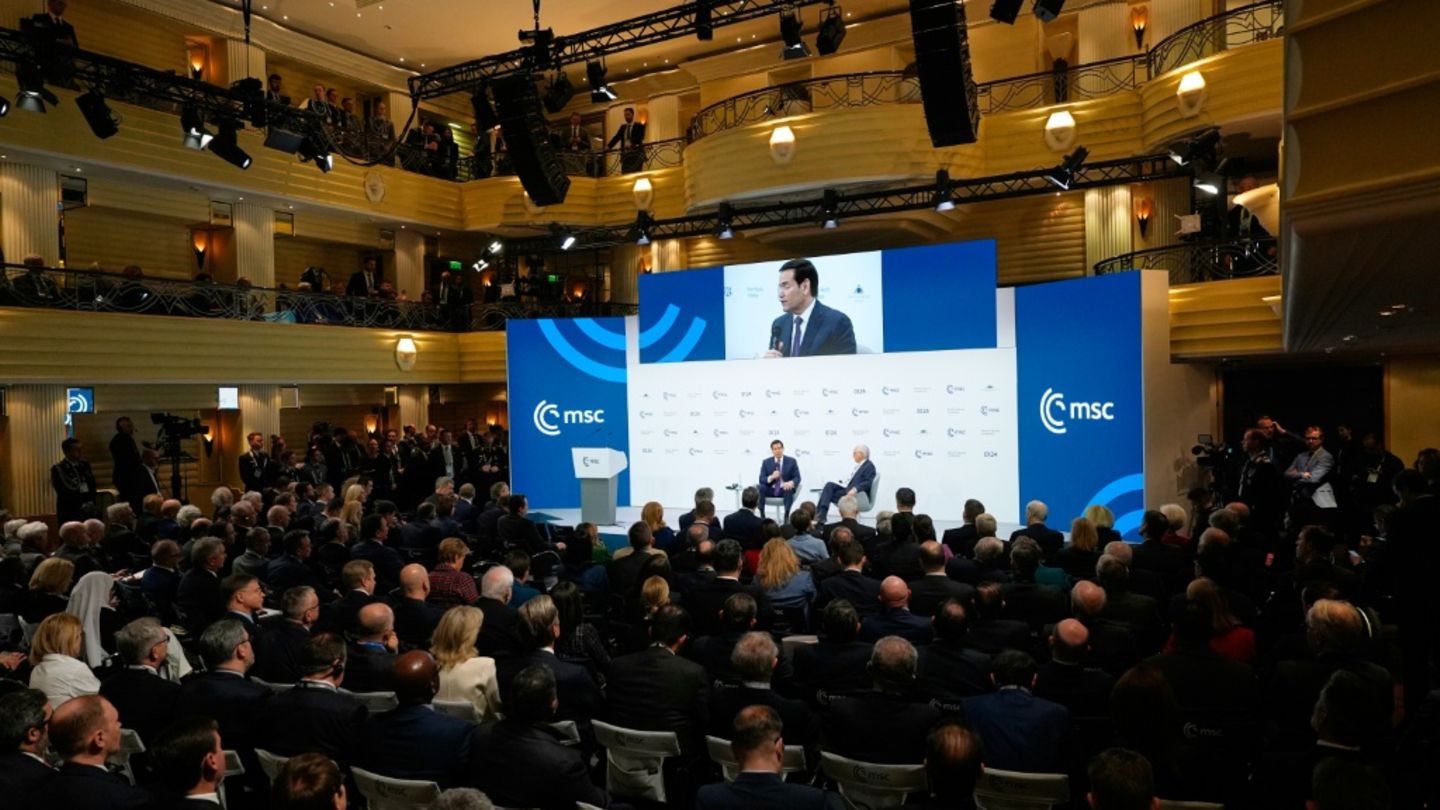
In their speeches, Chancellor Merz and Defense Minister Pistorius focused on the relationship with the USA a good year after President Donald Trump took office again. “A gap, a deep chasm, has opened up between Europe and the United States,” Merz said at the opening of the conference. The aim for Europe must be to assert itself “with new strength, new respect and self-respect”. Merz called for the relationship with the USA to be “repaired and revived”.
Pistorius expressed clear criticism of the US government for its efforts to annex Greenland – and for direct negotiations with Russia on the Ukraine war without the participation of EU partners. “All of this damages our alliance and strengthens our opponents,” Pistorius said on Saturday. NATO also makes the USA “stronger”, but the alliance must also “make sense” for Europe.
A few hours before Pistorius, US Secretary of State Rubio took the podium – and wooed his European partners in parts of his speech. “We don’t want a separation, we want to revive an old friendship,” said Rubio, pointing to the shared cultural roots of the USA and Europe. But he combined his words with clear demands: Europe must be able to defend itself, be proud “of its heritage and its history” – and resolutely combat irregular “mass migration”.
Another focus of the conference this year was the war in Ukraine. Numerous European states discussed with Ukrainian President Volodymyr Zelenskyj about further support for Kiev in the so-called Berlin Format, which brings together numerous EU countries as well as the leaders of the EU and NATO. In his speech, Zelenskyj called for faster deliveries of air defense ammunition, and on Saturday evening he accepted the MSC’s Ewald von Kleist Prize on behalf of the Ukrainian population.
On the sidelines of the conference, Latvia’s intelligence chief, Egils Zviedris, warned in an interview with the AFP news agency that Russia could be planning attacks on other parts of Europe even after a possible end to the Ukraine war.
More than a thousand guests took part in the MSC; in addition to speeches by prominent politicians, hundreds of discussion rounds took place at the Hotel Bayerischer Hof, and numerous heads of state and government as well as ministers met again for confidential discussions.
According to government circles, Chancellor Merz discussed further military support for Ukraine and the situation in Iran with US Secretary of State Rubio. According to the Beijing Foreign Ministry, a bilateral meeting with Chinese Foreign Minister Wang Yi before the Chancellor’s visit to China planned at the end of February was about deepening the joint partnership.
The situation in Iran also played an important role this year. After the bloody suppression of protests against the leadership in Tehran, Iranian opposition politician and Shah’s son Reza Pahlavi called on US President Trump at the conference to “help” his people. According to the police, around 250,000 people gathered for a demonstration against the Ayatollah leadership on Saturday, around two kilometers as the crow flies from the conference site – more than twice as many as the organizers expected. Pahlavi pitched himself to the demonstrators as a leader of Iran’s transition to a “secular, democratic future.”
At the conference, Germany and four other European countries said there was evidence that Russian opposition politician Alexei Navalny, who died in 2024, was poisoned in his Siberian prison. Laboratories detected epibatidine, the poison in South American poison dart frogs, in tissue samples from Navalny’s body smuggled from Russia. Navalny’s widow Yulia Navalnaya said her murder accusation against Russian President Vladimir Putin had now become “scientifically proven facts.”
