
These three towns, which make up an important rural urban triangle in the northeast of the Extremadura region, have easy access on roads, either by car or bus and even by train to Plasencia and Cáceres from Madrid.
Indeed, the name of this Spanish region comes from the Latin Extrema Dorii, which means “on the other side of the Duero River.” Its vast plains are intertwined with rivers and mountain ranges, giving rise to landscapes of great beauty. Among its crops and protected natural spaces, lynxes, wild cats and a wide diversity of birds live, creating a scenario where nature and cultural tradition coexist in harmony.
“Extremadura is an authentic place,” commented María Jesús, official tourist guide, “with natural beauty and tradition, which is often underestimated or little known outside of Spain, and travelers are surprised when they visit us.”
Consult the TurismoExtremadura.com portal for more information about this land of contrasts.
Plasencia
Gateway to the north of Extremadura, Plasencia invites you to travel back in time from the first step. Founded as an Iberian city by King Alfonso VIII in the mid-12th century, and with Roman and Arab traces still palpable, its strategic location on the historic Silver Route made it a key enclave since its origins.
Walking through Plasencia is to travel through centuries of history between walls, churches and convents. Its indisputable jewel is the Cathedral of Santa María, a unique fusion of styles divided into “old cathedral” and “new cathedral”: the first, Romanesque and sober (13th-14th centuries), and the second, an elegant mix of Gothic, Renaissance and Baroque that began in the 16th century. The monumental landscape is completed by palaces such as Carvajal-Girón or Mirabel, witnesses of the city’s medieval splendor.
Placentine life beats in the Plaza Mayor, a meeting point par excellence. Here, between the Municipal Palace and lively terraces, the traveler can stop to taste such emblematic local products as Iberian pork or local cheeses.
Caceres
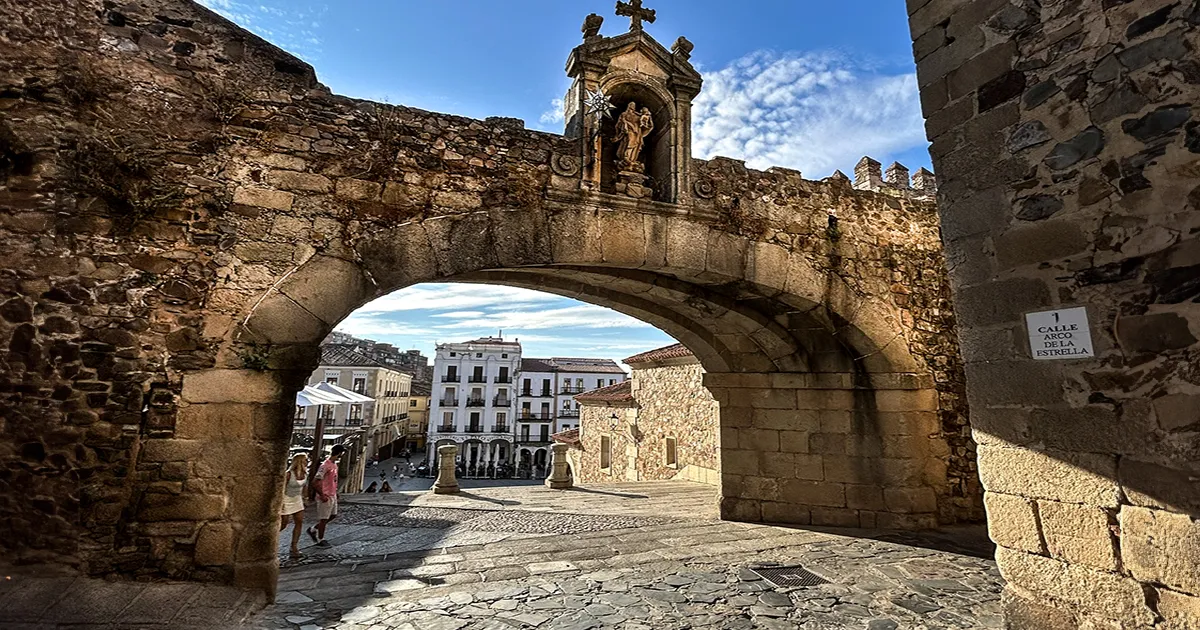
Cáceres surprises like an authentic open-air museum. Land inhabited since prehistory and later by Romans and Arabs, the city was the scene of disputes until it was integrated into the Crown of Castile and León in 1230. Today, its impressive historic center has been recognized as a Monumental City and World Heritage Site by UNESCO.
Behind its walls lies an extraordinarily well-preserved set of palaces, churches, defensive towers and medieval gates that transport the visitor to another era. Several scenes for the seventh season of Game of Thrones were filmed here.
The Carvajal surname is repeated throughout the route, linked to important buildings and a key family in the political and religious history of the city. Everything leads to the monumental Plaza Mayor, with more than 7,000 square meters, animated by shops and restaurants that serve as a prelude to the old town.
As a perfect contrast to the past, Cáceres also offers a look at the present with the Helga de Alvear Museum of Contemporary Art, which houses one of the most important private collections in Europe.
Trujillo
Trujillo captivates with its intact medieval essence and its serene atmosphere. With just over 8,600 inhabitants, this historic town brings together pre-Roman, Roman, Arab and Visigoth vestiges, but it is its medieval image that makes it unforgettable. Its narrow streets lead to the Plaza Mayor, presided over by the equestrian statue of Francisco Pizarro, conqueror of Peru.
In front of the church of Santa María la Mayor, of late Romanesque and spectacular altarpiece from 1490, is the bust of Francisco de Orellana, the first European to travel the Amazon River. Inside the temple lie the remains of Diego García de Paredes, known as The Samson of Extremadura, a character mentioned in Don Quixote de la Mancha.
The Plaza Mayor also houses the imposing Palace of the Conquest, ordered to be built by Hernando Pizarro, brother of the famous conqueror, as a symbol of the power and fortune achieved in the New World.
At the top of the hill, the old Arab citadel watches over the city and becomes the scene of the Music, Dance and Theater Festival each end of August. And for lovers of good food, an essential date: the first week of May, when Trujillo celebrates the National Cheese Fair, transforming the Plaza Mayor into a gastronomic paradise where cheese is the absolute protagonist.
Please see the summary of the videos we include here.
Gastronomy
Extremadura is a destination that is also enjoyed with the stomach. The region is characterized by its premium meat products, especially the famous Iberian pork, its artisanal sausages and cold cuts that are a real pleasure for any meat lover.
Local cheeses are another treasure not to be missed. The star is Torta del Casar, a soft, spreadable, melting cheese with an intense flavour. Ideal to spread on crusty bread, accompany with fruits or pair with regional wines.
Speaking of wines, Extremadura offers some with their own personality. Fresh whites, soft rosés and robust reds are produced in the region, and one of the most recommended is Pago Los Balanciles, whose surprising flavors leave an unforgettable mark on the palate.
For the full experience, plan a food tour: visit local markets, try tapas in town squares, explore artisanal cheese shops, and end the day with a glass of wine in front of a postcard-perfect rural landscape.
How to get there?
There are several airlines that provide service from Miami and the main cities of the United States to Spain, let’s say Madrid where you can board the train to Plasencia or Cáceres and bus to Trujillo.
If you carry a US passport you do not need a visa, but if you travel with a document from another origin, contact the Spanish consular office to receive appropriate information.
Where to stay
In Plasencia we recommend the Hotel Carvajal Girón, located in the old town and very close to the cathedral.
For Cáceres, the NH Collection Palacio de Oquendo hotel, a few steps from the Plaza Mayor and the great old town.
If you spend the night in Trujillo, opt for the Parador, located in the old Franciscan convent of Santa Clara from the 16th century.
Check the TurismoExtremadura.com website for more information.
Save money
Follow these tips to make it easier on your pocketbook. DO NOT EXCHANGE MONEY, neither before traveling nor at the destination. Most travelers tend to exchange dollars and ignore that they are charged a commission that is often excessive.
Better have the money in your bank account and use the ATM card as soon as you arrive at the destination. The issuing bank will charge you three or four dollars, but you’ll save the exchange fee and get the best international rate available that day.
You can also use credit cards in stores, restaurants and hotels.
