
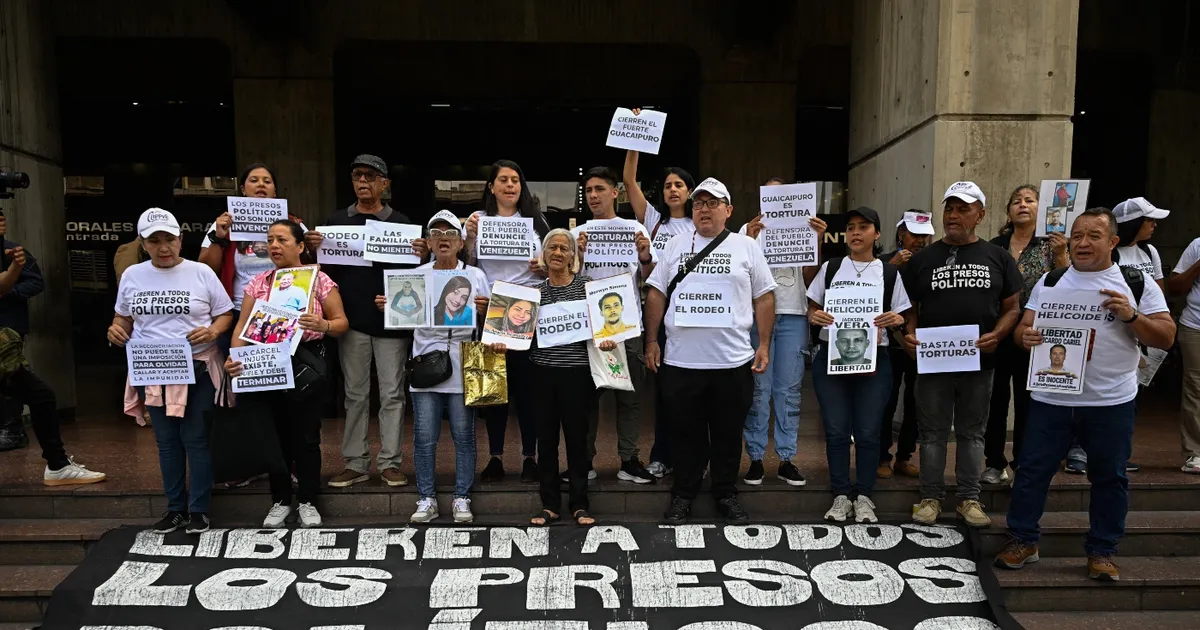
CARACAS.- Factions of the Venezuelan opposition and a NGO They asked this Thursday that the dialogue between a group of opponents and Chavismo includes the electoral issue, the liberation of political prisoners and the reestablishment of the autonomy of the Central Bank of Venezuela (BCV), proposals that do not appear among the agreements of this first cycle of talks, which ended on Wednesday.
The Unión y Cambio group, which is not represented in the dialogue, demanded that the electoral issue be “the first point of discussion” in the upcoming talks between Chavismo and the opposition, which agreed on the renewal of the Supreme Court of Justice (TSJ) and the recovery of Venezuelan assets abroad.
In this sense, deputy Tomás Guanipa said that the coalition considers it “very important” that the electoral issue be addressed as soon as possible and that there be an agreement to “radically” change the National Electoral Council (CNE), currently controlled by rectors sympathetic to Chavismo, to then move towards a presidential election schedule.
The leaders María Corina Machado and Edmundo González Urrutia, who head the largest opposition coalition in Venezuela, do not participate in this dialogue, but some of the parties that make up the bloc, such as Voluntad Popular and Primero Justicia, support the talks that began on August 1 under the auspices of the United States.
Political prisoners ignored
The NGO Access to Justice regretted that the issue of political prisoners has been left off the negotiating table and valued the agreement to renew the entire Supreme Court of Justice (TSJ).
“We regret that the negotiations that have been carried out recently have not included the issue of political prisoners, because we do not see any justification,” declared the director of the NGO Access to Justice, Ali Daniels.
However, the leader Dinorah Figuera, who leads the opposition delegation in the dialogue with Chavismo, He pledged this Thursday to work to achieve more releases of political prisoners in the “coming days.”
According to the NGO Foro Penal, there are currently 382 political prisoners in Venezuela, after hundreds of releases that occurred this year in the midst of a process of releases ordered by the interim Government of Delcy Rodríguez and the approval of an amnesty law in February that, for the most part, favored people with restricted freedom.
Autonomy of the Central Bank
Chavismo and an opposition group made up of former deputies closed the first cycle of dialogue with two agreements focused on the complete renovation of the TSJ and the recovery of Venezuelan gold in the Bank of England to attend to the victims of the double earthquake on June 24, which has left at least 6,301 dead and nearly 18,000 people homeless.
In 2023, the Chavista Government assured that Venezuela has 31 tons of gold in the Bank of England, equivalent to about 1,950 million dollars, due to questions from the British Justice about the legitimacy of the deposed president Nicolás Maduro, who faces a judicial process in the United States.
Despite the recent relief of sanctions by the White House, structural restrictions persist and funds and assets of the Venezuelan State abroad remain frozen or under control, such as gold reserves deposited in the Bank of England or assets of Citgo, a subsidiary of the state oil company PDVSA in the US.
The opposition party Movement for Venezuela (MPV), which also has no representation in the dialogue, proposed reestablishing the autonomy of the Central Bank through these conversations between the ruling party and the opposition.
In a letter addressed to Dinorah Figuera, the national general secretary of the MPV, Simón Calzadilla, asked that the reestablishment of the autonomy of the Central Bank of Venezuela (BCV) be considered in the negotiation process with the appointment of “capable professionals, not linked to parties or the Government.”
He also proposed that a “capable Finance Minister be appointed, not linked to the administrative past of the Government and political parties, who can address and design, in coordination with the BCV, a balanced fiscal policy and reestablish a simple exchange system.”
