
In less than a month, the Republican Government managed to rescue the 10 Americans that the Venezuelan regime maintained as “change sheets” and, while the world talked about a negotiation, he told the poster of Los Soles and the Aragua train – which says they are under the leadership of Maduro, Diosdado Cabello and Vladimir Padrino López – as a terrorist organization, the reward raised the reward for the delivery of the dictator Venezuelan to the figure never before 50 million dollars and mobilized warships off the Venezuelan coast.
The objective is clear: dealing with the threat represented by the poster of Los Soles and the Chavista dome to the national security of the United States. This has made it clear from President Trump, the Attorney General Pam Bondi, the Secretary of State, Marco Rubio; Undersecretary Christopher Landau and, more recently, the White House spokeswoman, Karoline Leavitt.
“President Trump has been very clear and consistent. He will use all the power of the US to curb drug flow and take the culprits before justice,” Leavitt said on August 19, before emphasizing that for the current administration the Maduro regime is not the legitimate government in Venezuela, but a narcoterrorist poster. “Maduro is not a legitimate president, he is a fugitive of this poster, accused in the US for drug trafficking,” he said.
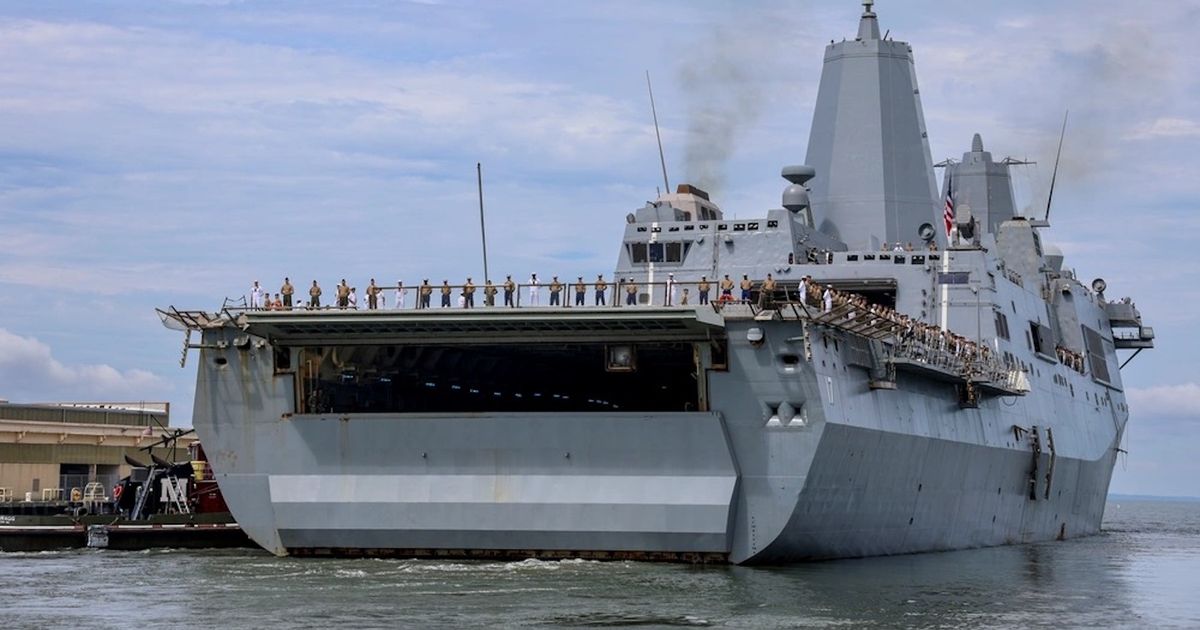
With this, the doubts of the magnitude of the military mobilization that ordered the Pentagon on August 14, to the Iwo Jima Amphibious Ready Group (ARG) and the 22nd Marine Expeditionary Unit (MEU), with more than 4,500 marines or marine infants. The deployment includes three warships: the USS IWO Jima (LHD 7), the USS San Antonio (LPD 17) and the USS Fort Lauderdale (LPD 28), UH-18 Venom helicopters, a nuclear attack submarine, a cruise with guided missile Narcos “.
“The Pentagon already ordered the deployment of boats that came out of the base of Little Creek, in Norfolk, Virginia. These amphibious assault ships, supported by marine infants and aircraft, give the president an immediate response capacity to any crisis,” explains the greatest retired Jesús Romeroformer intelligence director of the naval forces of the South Command, in conversation with Las Américas Diario.
“Extraction actions”
Although the US military presence in the Caribbean Sea is not new, since it maintains troops in allied countries, such as Panama, Dominican Republic and Guyana, where it carries out training and anti -drug operations, this current deployment seems to go more than a routine anti -drug operation to meet national security objectives.
“Venezuela is today a clear threat due to the increase in cocaine flow that leaves its coasts, from La Guajira to the Orinoco Delta and the border with Guyana. The deployment of maritime elements seeks to repress that traffic,” says Romero. He considers that the presence of these ships in waters near Venezuela sends a clear signal to the Venezuelan regime: “It is a demonstration of commitment and a warning to hostile addresses.”
The Intelligence Exoph for official mentions that, with these new military resources, the president would have a strategic tool to execute “surgical” actions, with combined air-marra-terrage operations ranging from humanitarian assistance and evacuations, to limited combat missions, without the need for a conventional conflict. “We are talking about forces capable of combined operations in air, land and sea, which even allow surgical extraction actions in case there is an arrest warrant (against mature, hair or godfather López),” he says.
It also indicates that the ARG usually operates under a strict operations security scheme, known as (OPSEC), which allows the confidentiality of the routes, times, areas of operation, objectives and confrontation rules (ROE); Limited communications and limited crew and changes of direction, speed or patrol zone to avoid enemy intelligence.
“In the context of the conflict with Venezuela, Navigate under OPSEC allows the US to maintain the surprise factor in case of amphibious operations or interdictions, prevent hostile actors from adjusting their defenses or asset transfers and integrating the ARG into a joint operation with other forces without revealing coordination,” he says.
A powerful tool
The operations would be framed in Title 50 of the US Code, the powerful tool that Trump has to face the Maduro regime after designating the Suns poster as a terrorist organization. This gives it the ability to execute military or clandestine operations, sanctions and confiscations of assets without previously informing the Congress.
This designation, plus the increase in Maduro reward, completely changes the panorama. And it is that Washington no longer chases the dictator only as a drug trafficker, but as the head of a terrorist organization. “This is key (…) When a group or individual enters the category of terrorism, the US has a much broader legal and military fan to act. That includes capture operations outside its borders,” says the retired colonel of the American armed force, Octavio Pérez, in conversation with conversation with Las Américas Diario.
Remember, for example, that in 2013, under the same legal framework, US forces entered Tripoli, Libya, and took a high leader of Al Qaeda in a lightning operation. “That is the type of mission that now enters the options against Maduro or Diosdado Cabello,” he warns.
Both Pérez and Romero rule out open clashes between Washington and Caracas. Both see an extraction surgical mission much more feasible. “This is what is normally called a surgical operation: it does not imply thousands of casualties, but a planned movement to meet a specific objective,” says Romero.
The “danger” closer
Beyond the operational capacity of Washington, Pérez emphasizes that the reward of 50 million dollars per Maduro places it in a state of constant vulnerability, even in the face of its closest environment. “No one in the world has had such a high reward on their head (…) with that amount, even a cousin could sell you. That was what happened with the children of Saddam Hussein in Iraq: they were betrayed and dejected because there were millions of dollars at stake,” he says.
The colonel compared the situation with that of Hussein himself, captured in 2003. “He spent his last months hiding, sleeping every night in a different place, until he was found in a hole. Maduro will have to live with that same fear,” he emphasizes.
And that fear in Miraflores is palpable. Despite the bravery of the regime, the mobilization of 4.5 million militiamen throughout the Venezuelan territory and the prohibition – for 30 days extendable – of all activity related to drones in Venezuela, would be a sample of this.
“When you have a head of state indicated as a drug trafficker, terrorist and with 50 million on his head, it is not unreasonable to think that at any time a command between, capture him and take him out of Venezuela,” Pérez points out, when Libya’s ghost relives in Caracas: “If a Al Qaeda leader took him out of his bed in Tripoli, why not Maduro in Caracas?”
(Email Protected)
