
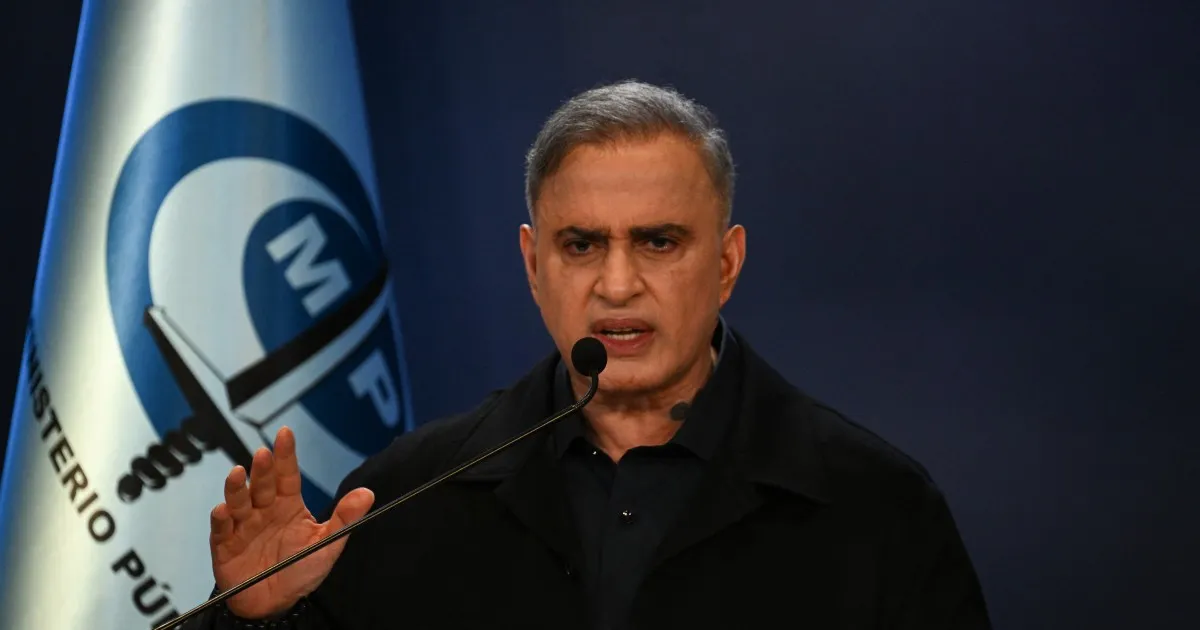
CARACAS – He fiscal general of Venezuela, Tarek William Saab, and the Ombudsman, Alfredo Ruiz, submitted their resignation to the National Assembly (AN, Parliament) —controlled by Chavismo— in the midst of the amnesty process for political prisoners from 1999 to the present.
Saab will now serve as ombudsman temporarily, after the resignation of Alfredo Ruiz Angulo for alleged personal, family and health reasons, according to a letter that he also sent to Parliament. The until now attorney general was ombudsman from 2014 to 2017.
The constitutional procedure stipulates the appointment of a Nominations Committee, so the AN voted for managers for both positions.
The Chavista prosecutor resigned from his position, the secretary of the National Assembly reported on Wednesday, less than two months after the fall of dictator Nicolás Maduro.
Parliament received a communication addressed to Jorge Rodríguez, head of the Legislature, signed by Saab, “through which he submits (his) resignation from his position as attorney general of the republic,” the secretary read during a parliamentary session.
Saab, in office since 2017, advocated for the return of Maduro, captured in a US military operation on January 3, and condemned the incursion as illegal and in violation of international law.
The Chavista prosecutor calls himself a defender of human rights, but the opposition always reproached him for turning a blind eye to complaints of abuses by law enforcement.
For his part, lawyer Larry Devoe was voted as prosecutor in charge. He heads the state National Human Rights Council, a body that is responsible for coordinating and supporting public policies on the matter and is Venezuela’s representative before the international human rights system.
Jorge Rodríguez announces the resignations
The president of Parliament, the Chavista Jorge Rodríguez, announced in the middle of the session, broadcast on the state channel ANTV, that he received “messages” with the resignation of both officials, that They had been ratified in their positions in October 2024 for a period of seven yearsthat is, until 2031.
Likewise, he said that there is currently no deputy prosecutor in the Public Ministry (MP, Prosecutor’s Office) who can assume the position temporarily while the selection process for the new prosecutor by the AN is activated.
Given this, he indicated that a “manager” will be elected for both positions while the Parliament’s Nominations Committee is activated.
Saab, who has also been a governor supported by Chavismo, came to the Prosecutor’s Office in 2017 by appointment of the plenipotentiary National Constituent Assembly, a forum made up exclusively of “defenders” related to the Nicolás Maduro regime.
The Chamber also then ratified Alfredo Ruiz as Ombudsman.
On Friday, the now former prosecutor considered that the Amnesty Law approved by Parliament closes “an important historical cycle” in Venezuela.
“I would say that the approval of the Amnesty Law closes an important historical cycle that is that of healing wounds, obviously the product of dispute and conflict, beyond what the Law itself narrates,” the official stated then, according to a press release released by the Prosecutor’s Office.
The National Assembly will apply article 279 of the Constitution of the Republic of Venezuela, which must rule in favor of resignation because it is that power of the State that is in charge of appointments.
What does Article 279 say?
Selection Process: It is based on a public competition, evaluation of applications by a committee, and final selection by the National Assembly.
Composition of the Committee: Deputies, spokespersons for Popular Power and representatives of social organizations.
Nominations: A shortlist (at least three candidates) is formed for each position (Ombudsman, Attorney General, Comptroller General).
Decision: The National Assembly chooses the incumbents with the favorable vote of the majority of its members.
Objections: Citizens can present objections to the applications before the Evaluation Committee.
Removal: Members of the Citizen Power can be removed by the National Assembly in case of serious misconduct, requiring a ruling from the Supreme Court of Justice if there is criminal responsibility.
Lack of Agreement: If the designation is not achieved, the process may lead to mechanisms established in the Organic Law of Citizen Power.
This article is fundamental for the formation of the bodies that make up the Citizen Power, ensuring that their selection goes through a process that seeks citizen participation and the suitability of the candidates.
