
The decision came just one day after another announcement that shook the administration, the immediate departure of the county’s experienced chief operating officer, Jimmy Morales, and the retirement of PortMiami Director Hydi Webb, two figures who had been directly involved in negotiations related to the facility.
Although Levine Cava officially presented both movements as part of an administrative reorganization, the proximity between the announcements gave rise to political speculation about a crisis that had been brewing for more than a year and that today faces economic, legal and strategic interests of enormous magnitude.
“We negotiated in good faith and carefully analyzed the proposal,” said the mayor when announcing the expropriation. “The deal included clear benefits, including the County gaining ownership of the facility and a financial structure that would allow the acquisition to pay for itself over time, without dipping into taxpayer dollars. But in the end, the price was simply too high.”
The mayor added that, even if the funds came from port revenues and not directly from general taxes, the administration had the responsibility to “protect the public interest” and act as responsible administrator of public resources.
The terrain of discord in Miami-Dade
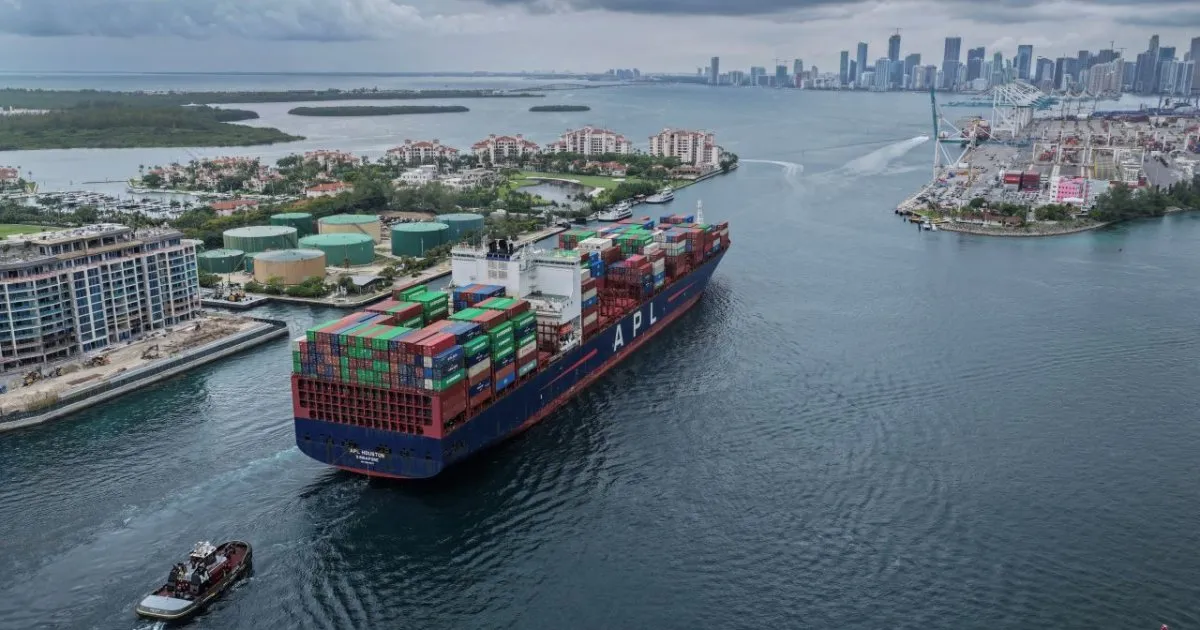
The conflict revolves around an approximately 9.6-acre parcel located at the northern end of Fisher Island, where a marine fuel storage and distribution terminal has operated for almost a century.
According to official county documents, the facility was originally built by Belcher Oil Company in the 1920s and has served for generations as the primary source of supply for cruise ships and cargo ships operating out of PortMiami. In 2003, TransMontaigne acquired the property.
The terminal has a storage capacity of 672,669 barrels of fuel, 12 large storage tanks, two docks for supply vessels, fuel mixing systems and a complex network of internal pipelines. In 2024, it sold about 3.88 million barrels of fuel and 92% of that volume was destined for the cruise industry.
For PortMiami, the facility represents much more than an energy terminal.
The port generates an estimated economic impact of $61.4 billion annually in Florida, equivalent to 3.9% of the state’s Gross Domestic Product, and directly and indirectly supports more than 340,000 jobs, in addition to generating approximately $2.2 billion in state and local taxes.
For this reason, those responsible for the port insisted for months that the continuity of the fuel supply is a matter of regional economic security.
Beginning of the conflict
The crisis dates back to May 2024, when TransMontaigne Terminals LLC, owner of the terminal, publicly announced that it was studying selling the land.
According to Commissioner Raquel Regalado, the port had opportunities to acquire the property before interested private investors appeared, but it never exercised that option.
“This infrastructure has existed since the 1920s and has practically not changed since the 70s,” said Regalado in an interview with the program “A Primera Hora” on Actualidad Radio. “The port had opportunities to buy it and they didn’t do it.”
Ultimately, a group led by HRP Group, whose main shareholder is developer Roberto Pérez, acquired the property for approximately $180 million with plans to demolish the facility, decontaminate the land and develop a luxury residential project valued at approximately $2 billion.
The operation sparked immediate concern among port operators, cruise companies and county officials.
The County reacts
Faced with the risk of losing the port’s main source of fuel, Levine Cava issued a memorandum in September 2025 in which it recommended the acquisition of the property through negotiation or expropriation.
In that document he argued that losing access to fuel “would substantially affect the functionality of PortMiami” and would put Miami’s position as the world’s leading cruise port at risk.
Subsequently, on October 9, 2025, the County Commission approved Resolution R-995-25 by nine votes to four. Commissioners René García, Danielle Cohen Higgins, Roberto González and Micky Steinberg voted against.
The resolution authorized continued negotiations with HRP and established that expropriation could only begin if 60 days passed without an agreement or if the mediator declared a stalemate in the negotiations.
It also required the administration to present at least three viable alternatives for building a new facility within the port.
The report that changed the debate
A few days before, on October 7, 2025, Levine Cava had sent the commissioners an extensive 55-page report on the negotiations and the alternatives analyzed.
The document concluded that acquiring the existing facility was PortMiami’s preferred option.
The report analyzed ten alternative scenarios that included building a new terminal within the port, moving it to another coastal point, building it inland, transporting fuel from Port Everglades, using barges, trains or trucks, and even developing a floating terminal.
Most options were considered technically unfeasible, too expensive or incompatible with the port’s current operations. One of the most compelling findings was that the port has practically no free land.
According to the report, 85% of the port’s surface is committed through contracts, 14% corresponds to roads and only 1% remains available for operations.
“The county had decades to act”: HRP
The developers’ narrative is radically different. Roberto Pérez, executive director of HRP Group, quoted by a major real estate media outlet, said that Miami-Dade knew perfectly well the strategic importance of the land and had multiple opportunities to acquire it.
“The county is in this situation as a direct result of its own incompetence after years and frankly decades of lack of planning for PortMiami infrastructure,” he said.
According to Perez, the owners offered several alternatives, including the possibility of financing a new fuel facility elsewhere.
He also maintained that during the mediation process the company acted in good faith and that the County decided to abandon the talks to opt for an expropriation that it considers “long, costly and ultimately fruitless.”
HRP insisted that it is not a fuel terminal operating company but a firm specialized in the transformation of complex industrial properties.
Fisher Island enters the scene
The dispute took an unexpected turn when the Fisher Island Community Association, which had negotiated with HRP, filed a lawsuit related to agreements reached between the developers and the community.
Its president, James Ferraro, maintained on television that residents never imagined that the property would end up becoming the object of a multimillion-dollar negotiation with the County, understanding that the price of the land was 600 million dollars. Months after having paid 180 million for that same land.
Ferraro said he supported the need to maintain fuel supplies for PortMiami, although he clarified that his community wants modern and safe facilities.
“We want a safe facility. If the County modernizes the tanks and creates a state-of-the-art facility, we’re fine with that,” he said.
Ferraro also questioned whether taxpayers end up financing a windfall for private investors.
Commissioners divided
Levine Cava’s decision also does not achieve consensus within the Commission.
René García has been one of the most consistent opponents of expropriation. Their main argument is that the problem was created by the lack of planning by previous administrations and that the government should not automatically resort to taking away private property to correct that mistake.
“How are we going to take away someone’s private land because of a County ruling?” the commissioner questioned and maintained that the real solution would be to build a new facility within the port lands.
According to the information he received from the administration itself, five to six acres would be enough to develop a modern fuel depot.
The senator told DIARIO LAS AMÉRICAS that, although it would be necessary to renegotiate some existing contracts at the port to find that land, the cost would be much lower than the hundreds of millions of dollars that could end up being paid for the current property.
Raquel Regalado agrees with García’s concerns. The commissioner believes that the controversy has revealed decades of lack of strategic investment in port infrastructure. He also insisted that the current facility is technologically obsolete and will sooner or later require significant investments. However, Regalado advocated keeping the doors of mediation open before engaging the County in a complex judicial process whose economic outcome is uncertain. He also highlighted the fact that the money invested in this operation is not provided by taxpayers, but comes from funds generated by the port.
“Where were the lawyers, where was the administration, where was the Commission that was not attentive to negotiate this contract,” said commissioner Juan Carlos Bermúdez, who advocates having the expropriation mechanism as a fundamental tool to negotiate with the current owners of the land. Commissioner Bermúdez left a question in the air, what will be happening with other contracts?
What will happen now?
The June 5 announcement does not mean that the property has been expropriated. What the county mayor did was order the initiation of the necessary legal procedures to try to acquire it through eminent domain. A process that could last for years.
According to the County’s own report, an expropriation would require proving in court the public need for the acquisition, making judicial deposits, facing litigation over the value of the property and eventually subjecting the final compensation to the decision of a jury.
Meanwhile, the administration must continue to ensure that PortMiami maintains access to enough fuel to sustain an economic activity that moves tens of billions of dollars and is one of the pillars of South Florida’s economy.
The battle over the Fisher Island tanks has already caused two high-profile departures within the administration, divided the Miami-Dade Commission, pitted the mayor against some of Florida’s most powerful developers and opened a debate over decades of failed planning.
But the central question remains unanswered: Is it better for the County to buy an old facility, build a new one, or embark on an expropriation that could end up costing much more than either side is willing to admit?
The answer will likely define the future of PortMiami for decades to come, but it confirms that the current crisis is a consequence of years of indecision.
(email protected)
