
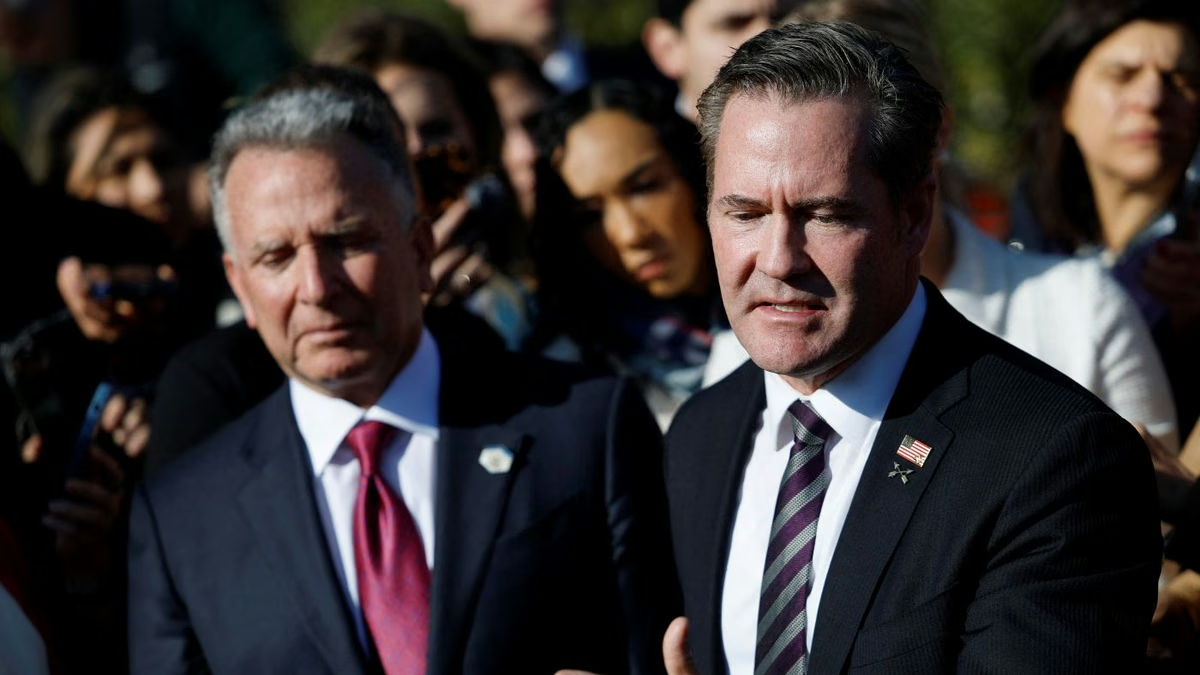
Although the UN General Assembly once again approved the resolution against the alleged United States embargo on Cuba, “the effort” of the American delegation, led by the ambassador, Michael Waltz, “denotes serious and consistent work to unmask the big lie that Washington is the cause of the problems in Cuba,” says María Werlau, executive director of Archivo Cuba, who also criticized Chile’s abstention in the vote.
“For the first time something is done, I have never seen the United States as a delegation act actively on Cuba… An effort like this, consistent, of lobbying the countries, with presentation of materials (graphics) and testimonies I had never seen him at the United Nations“adds Werlau in an interview with DIARIO LAS AMÉRICAS (DLA).
“I know the terrain,” says the director of this non-profit organization founded in 2001 to promote human rights with research and verified information about what is happening on the island.
The provocation caused by the regime’s spokesperson at the UN headquarters, Bruno Rodríguez, during the speech of the US representative, Walz, at that international organization demonstrated to what extent the Castro regime feels isolated and mortally wounded in the face of Washington’s current diplomatic efforts to unmask the dictatorship, which has been exercising power for 67 years. State terrorism and repression against the Cuban people, and especially against those who raise their voices to denounce the regime or confront its barbarity.
But Cuban totalitarianism has not been limited to acting within the island, but in various regions of the planet. where the failure of the socialist-Castro ideology and the failure of the Cuban revolution has been exportedthe pretext for the Castro dynasty to take over the island and kidnap it under the worst and fiercest dictatorship in the Western Hemisphere.
A turn to the Castro lobby in New York
The resolution, which Havana presents every year at the UN General Assembly, was approved on Wednesday in its thirty-fourth consecutive year with 130 votes in favor, 17 against and 25 abstentions. According to Werlau, “the result is very unfavorable in general, although comparatively it is much better.”
“Until recently, The United States and Israel were the ones who voted against. “The most interesting thing this year was the result from Latin America, whose countries previously voted in favor of the resolution.”
Now, five countries in the region voted against (Argentina, Colombia, Costa Rica, Ecuador and Paraguay), six abstained (Chile, Haiti, Honduras, Jamaica, Peru and Dominican Republic) and three did not vote (Bolivia, El Salvador and Venezuela). Only Mexico and Brazil voted in favor.
“That is reverse a very important trend that denotes how Cuba has been losing allies and friends in the region,” says Werlau, who recently participated with Cuban opponents and activists in the event “Cuba Libre: The oppression that Havana hides” at the UN headquarters in New York.
“Although it is a non-binding resolution, it has symbolic power in the world. We know that Cuba (the Havana regime) uses this resolution to obtain aid, credibility and present itself as a victim. We must put an end to that,” he adds.
According to Werlau, “Cuba, intelligently, has privileged countries in the Caribbean, in Africa and in the Pacific, small islands, to introduce medical brigades and do work in their embassies through intelligence services. This has happened for decades, and they have never found anyone who can oppose them to reverse that. So what we are seeing seems very significant to me.”
Chile’s abstention causes confusion
In a bulletin distributed on Thursday and titled “A less adverse vote at the UN against US sanctions on Cuba”, Archivo Cuba highlights Chile’s abstention.
According to the text, the Chilean ambassador to the UN, Roberto Ampuero, who lived in Cuba as a young leftist exile between 1974 and 1979, and reflected his time on the island in his novel “Our Olive Green Years” (1999), argued that “the sanctions fall on the most vulnerable.” The bulletin adds that, “fortunately,” Ampuero also called for human rights and political reforms in Cuba.”
“I lived in Chile for seven years and I love that country. I don’t know why they abstained and for me it is not acceptable. Chile is a great country, it is an example for the world that should take the side of the Cuban people, especially if the Chilean right, as is the case, is aware of the Cuban interference there that almost destroyed that country during the Allende government,” Werlau ditches.
Archive Cuba does not blame Ambassador Ampuero “for following the instructions of his chancellor and president,” while remembering that Chile has received thousands of Cubans fleeing the dictatorship.
“Can Chile expect the UN Security Council, with China and Russia among its members, to sanction Cuba?” he asks in the Archivo Cuba statement.
“Disproportionate” presence of Cuban “diplomats” at the UN
Together with the opponents and activists José Daniel Ferrer, Luis Manuel Otero Alcántara, Emilio Morales and Orlando Gutiérrez Boronat, the executive director of Archive Cuba was recently harassed in an act of repudiation during the event “Cuba Libre: The oppression that Havana hides”, organized by the United States Permanent Mission at the UN headquarters in New York.
“I felt embarrassed, in a room full of ambassadors from different countries of the world, of press media… It was a pathetic thing, it made me think who gave the order to do this, because that hurts (the regime of) Cuba,” says Werlau and adds:
“Maybe they are frantic and desperate and don’t think with their heads. They did that to (former OAS Secretary General Luis Almagro); they interrupted me in Geneva… What happens is that the Cuban regime, for decades, has worked freely in the United Nations and no one has opposed it, because no one cares, because no one wins anything. Now the United States has drawn a line here. I want to see what will happen…”, he comments.
According to the director of the Cuba Archive, the presence of Cuban officials in the United Nations “is disproportionate”.
“What is Cuba doing there with 47 diplomats when the people are dying of hunger and calamities? It is the great powers that can have such a large detachment in a city as expensive as New York.”
According to Werlau, the majority of these supposed Cuban diplomats “belong to the intelligence center, that is known. When I lived in New York, I met those (supposed diplomats) at all the academic events. Now I understand that they were prohibited from going to universities, and that made me very happy, because that is where they recruited (the spies of the Havana regime) Ana Belén Montes, Manuel Rocha. They recruit all these people in American universities. There are “We have to put a stop to all this,” the activist concluded.
(email protected)
