
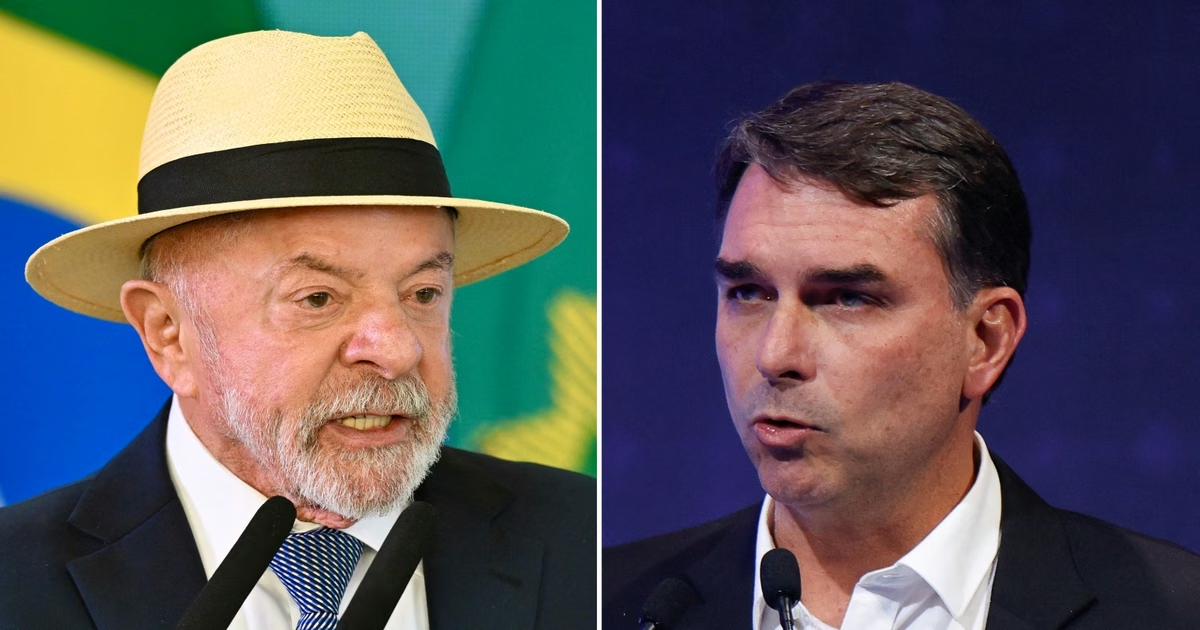
If no candidate obtains more than 50% of the valid votes, the runoff would be held on October 25. In addition to the president and vice president, Brazilians will elect the members of the National Congress, 27 governors, vice governors and legislative assemblies of all federative units and the district council of Fernando de Noronha.
In the case of Parliament, 513 deputies and two-thirds of the Senate will be elected: 54 out of 81 senators. There are 13 presidential candidates in the race, but polls focus the process on the leftist president Luiz Inácio Lula da Silva (Workers’ Party), 80 years old and who aspires for a fourth term, and the right-wing senator Flávio Bolsonaro (Liberal Party), 45 years old and son of former president Jair Bolsonaro.
Carlos Torres Jiménez, Costa Rican analyst and researcher, tells DIARIO LAS AMERICAS that the Brazilian electoral process is marked “by a polarization between the left and the right, where the candidates who lead the polls have diametrically different visions of their country.”
In that sense, he highlights that this occurs as in the last four major elections in the region: Chile, Peru and Colombia. He adds that it is a broad and complex election, “the biggest election in America, after that of the United States.”
He points out that there are also a number of particular populations that have their special vote, as is the case of indigenous groups. The analyst highlights that Brazil is the sixth largest economy in the world, the second largest in the Americas, an industrial giant and China’s main trading partner in the Americas. He considers that there will be a closed election, similar to that of 2022. found in other positions, in third parties and other places,” he indicates.
Jesús Mazzei, Venezuelan political scientist and diplomat, indicates to DIARIO LAS AMERICAS that “There is a high polarization and a great fragmentation of the Brazilian political spectrum. This fragmentation will most likely be reduced for the second round.” Mazzei asserts that, for the first round, according to surveys such as Datafolha and Quaest, the electoral preferences are headed by Lula. According to Datafolha, the current president has 38% of the electoral preferences. Meanwhile, Bolsonaro appears with 33%.
In the case of the writer Augusto Cury (Avante Centrist Party), he is in third place with 8%.
Mazzei explains that, so far, Lula Da Silva has the first option, but the second option is full of many imponderables. “If Flávio Bolsonaro gets a good vote in the first round, he would be like the absolute leader of the opposition. Yes, with an architecture and a political negotiation he achieves the agreement of other political leaders who are aspiring, he can nuclearize the entire opposition before him,” he points out.
Political geography
Political scientist Jesús Mazzei expresses that the Brazilian electoral political geography is divided. “For example, the opposition has a strong hold in the southeastern region, which includes the states of Rio de Janeiro, Sao Paulo and Rio Grande do Sul, among others.”
He agrees with Carlos Torres Jiménez that the Brazilian elections will be defined by a narrow margin. At this point, he highlights that The Brazilian electoral system “is very transparent, very credible, very efficient, very impartial. And it has shown it historically throughout all the elections, after democratization since 1985.”
Torres Jiménez says that, according to polls, the northeast, southeast and central west of Brazil are where Lula has the greatest base. In the south, and paradoxically the north of Brazil, Bolsonaro is taking the biggest lead. “Both the north and the southeast have the highest number of votes with third party candidates,” he adds.
On the other hand, Mazzei highlights that, in Brazilian society, especially with the presidency of the leftist Dilma Rousseff (2011-2016), a very anti-Worker’s Party sentiment was consolidated from an electoral point of view. “This also explains Jair Bolsonaro’s victory in the elections in which he defeated Fernando Haddad in 2018 by a significant margin,” he adds.
In 2022, Lula obtained 50.84% of the votes against 49.16% for Jair Bolsonaro. The leftist returned to power then, after being president for eight years, being in prison for corruption and after his conviction was annulled. Jair Bolsonaro He was sentenced, in September 2025, to 27 years and 3 months in prison after being accused of participating in an attempted coup d’état, after the presidential elections. He is currently under house arrest.
Campaign in Brazil
Researcher Carlos Torres Jiménez maintains that, in the two central issues of the electoral campaign, the fight against organized crime and violence, Lula and Flávio Bolsonaro appear tied so far or the right-wing candidate has two or three points ahead.
“I think it is a choice that It will be decided particularly by what issue brings voters to the table. If the issues are security and violence, Bolsonaro has a very good chance, suddenly, not only of reaching the second round, but of possibly winning it,” he asserts.
He believes that, if the economic agenda and the country’s image at an international level are imposed, Lula should win. The analyst indicates that Lula da Silva talks about a healthy economy, he talks about fiscal responsibility, foreign investment, an independent Brazil in the world, a Brazil that has been fighting against poverty and inequality.
“What is Bolsonaro selling? A country that seeks to be more in line with conservative values, family values and so on, talks about a freer economy, speaks of greater integration and closeness to the United States, but it speaks more to the central issue that has been vital for almost all Latin American countries and that is the issue of insecurity and violence,” he points out.
“Candidate Bolsonaro talks a lot about the Bukele model and also the Maga model of the United States, basically less controls, greater freedom,” says Torres Jiménez.
Lula and Flávio Bolsonaro sought to capitalize on Brazil’s Independence Day, September 7. The current president led the traditional civic-military parade, in Brasilia, to celebrate 204 years of independence from the Portuguese Crown.
For his part, the son of the former president gathered around 28,500 followers on Avenida Paulista in Sao Paulo. From there he linked Lula with Judge Alexandre de Moraes, who conducted the trial that put his father in jail, and is currently facing a scandal for his closeness to Daniel Vorcaro, an imprisoned banker. “First, out with Lula, out with Moraes!” said Bolsonaro. He promised to “rescue the credibility” of Brazilian justice.
Foreign policy
For the first time in this election, the issue of Brazilian foreign policy is debated, says Jesús Mazzei. In the last week, Lula stressed: “No foreign ruler has the right to tell us who we can buy and who we can sell.” This is in reference to the tariffs imposed by the United States on a large part of Brazilian products.
Furthermore, the motto of the Independence Day parade was “Sovereignty, the force that unites Brazil.”
US President Donald Trump said in June that Brazil “has become a country that is a bit harsh, a bit dangerous politically.” In May, after receiving Lula in Washington, the Republican president met with Flávio Bolsonaro. He described the senator as an “intelligent young man who loves his country.”
“During his first presidency, Trump had very good relations with Jair Bolsonaro. They have great political harmony, they converge on a vision of this new right movement, the social sectors that support them,” says Mazzei.
It also highlights that the Brazilian elections will be one month after the midterm elections in the United States. “Of course they are not going to influence the electoral result of the United States, but these US elections could eventually indirectly influence the Brazilian second round,” he says.
He adds that, If Flávio Bolsonaro wins, the liberal conservative axis would be consolidated, a very consolidated right-wing bloc in South America, fundamentally. “In Latin America, Mexico and Uruguay are the only two countries that are being governed by center-left parties, Morena and the Frente Amplio,” he recalls.
For his part, political scientist Carlos Torres Jiménez points out that, to date, Brazil does not seem to be as strongly influenced by Trump, as was the case with other elections in the region, and particularly mentions the case of Honduras.
“And why is that? Because Flavio Bolsonaro has committed several important sins during the electoral race. The first is to go against the payment system that Brazilians adore. Second, he has been involved in corruption scandals with bankers and others. And third, let’s say in one way or another, the Brazilian is proud, let’s say, of his independence and his greatness and does not look favorably on Trump’s intervention, let’s call it that,” he emphasizes.
@snederr
