
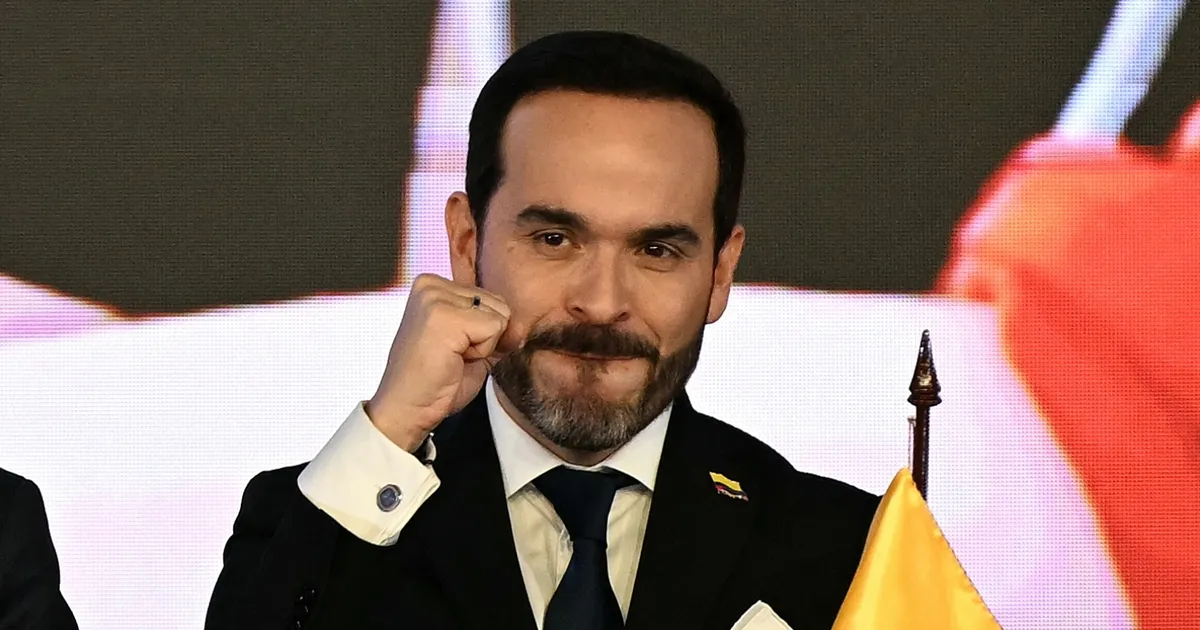
On stage, the refusal of President Gustavo Petro and Senator Iván Cepeda, former candidate of the leftist Historical Pact, to recognize the legitimacy of the elected president, the right-wing Abelardo De la Espriella, stands out.
Mario Hernán López, professor at the University of Caldas, points out that Colombians are attending “to a transition process practically unprecedented in the country’s recent history. “We are moving for the first time from a left-wing government to a right-wing government and in that sense what is happening in the transition process is part of the pulse that is now opening.”
López refers to DIARIO LAS AMERICAS that the current government has warned that it is not willing to overthrow the social reforms on which it worked, “former candidate Iván Cepeda has said the same and has called for a kind of civil resistance about the scope of which is profusely debated.”
He affirms that, on the other hand, in the decisions he has been making and in the speeches of the incoming government, a right-wing perspective is positioned in matters of public policies. The elected president promises to promote private investment in Colombia, reduce the State by 40% and toughen the fight against guerrillas and drug trafficking cartels.
“What we are seeing about whether the transition is made or not, if it continues to be a dispute over the media and social networks, prolongs in an unprecedented way, I insist, a political struggle in an unprecedented transitional process,” he maintains.
On July 7, De la Espriella ordered his team to “immediately” interrupt the joining process “with the corrupt government that is ending its term.” The lawyer denounced “handmade contracts” during the Petro administration that began in 2022.
“My duty is to protect the interests of the nation and guarantee a serious, transparent transition at the service of Colombians, never legitimize disaster or ignorance of order constitutional”, argued De la Espriella in X.
Later, the elected president of Colombia argued his reasons. “Do not ask me to be politically correct, I am not a politician, that is why I speak up front. You cannot make a connection with a government that ignores the incoming government. Petro, his heir and those who are supporting him are not democrats; from which Colombia was saved, thank God we defeated them. Petro and Cepeda do not know who they are facing; To defend order and the Constitution I will be forceful”he assured.
The 47-year-old lawyer won with 12,959,000 votes over Senator Iván Cepeda who obtained 12,708,000.
Call to the Armed Forces
Petro responded in
The leftist president insisted that “The response is active resistance and when the people decide, civil disobedience, It is almost totalitarian authoritarianism, due to the power so far achieved by Abelardo in the Cortes and Congress, that is coming. It is fascism that is coming and with fascism it is not treated, but rather defeated.”
De la Espriella pointed out that “There is no peaceful resistance when it comes to justifying a coup d’état.” He asked the Colombian Armed Forces to “fulfill their oath to protect the Constitution and democracy” and not follow orders contrary to the constitutional order.
Petro reiterated his statements: “We are not inventing when we say that Abelardo’s government was elected from abroad, with non-existent votes in the percentage automatically adjusted by algorithms made by private Israeli companies with the endorsement of his genocidal government, and processed by the company that I myself denounced.”
In the midst of the questions, the current president assured that he is leaving the Colombian government “with less assets than I had when I entered and with my accounts blocked and I cannot make any financial transaction by order of the US government, apparently, without President Donald Trump knowing.”
However, for the elected president the situation is clear. “I did not agree to meet with Petro, everything about him is falsehood and nonsense. You should not temporize with the enemies of the country; as I said during the campaign I came to confront, defeat and punish that guy. I have already served the first two parts of those sentences. “He knows I will make him pay before the law for his crimes.”
In the midst of the confrontation, Abelardo De la Espriella pointed out that the complaints about alleged fraud in the June 21 runoff are part of a strategy to generate destabilization.
“This narrative of alleged fraud is the excuse to set the country on fire. I will be a ‘tiger’ defending Colombia from the coup plotters; Let no one doubt it,” he said.
Message to the bases
Germán Sahid, professor at the Universidad del Rosario in Colombia, tells DIARIO LAS AMERICAS that the threat of a lack of recognition of the elections had been minimized, since both President Petro and Senator Cepeda had “reluctantly” recognized the electoral results.
He also adds that, suddenly, the issue was reactivated first by the president and then by Cepeda, with a more conceptual, political, ideological and legal construction.
“It seems that “Cepeda and Petro are speaking to their social bases,” he states.
Sahid highlights that there is widespread discomfort from social organizations, those of certain indigenous people, those of Afros and, above all, many urban groups that felt betrayed.
“Many of these social organizations are highly ideologized and quite undemocratic. And they, let’s say in their local, regional, neighborhood plans, felt that they had, at this moment, to take advantage of the victory of Abelardo De la Espriella, and especially by the narrow margin rather than the victory, they wanted to create a kind of insurrectional environment,” he maintains.
He believes that these highly ideologized structures “needed to create the social mass movement, of disorder, of social outbreak, to make Abelard’s government unlivable. Finally, the objective of these political-social structures is to change the political-economic model of Colombia, that is, to change the Constitution. They need to push for what they call national popular constituent assemblies.”
The analyst points out that, in Colombia, there was never really consensus to change the 1991 Constitution.
In his opinion, Petro and Cepeda “are setting the political-social-communicational environment in these next five years.”
He highlights that the Colombian president does not relinquish his leadership “and almost conditions Cepeda that the leader is Petro and that he is simply going to be his articulating figure in the Senate and in the territories.”
Cepeda said that civil disobedience is subject to four conditions: that Abelardo De la Espriella renounces his US nationality, that he clarify whether he is a collaborator or member of US security agencies; that respects national security and judicial sovereignty; the cessation of “all persecution” against Petro, against political opponents and to stop “encouraging his judicialization by the US Department of Justice.”
“When the law, institutions or authority come into conflict with moral conscience, the citizen not only has the right, but the duty to resist peacefully, refusing to collaborate with injustice, disgrace and oppression. That is what we will do, let there be no doubt “if De la Espriella takes the path of violating our national dignity”indicated the defeated senator on July 3.
Professor Sahid highlights that Cepeda’s conditions have nothing to do with Colombian laws: “They need to create a kind of alternative institutionality or re-signify the laws to remain in force. They have no real legal arguments to ignore the elections.”
At this point, he explains, within a year and a half in Colombia there will be regional elections. “So, they want to keep social organizations mobilized while awaiting local results. They seek to maintain Cepeda’s brand in mayors and governorships,” he points out.
Proposal without support
The president of the Supreme Court of Justice of Colombia, Iván Mauricio Lenis, indicated on July 6 that he finds no support for the use of the figure of civil disobedience.
“Civil disobedience is so that the constitutional order is complied with, so that the rules or guidelines that are in the Constitution are complied with. And until now I “I do not see any circumstance of aspects of the regulation that are being breached or that motivate action”explained the magistrate.
He pointed out that, until now, what is perceived is a demonstration of civil disobedience.
In this sense, Lenis maintained that this matter becomes a political aspect.
For his part, Rodrigo Lara, appointed Minister of the Interior of the upcoming Government of Abelardo De la Espriella, stressed that civil disobedience is a euphemism to transfer political confrontation from institutions to the streets.
“We already know that this means ‘front lines’ and dissident blockades of total peace. Colombians can rest assured that the new government will enforce the Constitution and the law. It will never allow violence, blockades or intimidation to once again be imposed on the daily lives of citizens,” he assured.
@snederr
