
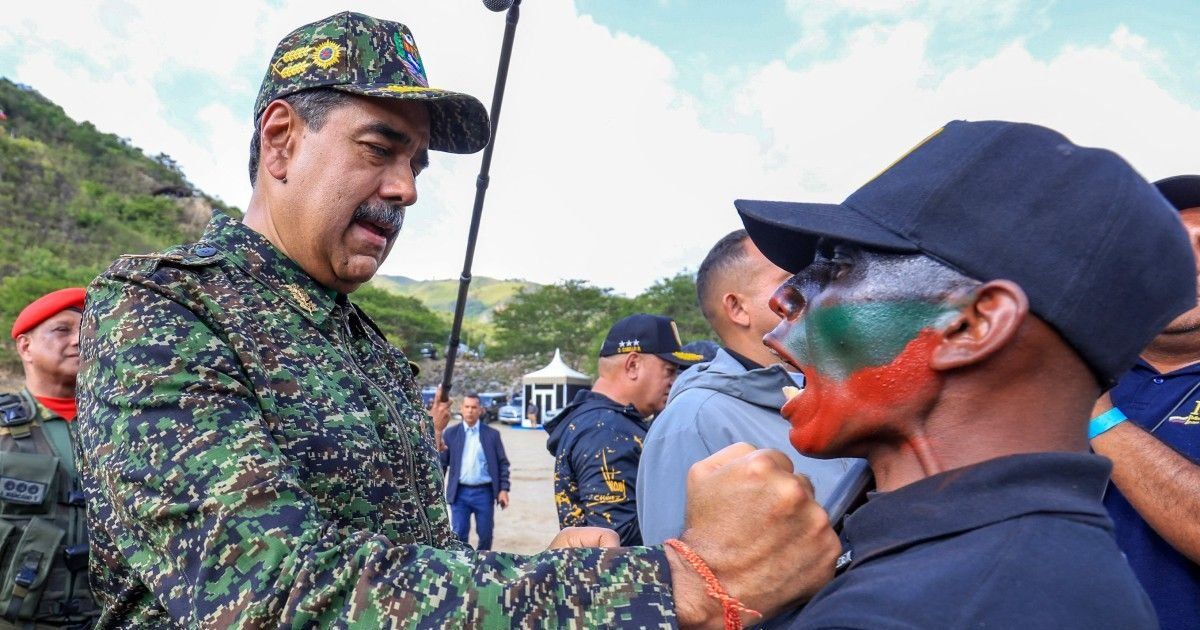
The threat of dictator Nicolás Maduro to activate a state of shock in Venezuela In response to the United States naval siege in the Caribbean for the so -called Los Soles poster, it opens a new chapter of political and social uncertainty. Although it has not been applied in more than two decades of Chavismo, its mere mention suggests the intention of the regime to shield itself at the expense of greater restrictions on citizen rights.
“An external statement is an exceptional measure provided for in article 338 of the Constitution of Venezuela that allows the Executive to suspend constitutional guarantees when the country faces a serious external threat. It is decreed for up to 90 days (extendable) and grants the Executive extraordinary powers to act in defense of the nation, including military mobilization, media control and restrictions on civil rights,” he said in contact with Las Américas Diario The constitutional lawyer Carlos Sarmiento Sosa.
The expert analyzed the current situation and pointed out that “in case a state of external shock was decreed in response to US actions in the Caribbean in combat against drug trafficking, it is difficult to predict because it would be to advance hypotheses without sufficient foundation. However, once decreed, internally it could be used to further concentrate the power in the executive power, in the expense powers ”.
And the most delicate, he added, is that the expert is that “under the pretext of an external threat, the persecution of civil and military opponents considered uncomfortable could be increased, as some analysts have warned. From the point of view of the effects for the outside, the geopolitical tension could increase and justify preventive military actions of the US military forces in the Caribbean.”
For his part, also the constitutionalist lawyer Nelson Chitty put the focus on the institutional erosion that the South American country is experiencing.
“In Venezuela, if we are serious, we will say that the Constitution is not met. Venezuela lives the time of deconstitutionalization, of derepublicanization, of deinstitutionalization and of the distrust, which in simple terms tell you that in Venezuela it is used and abuses the ways of fact.”
Chitty also alerted the specific risks for citizens if the dictatorship activates the state of shock.
“He (Maduro), as de facto president can decree, he can instruct forced constriction. What does that mean? Well, it is to go out. That recruit of other times can advance it. It can even make the wages of legal persons (…).”
The voices of Sarmiento Sosa and Chitty coincide at a key point: although the state of external shock is provided for in the Constitution, its application in this scenario could be the perfect excuse for a new cycle of concentration of power, political persecution and greater international isolation.
