
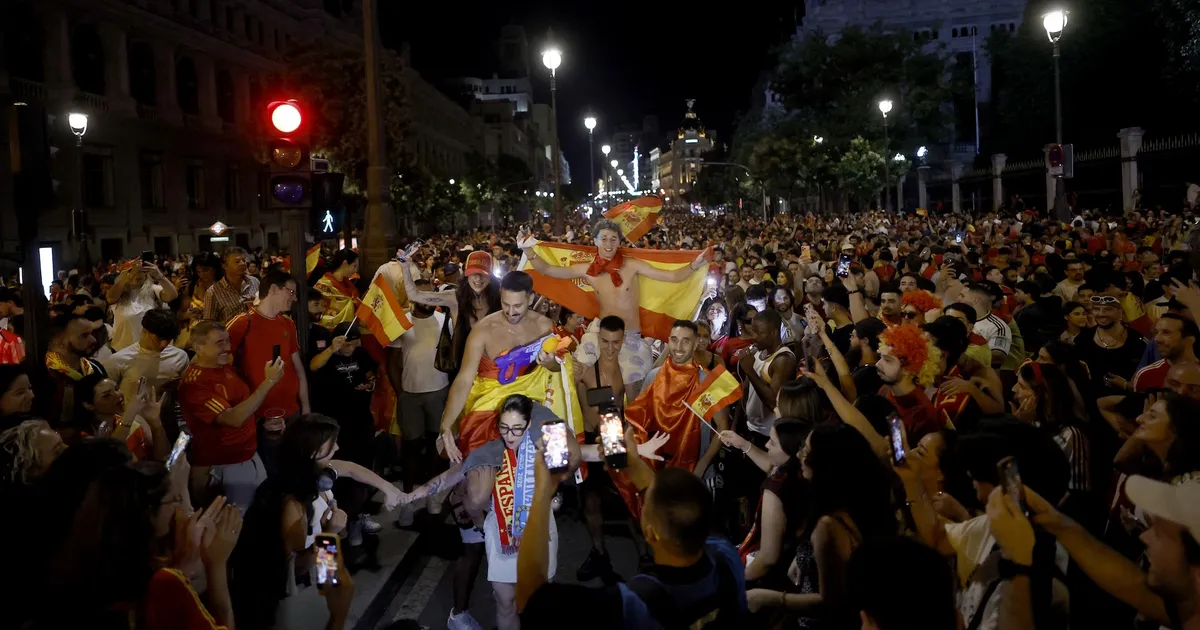
Madrid.- The beer cans, broken glasses and plastic bags on the streets of Madrid remind us of the great party that took place, but the cleaning services are hurrying to leave the city pristine for the arrival of the champions.
“Honestly, I’m very tired, because yesterday, with the whole issue of the extension and all this, in the end you go to bed on a Sunday at half past one, two, then if you go to Colón to celebrate, it’s already three in the morning, you sleep for four hours… and now to work,” says Bruno González del Yerro on Monday morning.
The fatigue is evident in this 32-year-old young man whose formula to survive is “the adrenaline of the game” and “coffee, a lot of coffee.”
He waits impatiently for the end of his morning meeting to have “a coffee with his colleagues” and thus “comment a little on the play, because in the office they are also quite fond of football.”
“I have a lot of circles under my eyes. I slept for four hours, nothing more! I went to bed at 4 in the morning and now I have to go to work,” says Catalina Sánchez, a 64-year-old secretary who spent the night celebrating with her daughters, with a smile.
And the biggest challenge for many Spaniards this Monday will be to endure the work day.
“This thing about winning a World Cup final and having to work the next day is a bit tough, huh? The truth is that they could have held the final on a Saturday, right? It would be better for the people who have to work the next day,” says Paco Penadés, a 43-year-old civil servant.
Aphonia and dark circles
The students Tomás Hernanz and Martín Peña, 18, are also hoarse.
After a long night of partying, Tomás has the Spanish flag tied on his back, and neither of the two friends wants to go to sleep yet because “it’s something that happens every four years” and “few teams have had the opportunity to win this trophy.”
The plan of these young people is to “spend the whole day in Madrid”, and enjoy “a feeling that we want to experience now and we are not going to regret it.”
The Spanish team will parade through the center of the capital this Monday, with a route to the Cibeles fountain, where the town hall is located and the usual venue for Real Madrid celebrations.
The installation of a stage has been planned where a ceremony will take place to celebrate the title won by La Roja.
“As soon as I can, I will be prepared to receive our champions,” says José Márquez, a 37-year-old soldier who works “right next door.”
He also tries to hide his tiredness: “At 2 o’clock I went to bed so I’m a little sleepy, but it’s worth it.”
In the streets of Madrid, the cheeks of some fans are still painted red and yellow, while other pedestrians go to their jobs wearing the team’s shirt.
Spain’s victory against Argentina in the final of the 2026 World Cup, sixteen years after La Roja’s first World Cup, gave rise to an explosion of happiness in every corner of the country: horns, horns, fireworks, screams. The entire country jumped in unison after the final whistle and the party lasted for several hours.
Celebrations that were tinged with tragedy by the death of a teenager in Ciudad Rodrigo, in the west of the country, after the collapse of a fountain on which several spectators had climbed and which collapsed due to its weight.
