
Coalition bipartisan
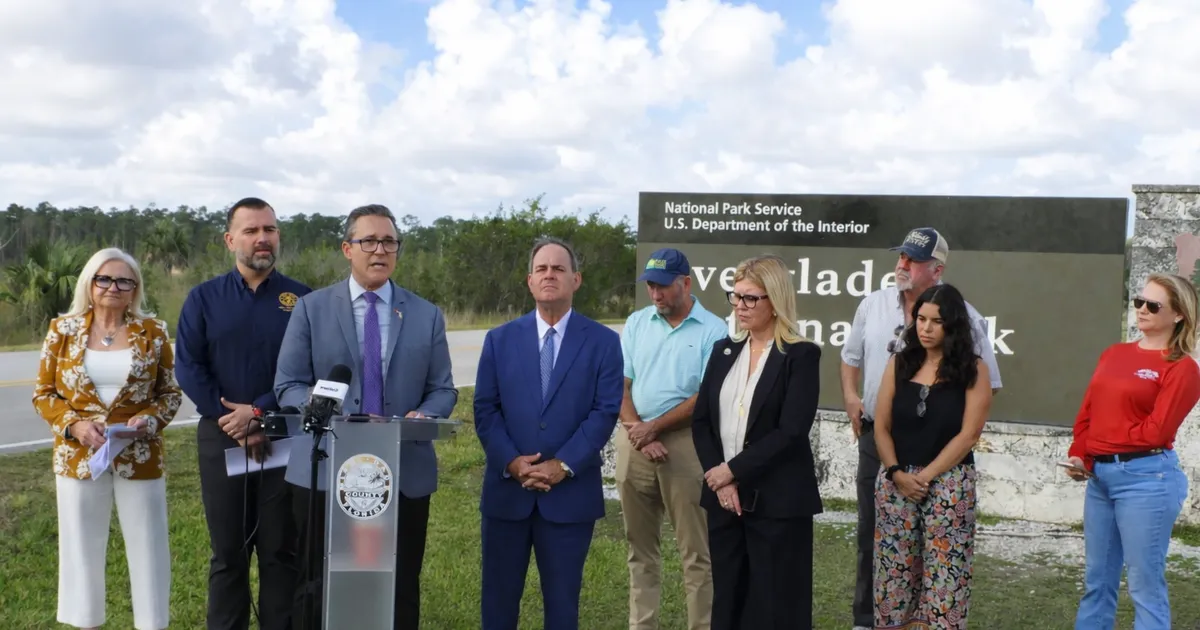
During a press conference held on Monday, March 9 in front of the Everglades, the third largest national park in the US, García, who also acts as the governor’s appointee on the Everglades Restoration Task Force, brought together mayors, commissioners, environmental organizations and agricultural representatives to warn about the risks of the legislation recently passed in Tallahassee.
“The legislature has the right to propose laws, but we also have the right to respond,” García said when addressing his concern.
Senator Garcia explained that the Urban Development Boundary (UDB) was created to concentrate urban growth in already developed areas and protect agricultural lands and wetlands surrounding the Everglades.
According to District 13 commissioner, the change proposed by state legislation could weaken one of the most important mechanisms to control urban expansion.
By that is clue for he south of Florida
He UDB is an imaginary line of approximately 80 miles that separates the urban areas of Miami-Dade County from agricultural areas, water reserves and the Everglades.
It was established by the Commission in the 1970s, with the purpose of curbing urban sprawl, protecting drinking water supplies, preserving agricultural lands, and safeguarding Everglades ecosystems.
Currently, to move that line and authorize construction, a supermajority is required on the Commission, precisely because these are environmentally sensitive lands.
García warned that the new legislation seeks to reduce that requirement to a simple majority, which would facilitate changes in the limit.
“That could mean that moving the line requires just a few votes,” he warned.
The commissioner also noted that urban sprawl would put pressure on public infrastructure. “More expansion means more roads, more water and sewer systems, more police and fire services and, ultimately, more taxes for taxpayers,” he said.
Leaders premises they ask preserve he control
Homestead Mayor Steve Losner, present at the press conference after welcoming the “Deep South,” maintained that the debate goes far beyond protecting water.
“We are facing the Everglades, but this is not just about the water; it is about our quality of life, our diverse economy and the open spaces that make South Florida special,” he said.
He complained about Tallahassee’s influence. “In recent years, they have continued to attack our local sovereignty. And this bill, these measures, if passed, will radically change our way of life and the image of South Dade and the entire South Florida region.”
Losner warned that allowing development to the edge of the national park would change the landscape of the region.
When referring to the potential impact of the legislation, he evoked the well-known children’s story in which “the sky is going to fall and the king must know,” a metaphor with which he urged that the governor be informed about the seriousness of the problem.
He water potable and he can local
Palmetto Bay Mayor Karyn Cunningham stressed that the Everglades represents much more than a landscape.
“This is not just a backdrop for South Florida; it is the lifeblood of the state,” he said.
Cunningham highlighted that the ecosystem is essential for water security, since the water that filters into the natural system feeds the aquifer that supplies millions of people.
He also defended that decisions about urban growth should remain in the hands of local communities, who are the ones who know the needs of their territory.
A forehead common from Miami beach until homestead
“Many of you may be wondering, why is a Miami Beach commissioner concerned about what is happening with the UDB when we are an hour away from Miami Beach? Why is this commissioner concerned? Because we have seen a disturbing pattern in our legislature: every year, they undermine the rights of our residents and the rights of local government,” said the Miami Beach commissioner. Alex Fernandez who He explained that the concern is not limited to the south county cities.
“When officials from places as different as Miami Beach, Hialeah, Palmetto Bay and Homestead agree on an issue, it shows there is a serious problem,” he said.
Fernández highlighted that both the Everglades and the Art Deco historic district of Miami Beach are part of the economic and tourist heritage of the region and maintained that the Tallahassee sessions “want to become local zoning boards, depriving our residents of their voice and their local decision-making capacity.”
“We are not Disney. These communities are places where people live and we must protect them,” he said.
Agriculture, water and economy also in risk
Representatives from the agricultural and environmental sectors also participated in the conference.
Peter Shepley, of the Miami-Dade Farm Bureau, warned that the agricultural lands in the south of the county constitute a unique resource in the United States.
“Once we lose those lands, we will never get them back,” he said.
For her part, Mariana Aziz, from Miami Waterkeeper, recalled that the ecosystem allows rainwater to filter into the aquifer.
“More than three million people depend on this natural system for their drinking water,” he noted.
Aziz added that upsetting that balance could also affect the regional economy, including Biscayne Bay, which generates billions of dollars in economic activity.
“Preventing the paving of this important land allows rainwater to seep into the aquifer and provide us with drinking water. More than three million people depend on this delicate ecosystem. Therefore, trying to move the UDB, trying to pave over a paradise, is a great threat to the way of life in South Florida,” the specialist warned.
“It is estimated that Biscayne Bay generates more than sixty-four billion dollars in economic gains. All of this can be lost if we upset this subtle balance by preventing stormwater from seeping into our aquifer and providing us with drinking water, if we allow stormwater runoff to reach our cities and pollute our Bay.”
They question he argument of the dwelling affordable
Maribel Balbin of the Hold the Line coalition rejected the argument that expanding development beyond the UDB would solve the housing crisis.
“This is not about affordable housing; it is about increasing profit margins and shifting the costs of urban expansion to taxpayers,” he said.
Balbin explained that development in new areas requires expensive infrastructure, from roads to utilities, which residents often end up paying for.
That proposes he project of law H.B. 399
HB 399, sponsored by State Representative David Borrero, is part of a legislative package on land use and development regulations.
Among other provisions, the legislation seeks to modify certain approval processes for urban projects, establish new rules for permits and development exceptions, facilitate the construction of certain types of housing and order a study on whether counties can protect the environment without limits like the UDB.
One of the most controversial points is that it could allow the urban development limit to be modified with a simple majority, instead of the supermajority currently required.
Flexibility of the UDB
Developers and some legislators maintain that the urban boundary artificially restricts the availability of buildable land.
According to this argument, the price of land within the developable area has exceeded one million dollars per acre, which makes housing construction more expensive.
Allowing development outside the boundary, they say, would increase the supply of land and help reduce housing costs.
In this context, García highlighted that real estate developers such as Armando Codina and Jorge Pérez have written opinion articles opposing this legislation. “So it’s not just the environmentalists, the farmers, the politicians who are opposed. It’s a broad coalition of people who have a vested interest not only in their financial success, but also in the success of this community by preserving these lands.”
Called to the governor
The participants in the press conference agreed to ask Governor DeSantis to intervene with his veto if the project passes the entire legislative process and is approved in the Senate.
“This is not being against growth,” García concluded. “It’s about growing responsibly, protecting our farmland and our Everglades.”
(email protected)
