
Woman versus woman. Two old women prepare to perform an improvised play without a name, but with a script already written for years. The one who remains standing maintains a better physical appearance, although she does not dare to touch the other who is in a wheelchair. Her name is Ana Belén, the famous Spanish singer and actress who, during her long career, brought millions of viewers to her feet and now, retired, seeks the cameras again without apparent need.
The other old woman is Maricarmen Abascal, an anonymous being whose eviction from a rental home has gone around the world in images. Both would not have met if it had not been for the eviction, prepared in detail by the Socialist International, which, dying, needs oxygen.
Alberti revived
The artist begins to recite a work by none other than Rafael Alberti, the communist poet who, from exile, returned to Spain during the transition to die in his native Andalusia at the age of 96, a luxury that we exiles from communism have not been able to afford.
-Do you know what the poem is called? asks Ana Belén.
Maricarmen, 87 years old, remains silent. Even if I knew the name of the poem, I would have to wait for the artist herself to respond.
-“Eviction”-, Ana Belén finally says, after a silence also scheduled, which, in the libretto, corresponds to the choir, that is, to the Union of Tenants of Madrid.
The scene is pathetic. Maricarmen is a former civil servant who has enjoyed a rented apartment in Retiro, one of the most desirable neighborhoods in the Spanish capital, almost all her life.
His parents arrived at that apartment in 1956, with a rent that later became “old” without being modified. But Maricarmen doesn’t care about that story. She has joined the dramaturgy that places her as the protagonist of a great scene, where she shares the bill with Ana Belén.
You can die in peace now.
In the eye of the hurricane overnight
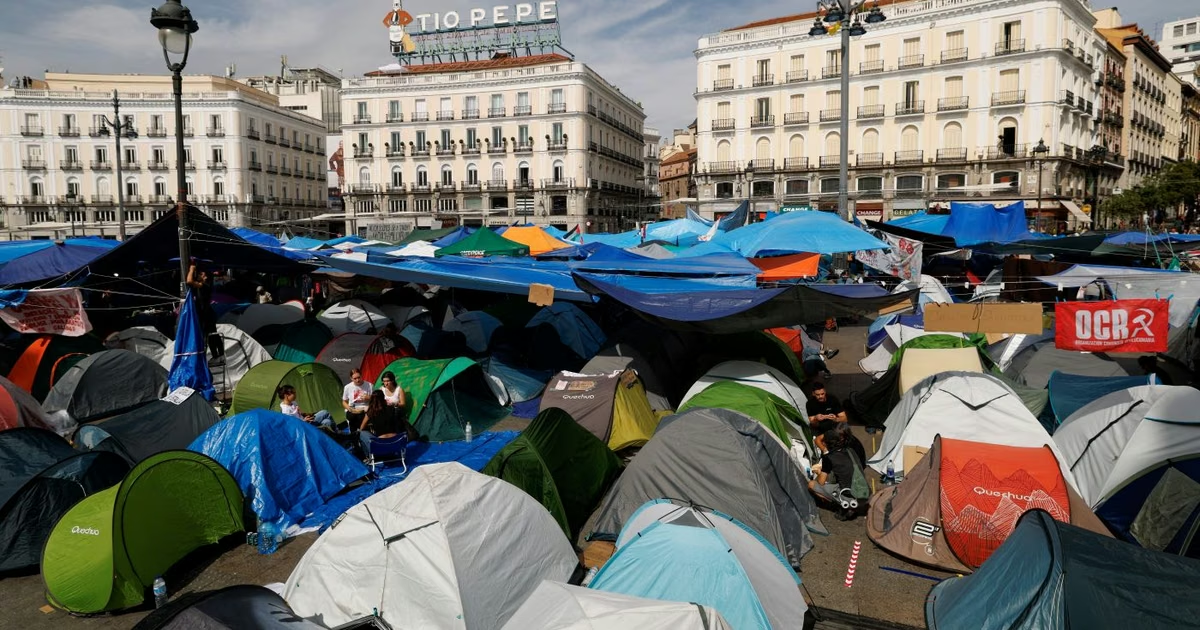
A few hours later, the pathetic scene takes effect. More than a thousand people, including “anti-systems”, “squatters” and unionists, take over Puerta del Sol supposedly in the name of Maricarmen. They set up tents, carry musical instruments, communist slogans and flasks of alcohol. The Madrid City Council relents and, together with Urbagestion, the family business that bought the apartment where Maricarmen lived, announces an agreement for the elderly woman to return to “her home.”
In the midst of the fight, the owners of Urba Gestión and, therefore, owners of the apartment, report cyberbullying and the sending of several boxes with cockroaches to their offices. They were as anonymous as Maricarmen and found themselves in the eye of the hurricane overnight. They understand that it is not in their best interest to fight and they allow Maricarmen to return with the same conditions she had: a ridiculous rent and at least eight years without being stripped of her rent ceiling.
Although the eviction was carried out after a Supreme Court ruling in their favor, Urba Gestión prefers to assume the humiliation of losing an apartment, the only one they have, located in an exclusive neighborhood.
The result is scary. It was the first warning and they have seen how far “the masses” can go when they accuse them, without evidence, of managing an investment fund, with the terrifying nickname of “vulture.”
An overlooked suicide
Meanwhile, the Executive headed by Pedro Sánchez is working on some decrees that aim to from now on control the housing stock at the national levelboth for purchase and rental. Sánchez has not been able to put into practice what must be done in the face of the very high demand for housing: free up public land, remove bureaucratic obstacles to building apartments and let the market regulate itself.
Sánchez has seen a huge vein in Maricarmen that he could not miss. She is an elderly woman who would be pitied, unlike Olga Matute, the 54-year-old woman with two daughters who, at the beginning of this month of September, took her own life after being evicted in Barcelona.
Perhaps, both Ana Belén and Maricarmen know that what happens in Catalonia cannot be touched, so as not to upset Sánchez’s government partners. It is striking that neither Ana Belén nor Maricarmen mentioned Olga in that pathetic scene at street level.
Guillén, the Caribbean Alberti
At the end of last year, Ana Belén confessed to journalist Jordi Évole what the worst moment of her life was: “It was a screwed time. Everything we gained we lost,” she said about a family business built together with her husband, Víctor Manuel, who was dedicated to producing audiovisuals.
But the capitalist system, the one she detests, allowed her to rise to new levels thanks to her talent.
The La Sexta network interview takes place in a beautiful Mediterranean villa, landscaped and well-preserved, with a taste that, let’s say, is “period” that emphasizes the minimalist sense of an aesthetic, not what lies behind it.
Ana Belén was already back in that interview. He had crossed the Atlantic countless times to sing the musical verses of Nicolás Guillén, the Caribbean Rafael Alberti, the communist and mulatto poet who served as Castro’s alibi for many years. It’s not that they tell me about it, it’s that I saw it with my own eyes in the gardens of the National Union of Writers and Artists of Cuba (UNEAC) in those “glorious” days, when dissidence rotted in prisons and there was no internet to denounce it.
In a very intimate moment of the interview, Ana Belén tells Jordi Évole: “The left has never taken anything from me,” and that is when our hearts stop. Out of rage, of course.
(email protected)
