
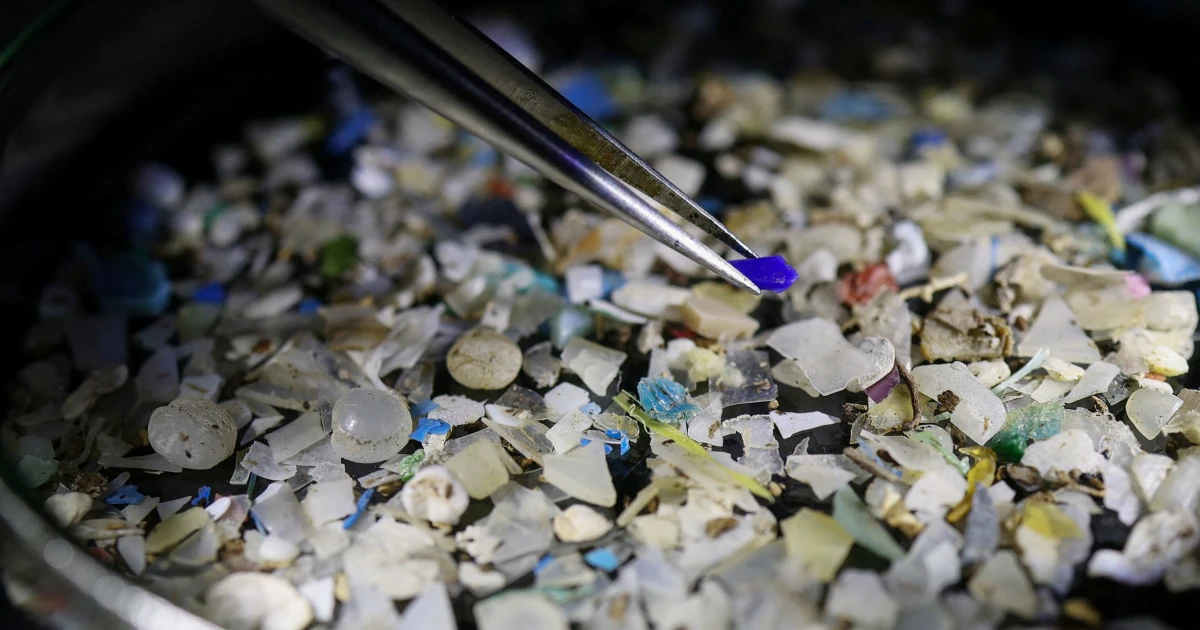
In a new study, researchers found microplastics inside prostate cancer tumors, raising new questions about the role of these ubiquitous contaminants in public health.
The findings, from a small study of 10 men, were presented Monday at the American Society of Clinical Oncology’s Symposium on Genitourinary Cancers and have not yet been published in a peer-reviewed journal.
In the study, researchers analyzed tissue samples taken from 10 men with prostate cancer, average age 65, whose prostate had been removed as part of their treatment for the disease. They also analyzed noncancerous tissue taken from the opposite side of the organ.
Microplastics were found in 90% of tumors and 70% of non-cancerous samples. Cancerous tissue contained, on average, 2.5 times more plastic than non-cancerous tissue, with approximately 40 micrograms of plastic per gram of tissue.
Stacy Loeb, lead author of the study and a urologist at NYU Langone Health, said the higher concentrations in the tumor tissue “were very surprising and concerning.”
This “raised questions about its possible association with the development of prostate cancer,” he added. “So, we will definitely continue to study this with more cases.”
(Researchers explain how easily microplastics leach into the food we eat)
Michael Eisenberg, a professor of urology at Stanford University School of Medicine, who was not involved in the study, said the new research does not establish a cause-and-effect relationship.
However, “we are finding many signals about the astonishing prevalence of micro/nanoplastics and the worrying associations with health problems,” he wrote in an email. “We need more data to understand the implications of these findings.”
This is not the first study to find microplastics in prostate cancer tumors. A 2024 study published in The Lancet by Chinese researchers also found higher levels of plastics in tumors compared to surrounding tissue.
Loeb said the new study used more precise techniques to measure the different plastics present in the samples. The researchers also took extensive measures to avoid contamination that could have skewed the results.
The ubiquity of plastic makes it difficult to study the presence of microplastics in human tissue: was the plastic actually found in the body or was it introduced through the plastic used in the research?
Previous studies that have identified microplastics in postmortem brain tissue and carotid artery plaques have been criticized for their methodology, including suggestions that the measurements could have been influenced by laboratory contamination.
(Planet Earth: The return of plastic absorbents by Trump’s decision worries many)
With this in mind, Loeb explained, extra strict precautions were taken in their study, which required a year of planning. When performing the surgical removal of the prostate, he explained, plastic was removed from the operating room as much as possible and the team deliberately took contamination into account in their analyses.
“I would say that, if anything, this might have been too conservative, since the samples we took were from deep in the prostate, so it’s not clear how much he might have touched them,” Loeb said. “The tumor and the benign tissue samples came from the same patient and were handled exactly the same, so the fact that we observed a high concentration of plastics in the tumor cannot be easily explained by contamination.”
Andrea Viale, an associate professor in the department of genomic medicine at MD Anderson Cancer Center in Houston, said that while the results do not establish a causal relationship between microplastics and prostate cancer, they show that this should be taken seriously as a possible theory for increased rates of advanced disease.
About 1 in 8 men in the United States will be diagnosed with prostate cancer at some point in their lives, according to the American Cancer Society. Over the past decade, cases of late-stage disease have increased annually by 2.6% in men under 55 years of age, 6% in men 55 to 69 years of age, and 6.2% in men 70 years of age and older.
“The fact that it is being detected in tumors means that, from a public health perspective, this problem deserves very serious attention,” said Viale, who was not involved in the study. “We should start implementing strategies to limit exposure, since we do not know its real effect, but it is something that should not be present.”
According to Eisenberg, microplastics could be causing higher levels of oxidative damage to prostate cells, in addition to affecting immune function. Loeb said they could also be increasing inflammation in the tissue, as well as facilitating the transport of potentially carcinogenic chemicals such as phthalates and bisphenols to the prostate. Increased exposure to these chemicals, commonly found in plastic packaging, has previously been associated with prostate cancer.
(Black plastic used in kitchen utensils has potentially carcinogenic chemicals)
At the same time, determining whether plastic particles influence the development or progression of the disease will not be easy.
“The problem is that when you talk about plastic, there are dozens of polymers, shapes, sizes and geometries, and plastic contains dozens of different chemicals, additives, stabilizers, plasticizers, dyes and contaminants, so it is really difficult to understand their causal role,” Viale said. “It could have a physical function in the fabric or be related to the chemical composition of the plastic itself.”
Loeb and his colleagues have already obtained a grant from the Department of Defense, now known as the Department of War, for a larger study analyzing the amount of plastic in tissue samples from 30 prostate cancer patients, as well as evaluating whether there is a relationship between the amount of plastic and the degree of inflammation in the tissue.
In future research, Loeb said he would also like to compare the prevalence of plastic in high-grade or aggressive prostate tumors with that in low-grade tumors. Likewise, it requests similar studies from other research groups in more patient populations to try to confirm this apparent relationship.
“In short, this study only provides preliminary data, so we are far from saying that this causes prostate cancer,” he said. “But I think more research is needed to determine if it is a possibility.”
