
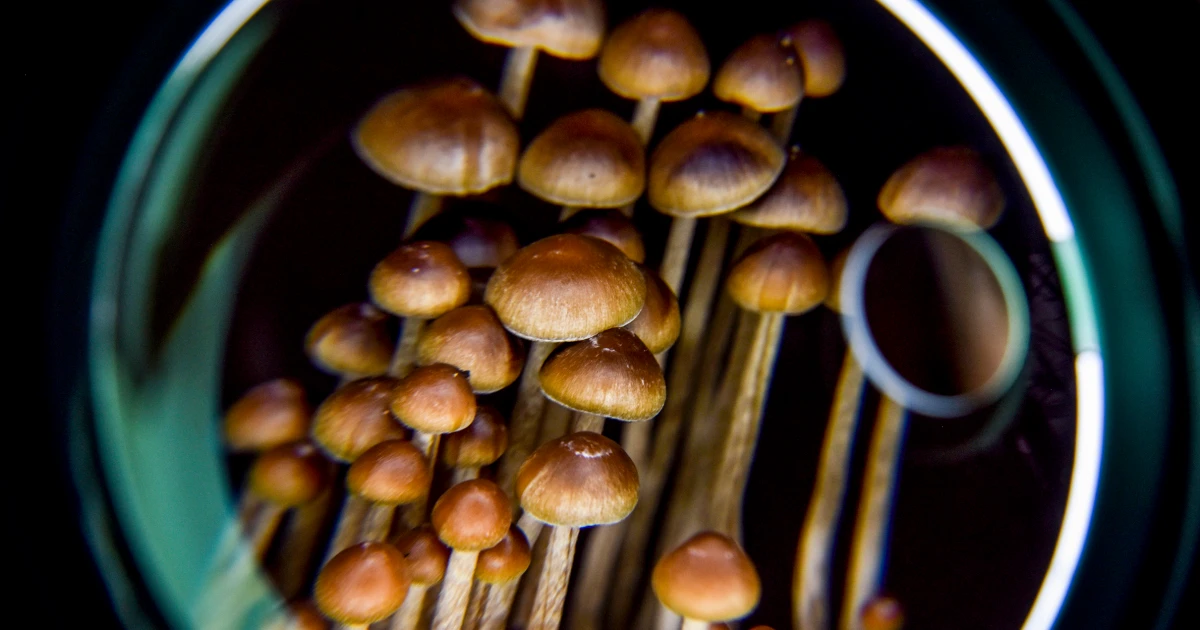
A single psychedelic trip could cause physical changes in the brain that may explain why some people report psychological benefits after the experience, a small study suggests.
The research, published Tuesday in the scientific journal Nature Communications, focused on psilocybin, the psychedelic compound found in hallucinogenic mushrooms. This substance has been the subject of numerous studies in humans, which have revealed that appears to relieve symptoms of depression and anxiety. It has also shown promising results in the medical field to treat addictions.
Exactly how it exerts these benefits is still being investigated.
This is a question that arouses growing scientific interest. Last month, President Donald Trump signed an executive order to accelerate research on psychedelics, specifically psilocybin and ibogaine — another psychedelic derived from the root bark of a plant native to the Congo rainforest. Following that order, the Food and Drug Administration (FDA) granted expedited review to two companies investigating the use of psilocybin to treat depression.
Researchers have generally divided into two groups: those who hypothesize that psychedelic trips are critical to any benefits—and brain changes—these substances produce, and those who believe the key lies in the specific compounds themselves, rather than the trips.
The new study supports the first position, suggesting thatThe intensity of the psychedelic experience does influence.
(Oregon allows legal consumption of psychedelic mushrooms: there is a lot of demand, high prices and hallucinatory experiences)
The research “revealed that the higher the psychological insight scores, the greater the improvements in therapeutic response,” said the study’s lead author, Robin Carhart-Harris, a professor of neurology at the University of California, San Francisco School of Medicine.
The study involved 28 people in London, average age 41, who had never before used psychedelics or been diagnosed with psychiatric disorders. All participants were given a 1-milligram dose of psilocybin—considered too low a dose to induce a trip—which served as a placebo dose in the study.
During the administration of this dose, Carhart-Harris and his team recorded the participants’ brain activity using an EEG (electroencephalogram). They then followed up with additional brain scans—including MRIs—over the next four weeks.
One month after the placebo dose, all participants received a 25-milligram dose. That dose is considered the industry standard for the therapy, and is the amount of psilocybin used by pharmaceutical companies seeking FDA approval for psilocybin-assisted therapy. (The psilocybin used in the study was supplied by one of the companies that has been granted an expedited review process: Compass Pathways, based in the United Kingdom. Several of the study’s authors have worked as scientific advisors for companies researching psychedelics, including Compass.)
One hour, two hours, and one month after dosing, researchers monitored participants’ brain activity. Before treatment and a month later, participants also underwent a type of MRI called diffusion tensor imaging (DTI), to measure how water moves through neural fibers between different parts of the brain.
In some of the so-called “tracts” – the connecting pathways – between the prefrontal cortex (responsible for functions such as emotional regulation and impulse control) and the middle areas of the brain, water flow appeared to be reduced after treatment, suggesting possible structural changes in these areas.
(An experimental gene therapy eliminates alcohol addiction in monkeys and gives hope to millions of people around the world)
“The general public tends to interpret this as a restructuring of the brain’s neural pathways,” said Albert Garcia-Romeu, associate director of the Center for Research on Psychedelics and Consciousness at Johns Hopkins School of Medicine in Baltimore. “What they really found is that the way water moves along neuronal fibers seems to be modified.”
The findings of the new study—which, according to Garcia-Romeu, are more exploratory than definitive—“suggest that certain structural changes occur after exposure to the drug; however, some of these changes are not necessarily considered positivebut rather resemble those that would be observed in cases of TBI” (traumatic brain injury).
Experiencing a more intense psychedelic trip seemed to generate greater changes, the study revealed. While none of the participants reported experiencing a trip with the placebo dose, all but one reported significant alterations in their states of consciousness after receiving the 25 mg dose.
Those who described deeper journeys—experiences that were also correlated with greater brain activity during the journey—as well as greater lucidity or meaningful revelations in the days following those experiences, showed more pronounced changes in the movement of water through brain tracts a month after the treatment ended.
“We don’t really know what it means, but the tracts become denser,” Carhart-Harris said, adding that some of the changes her team documented are the opposite of what researchers see in the brains of people with neurodegenerative disorders, such as Alzheimer’s disease, when the tracts become more diffuse.
Although the primary goal of the study was to investigate brain changes, about 70% of participants reported experiencing greater well-being two and four weeks after receiving the 25 mg dose.
(A man allegedly high on magic mushrooms who attacked crew members on a flight is arrested)
“There is probably an important relationship between being in a profoundly altered state of consciousness and whether people report being able to modify their thinking patterns,” said Joshua Siegel, associate professor of psychiatry at NYU Langone Health.
Psychedelic experiences may disorganize the brain’s neurological pathways, giving them the opportunity to reorganize or break out of their usual routines once the effects of the substance wear off, Carhart-Harris said.
In recent years, scientists have become interested in better understanding how psychedelics might trigger such brain plasticity: the brain’s ability to restructure its neural connections.
Various studies have suggested that psychedelics increase the number of synapses—structures that facilitate communication between neurons—in those brain regions linked to emotional regulation and depression, explained Siegel, who is also a researcher at the NYU Center for Psychedelic Medicine.
“However, most of these findings come from research carried out in rodents. The big question still remains as to what meaning these results have in humans and whether or not they correlate with therapeutic effects,” he commented. Researchers must also use indirect measures, such as brain imaging, when working with humans, since, unlike in animal studies, they cannot dissect the human brain after the research is completed.
Although Carhart-Harris, Garcia-Romeu and Siegel agree that more research is required—and, in particular, larger studies—both to replicate the results obtained and to determine whether the observed brain changes actually exert a therapeutic effect, Garcia-Romeu highlighted that the study provides new and very welcome information.
(War veterans want the US to allow the use of psychedelic mushrooms to treat trauma and depression)
“This work allows us to advance our path toward understanding why these substances appear to have the potential to generate lasting effects in people,” he said.
Typically, when a person is given a drug, the sustained benefits do not last after the effect of the substance has worn off. However, in the case of psychedelics, users often report that the effects persist over time, whether manifested as changes in depression or anxiety levels, he explained.
“This offers us a clearer perspective on the ideal methodology to study this phenomenon in humans and, if its therapeutic efficacy is confirmed, it helps us understand the reason for it,” concluded Garcia-Romeu.
