
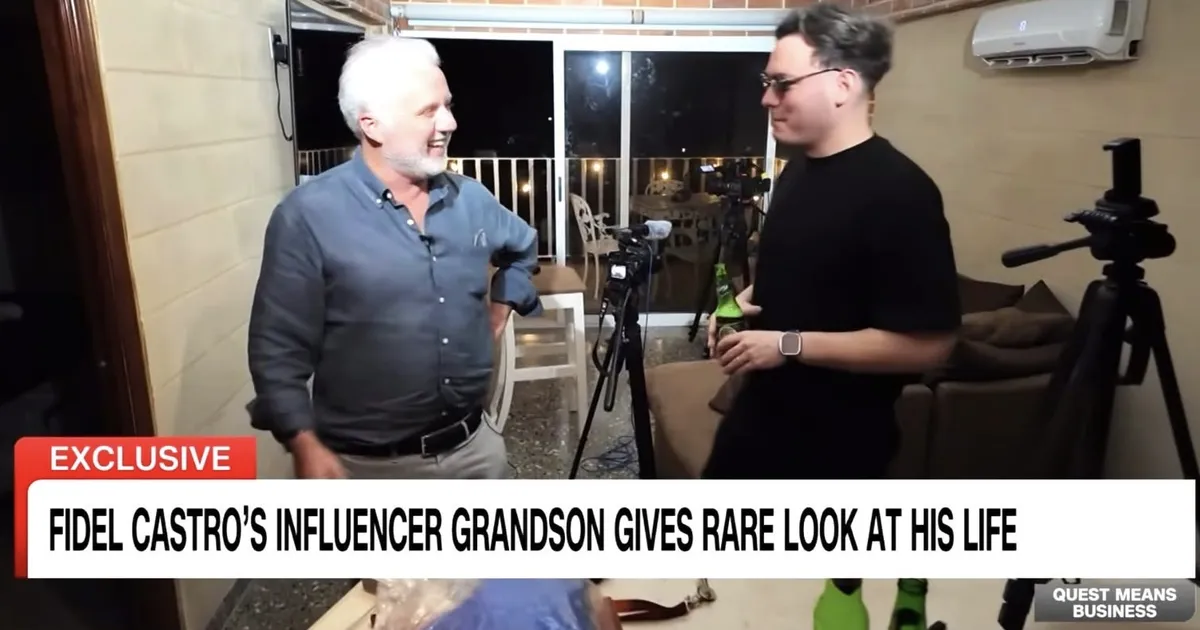
MIAMI. – “Cubans want capitalism” and “Díaz-Canel has done a bad job.” Two statements made by Sandro Castrograndson of Fidel Castro, to the American news network CNN, which due to their origin transcend the simple declaration and acquire a unique political weight in the current Cuban context.
Delivered from Havana, in the midst of blackouts, shortages and structural deterioration, his words burst into a scenario where the official story has sustained an opposing narrative for decades. This is not a dissident voice, but rather a businessman whose last name is linked to the power that has set the course of the island for more than six decades.
The interview, conducted by correspondent Patrick Oppmann, constructs a portrait crossed by contrast. The journalist documents access to the building in darkness, climbing completely dark stairs in the middle of the blackouts. However, upon arriving at the apartment, the scene changes: the space has electricity, modern appliances, including an LG brand refrigerator, full of food and drinks.
During the conversation, Sandro Castro appears drinking a glass of beer, in an environment that reveals a level of access distant from the daily reality of the majority. Added to this is his status as a businessman, associated with one of the best-known bars in Havana, which accentuates the distance between what he says and the place from which he speaks.
At 33 years old, Sandro Castro also represents an exception within his generation. In a country where large sectors of young people face enormous difficulties in becoming independent or accessing their own home, their reality confirms this difference.
In a Cuba on the brink of economic collapse, the interview itself reveals the harshness of daily life.
“It’s very hard, because you suffer thousands of difficulties. The same thing, one day I don’t have electricity, I don’t have water, merchandise doesn’t arrive… it’s hard,” laments Sandro Castro.
When asked if his last name represents an advantage, he answers:
“It’s my last name. I’m proud of it, logically, but I don’t see that help that you talk to me about” and then he states, “I’m like another citizen.”
The exchange also addresses his relationship with family legacy.
When referring to his grandfather, Fidel Castro, he says “I love it. He was a person with principles. God bless him, obviously” and he assures “he also respected others…it’s my way of thinking.”
And in his diagnosis he evaluates the management of Díaz-Canel, the designated president of Cuba who, protected by the privilege conferred by his last name Castro, can openly criticize, without fear of being judged or repressed as happens to ordinary Cubans.
“For me he is not doing a good job because a while ago he should have done many things that are not right and today they are harming us,” he says about Díaz-Canel, in a light-hearted criticism.
To this he adds a statement regarding the population: “The majority wants capitalism, with sovereignty.” Capitalism that he knows from the privileges he enjoys living in a closed and totalitarian socialist society.
Beyond the content, the moment and the way in which the interview occurs requires interpretation. In a country where public discourse has historically been controlled, and only opinions aligned with the ruling party are admitted, the fact that a figure from the Castro family expresses these types of opinions, apparently critical of the system, suggests possible hypotheses:
Faced with the possibility of an imminent change in Cuba that so far has not been outlined as to what it would be like, the young descendants of the Castros could be trying to distance themselves from the stigma that marks that family. Perhaps that is one of Sandro Castro’s purposes with these statements and others he has made where he appears to be divorcing the revolution by which his grandfather and great-uncle annihilated Cuba.
It could also be an attempt to temporize with other young people of his generation who, by natural law, will have to assume a leading role in the reconstruction of Cuba.
The CNN report seems to be betting on the idea of a change that appears from within. But this same construction opens another reading: that of those who, without completely breaking with the model, begin to place themselves in an eventual transition scenario.
From there, Sandro Castro’s words can be read not only as a criticism, but also as a strategy. A way to distance yourself, redefine your place in an environment that could change and project an image inside and outside the island. In this construction an obvious paradox also appears: a discourse that presents itself as pro-capitalist in the declarative, while its position within the current mechanism allows it to benefit from dynamics that are forbidden to the majority.
It would not be the first time that figures close to power adjust their language in moments of pressure. Political history offers enough examples of voices trying to reconfigure their role without completely breaking with their origins.
Therefore, beyond the immediate impact of his statements, the analysis requires caution. His words are surely intended to be seen as a sign of fissure, the greatest certainty is that it is a calculated movement within a structure that, despite the crisis, remains standing.
In a Cuba marked by scarcity, institutional wear and tear and social fatigue, each gesture acquires a particular value. But distinguishing between real change and opportunistic rearrangement remains, today, a pending task.
Therein lies the challenge for the observer, and also for journalism: not to remain only with what was said, but to understand what may really be behind that discourse.
