
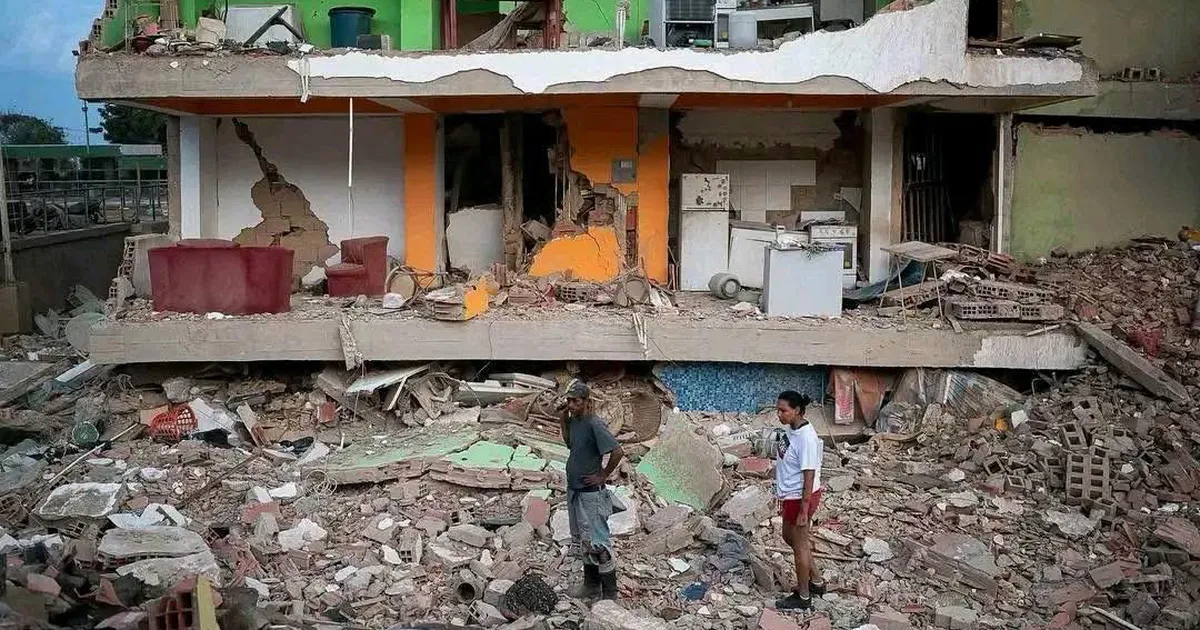
Since June 24, when two earthquakes of magnitude 7.2 and 7.5 shook Venezuela just 39 seconds apart, Leina has not seen her mother again. She and thirty other Cubans were registered on unofficial lists of missing persons provided by the citizens themselves.
As the hours have passed, a painful map of Cubans sought by their families after the earthquakes has been built. Among them are Olivia Hernández Pérez, a 28-year-old psychologist from Havana; Silvio René Garzón Molina, Olivia’s partner; the siblings Vanessa and Dayan Martínez, two minors from Mayabeque who lived with their father in La Guaira; in addition to Reinier Campos and other countrymen whose relatives continue to desperately search for them.
The regime in Havana, through Miguel Díaz-Canel, issued a statement: “From the first moment of the tragedy we have remained in permanent contact with the Venezuelan authorities and our embassy in that sister nation, to learn about the situation of our compatriots there and give them all possible help. The rescue efforts continue.” This has been one of the few times they have spoken in terms of “sister nation” since Maduro’s capture and Delcy Rodríguez’s alliance with the United States.
Meanwhile, the Cuban medical mission, which continues to operate in the 24 Venezuelan states under conditions of modern slavery, went ahead to post that all its members are “safe.” They also published images on the ground ensuring that, when the earth shook, the Cuban doctors had been there for a long time.
A week after the main earthquakes, the aftershocks are still being felt. In Venezuela there is no clear anti-seismic regulations, a culture of prevention and drills or a functional emergency network, as is the case in Chile and Mexico.
Hard experience
Leina was not at home when the disaster occurred. She has spent the days going and coming from the house of her husband’s relatives where she is temporarily sheltered in Caracas, to the area of the rubble of the Hoyo 2 residence, convinced that her mother is still there. He even claimed to have identified a possible “life hole”, a space between the remains of the structure where he could have survived.
The hope was not irrational. In the last few hours, international teams had managed to rescue several people alive after spending more than three and even four days under the rubble in Caraballeda.
“Everything is very fast, taking advantage of the internet. We live in the Hoyo 2 building. So, in this area, which is Paso 3 street or avenue, neither rescuers nor anyone had come up here to reconnoiter these buildings that are left here. They are only focused on the main avenue,” said Leina Moya.
“Then, on Saturday, a rescue team came from Mérida, and they were assigned this area and they are going to start working. They were just waiting for the rest of the equipment and machinery to arrive because they had not sent anyone to this area. So, in our building, what has shocked us the most for those of us who still have people inside is that the team from the Scientific, Criminal and Criminal Investigations Corps (CICPC) came to remove only the one who was their boss, who is a police commissioner. that institution. They took him out, they rescued him, they used all their machinery, they are not rescuers, but they could have helped. And now, they took him out, they had another dead person ahead who is the father of a little girl that they took away on the first day and they left the man there too.
Each rescue shows that, as long as there is an air pocket and time does not run out, miracles can still happen.
But the problem is no longer just time.
Relatives and neighbors report that search efforts are progressing in that area with very limited resources. It is, to a large extent, the residents themselves who remove debris with their hands and with the tools they get. According to the testimonies released by the families, heavy machinery has not yet reached the point where they believe Addis remains trapped.
Very close by, a team of Salvadoran rescuers managed to locate survivors, fueling the hope of those who continue to wait for news of their relatives. But to the place where Addis would be, those close to him insist, that help took too long to arrive.
Promises vs. reality
As the speeches and promises emerge, Leina is dealing with other rescuers that an aunt put her in contact with. The official toll continues to increase and civilian search efforts continue. The clock continues to be like a pacemaker outside the body and many are preparing for the worst, although without giving up hope.
On the one hand, Leina refused to leave the place where she hoped to hug her mother again, who had crossed a sea, bureaucracies and authoritarianisms to be reunited with her. On the other hand, an almost 100-year-old grandmother waits in Cuba for her daughter and caregiver Addis, whom she describes as a sensitive, noble woman and servant of Jehovah.
The family does not rest until they find the youngest of the Zaldívar-Rodríguez brothers, who left the country for the first time in her life with an invitation for family reunification, to see her daughter Leina, who is married to a Venezuelan.
Leina is a young professional restaurateur who, together with her husband, provides accounting and advertising services to small businesses in La Guaira and other regions of the country. He has lived for three years in Venezuela for love, he explains, and because he built a daily life with basic needs covered, something increasingly inaccessible in Cuba. “Everything seemed to work normally by the standards of a Cuban of recent times.” Rather, he says, giving his people a little bit of a better life there seemed possible.
For more than a hundred hours, his priority has naturally been to find his mother Addis, who had only been in the country for 15 days when this tragedy occurred.
One day after the original publication of this report in CubaNet, it was learned that Cuban rescuers reached the area where the building collapsed and determined that there were no signs of life where Addis Zaldívar was.
“Today I leave calmly, not without pain, but with the peace of having tried everything. After 6 long days, thanks to the Maxyieli team from the state of Mérida and the Cuban Rescue Brigade – with its canine and reconnaissance teams – we achieved a concrete response with the help of experts. I know that they did not want to be the bearers of bad news, their faces gave them away. But the truth, although it hurts deeply, is necessary to heal, continue and know that I did everything humanly possible for me mommy. My eternal gratitude to all the Cuban and Merida staff. Thank you for arriving, for entering and for giving me the answer I needed to start processing this,” wrote Leina Moya.
