
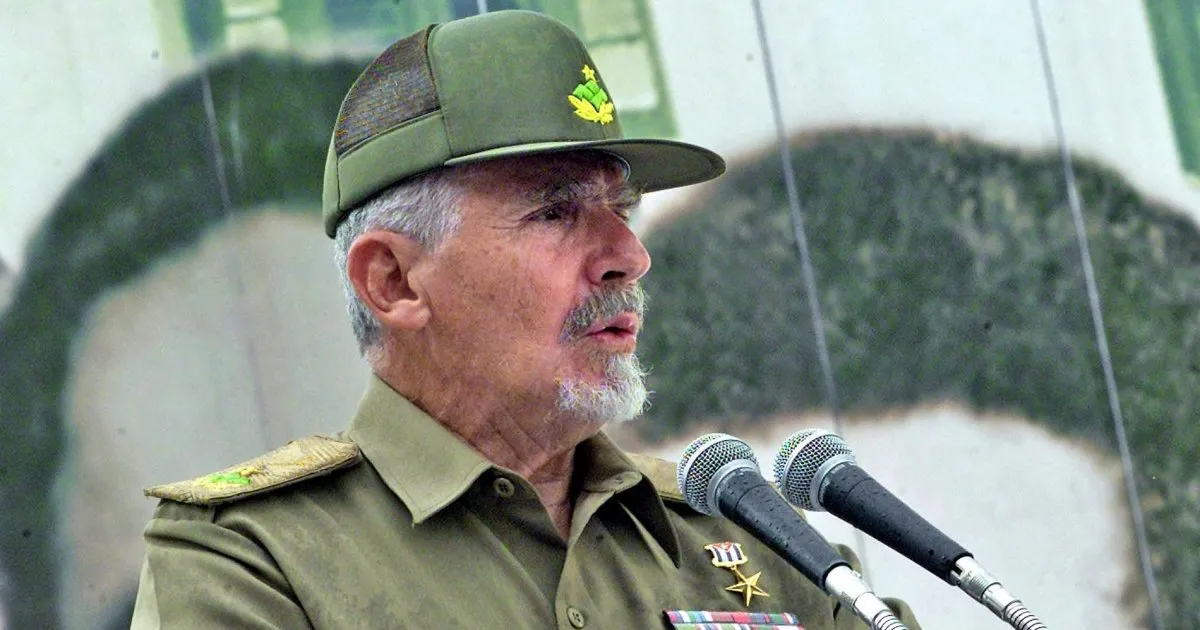
MIAMI.- Ramiro Valdés Menéndezfirst Minister of the Interior of Cuba and one of the most influential leaders of the system established by Fidel Castro after the revolutionary triumph on January 1, 1959, died this Sunday at the age of 94, as reported by the ruler Miguel Díaz-Canel through the social network X and later reported by Cuban state television and the official media Cubadebate. Until the closing of this edition, the authorities had not specified the causes of death.
“The physical departure of the Commander of the Revolution Ramiro Valdés Menéndez hurts deeply,” the president wrote when confirming the death of someone who held some of the most relevant positions within the Cuban leadership during much of revolutionary history.
Born on April 28, 1932 in Artemisa, he participated in the assault on the Moncada Barracks in 1953, was part of the Granma yacht expedition and fought in the Sierra Maestra alongside the rebel forces led by Fidel Castro. He was also part of the column commanded by Ernesto “Che” Guevara during the military offensive that contributed to the fall of Fulgencio Batista’s government.
However, beyond his participation in the armed struggle, his legacy was closely linked to the development of intelligence and surveillance systems that helped consolidate political control on the island.
The architect of the security apparatus
After the rebels came to power, he assumed responsibilities within the new institutions until he became the first Minister of the Interior. From that position he promoted the organization of the entities in charge of intelligence, counterintelligence and internal protection of the State.
Under his direction, organizations were strengthened that played a central role in political supervision and in the preservation of the system established after the Revolution.
Unlike other historical commanders who carried out mainly administrative or partisan functions, he built a good part of his political weight from the security and intelligence agencies. His career was linked for years to the institutions in charge of confronting internal and external threats, which gave him a unique position within the Cuban power structure.
Opponents, former political prisoners, activists and human rights organizations have repeatedly associated his name with the expansion of mechanisms used to monitor, control and neutralize dissent, as well as independent civic movements and sectors critical of the Government.
His career developed in parallel with the strengthening of the institutions in charge of guaranteeing the permanence of the Communist Party as the only legal political force, a reality that made him one of the most controversial personalities in the country’s recent history.
In addition to directing the MININT in two stages, he held numerous responsibilities within the state apparatus. He was a founding member of the Central Committee and the Political Bureau of the Communist Party of Cuba, vice president of the Councils of State and Ministers, vice prime minister and head of Information Technology and Communications.
A decisive figure within Castroism
Unlike other leaders who lost prominence over the years, he managed to remain in the main decision-making spaces for much of the revolutionary era.
His closeness with Fidel and Raúl Castro allowed him to retain notable influence even after leaving functions related to internal security.
For the ruling party, he was one of the most loyal historical commanders to the revolutionary project. For large sectors of the Cuban exile and the democratic opposition, however, it represented one of the most visible expressions of the control and surveillance structures developed by the island’s authorities.
His influence in Venezuela
The leader’s career also transcended Cuban borders.
In 2010 he was sent to Venezuela by the government of Raúl Castro in the midst of strengthening the political alliance between Havana and Caracas. Although officially his mission was related to the energy crisis that the South American country was going through, his presence raised questions due to his history at the head of the Cuban intelligence services.
For years, Venezuelan opponents, former officials and security specialists maintained that cooperation between both governments facilitated a greater presence of Cuban advisors in areas linked to intelligence, counterintelligence and state protection.
Valdés’ name frequently appeared associated with this process and with the transfer to Venezuela of political control mechanisms previously developed in Cuba.
Although there is no public evidence that he directed Venezuelan organizations, his presence in Caracas was interpreted by numerous observers as an example of the reach that Havana exercised over sensitive areas of the Venezuelan state apparatus during the governments of Hugo Chávez and Nicolás Maduro.
The end of a generation
Valdés’ death occurs in the midst of a deep economic, energy and social crisis in Cuba and further reduces the presence of leaders who directly participated in the guerrilla struggle led by Fidel Castro.
His prolonged absence from public events in recent months had fueled speculation about a possible deterioration in health.
Fidel Castro died before, in 2016; Faure Chomón Mediavilla, in 2019; Efigenio Ameijeiras Delgado, in 2020; and commanders Julio Camacho Aguilera and Marcos Antonio Hernández Alcaraz, both in 2024.
With their disappearance, Raúl Castro and Guillermo García Frías remain among the few historical commanders who still survive, progressively closing one of the most influential and controversial chapters in contemporary Cuban history.
For the Cuban Government, Ramiro Valdés will be remembered as one of the most faithful leaders of the Revolution. For a good part of the exile and the opposition, his name will remain associated with the creation and consolidation of the security and surveillance mechanisms that have sustained the Cuban political system for more than six decades.
