
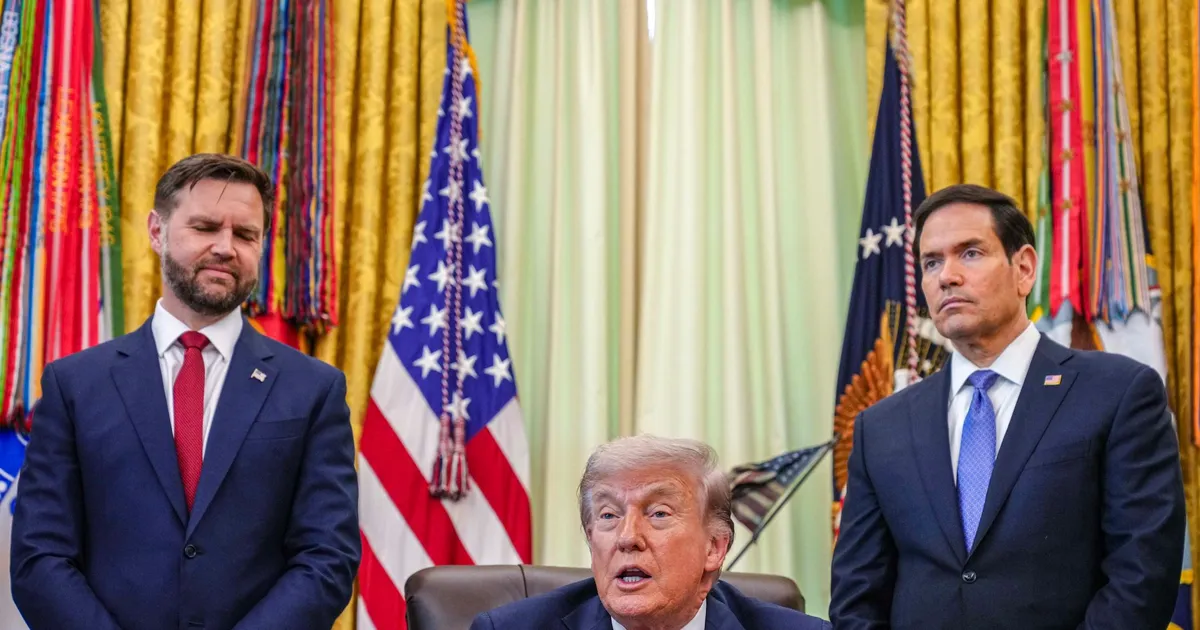
Since 12AUG25, the State Department suspended the traditional daily press conferences in which a high-level spokesperson presented the foreign policy issues of the moment and answered questions from the specialized press.
Until that day, the position of spokesperson for the Department was held by political commentator Tammy Bruce, who had been appointed on 20JAN25 by Donald Trump’s personal decision. During his administration, the State Department’s “briefings” already showed that current US foreign policy, even in its most minor aspects, is not only decided in the White House, but that its disclosure is a presidential matter. Bruce assumed the routine of giving his daily press conference only when his White House counterpart, Karoline Leavitt, had already concluded her own press conference. On dozens of occasions during State Department press briefings, Bruce’s response to reporters’ routine questions about foreign policy issues was to refer them to the White House. Secretary Marco Rubio’s spokesperson preferred to be omissive in her responses before eventually contradicting the White House.
*****
On 12AUG25 Tammy Bruce left the position of spokesperson for the State Department since Trump decided to nominate her as second in the US mission to the UN. The spokesperson was left in the hands of Thomas “Tommy” Pigott as “in charge” and who was only appointed as the owner on 24APR26. Pigott, who joined the Department as part of Trump’s team, did not hold press conferences during his interim term.
The appointment on 01MAY25 of Marco Rubio as acting National Security Advisor has also caused the Secretary of State to physically move to the White House for his daily management, as reflected in the daily public agendas disseminated by the Department itself.
*****
On April 22, 26, Ambassador Michael Kozak, who heads the Western Hemisphere cabinet at the State Department, published an unusual announcement on X. Accompanied by a photograph with Venezuelan politician Dinorah Figuera, Kozak said he had met with the “president of the 2015 Venezuelan National Assembly.” The purpose of the meeting, according to Kozak, would have been “to talk about the paths towards a stable, orderly and consolidated democratic transition.” For his part, Figuera republished Kozak’s text and wrote: “I attended as president of the @AsambleaVE, an institution recognized by the government” of the United States.
Both texts revived the multiple questions that still exist about legal aspects implicit in the unusual process that has led to the US not recognizing (JAN 23, 19) Nicolás Maduro (“nor his associates”) as the “government of Venezuela” and recognizing the provisional government of Juan Guaidó (2019-2023); the dismissal of Guaidó by the 2015 Assembly and the recognition by the US of Dinorah Figuera as president of the “only legitimate power” and consequently as head of the government of Venezuela (2023); Figuera’s declaration of having assumed executive power responsibilities (2023); the prohibition by his party (Julio Borges) for Figuera to accept the trip to Washington proposed by the State Department to formalize his relations with the United States (2023); the statement from the Department of State (07MAR25) in which it stated that the US “continues to recognize the 2015 National Assembly as the government of Venezuela”, the statement by Ambassador Kozaz (29AUG25) before US courts reiterating that “the National Assembly elected in 2015 was and continues to be the only democratically elected public institution in the country” and, finally, the communication again signed by Kozak in which he informed (11MAR26) the courts of her country that “the US is recognizing Delcy Rodríguez as the only Head of State, capable of acting on behalf of Venezuela.”
*****
The Otálvora Report consulted the State Department about whether the US continued to recognize the deputies elected in 2015 and headed by Figuera, as the “legislative branch” in Venezuela. The question stated, “Does the US recognize Delcy Rodríguez (as Ambassador Kozac reported to the courts) as “the only head of State,” but still recognize the National Assembly elected in 2015 as an active legislative power? We insist on “active.”
The spokesperson for the State Department in his response on April 24, 26, ignored any type of reference to the legislative power in Venezuela. The spokesperson’s response was: “As part of the Administration’s three-phase approach to Venezuela’s stabilization, economic recovery and political reconciliation, and democratic transition, the United States recognizes the Venezuelan interim government under interim President Delcy Rodríguez.”
*****
By the way. One of the most curious “explanations” offered about the US government’s decision to recognize Delcy Rodríguez as the “sole head of state of Venezuela” was issued on 23FEB26 by the Director of Hispanic Communications of the Republican National Committee, Jaime Florez. “You have to negotiate with her,” argued the Republican spokesperson based in Florida, “because at this moment she is the one who has the payrolls, the checks, the accounts, the management of public opinion, the management of the people in the streets, the management of the government. We do not have another person who can do it. And that cannot be improvised. You cannot send someone who arrives on a plane and the next day has the management of a country.” (No comments).
*****
At the end of September the election of the new Secretary General of the United Nations for a period of five years should take place. By unwritten rules, the next Secretary General should come from a Latin American or Caribbean country and according to the opinion of various governments, the choice should fall to a woman. The position is decided by the General Assembly based on a candidate recommended by the Security Council. The essential step for the election of the new secretary occurs in the Security Council, where the candidate must collect nine of the fifteen possible votes as long as none of the five permanent members issues a veto.
Although the surprise appearance of a new candidate is possible, the formal application process ended on 01APR26. The candidacies presented are those of the Argentine director of the International Atomic Energy Agency Rafael Grossi, the Costa Rican and Secretary of the UN Conference on Trade and Development Rebeca Grynspan, the former Chilean president Michelle Bachelet and the former president of Senegal, Macky Sall. The candidacies of Grossi, Grynspan and Sall were presented by their own governments. Bachelet’s nomination was made by Chile, Brazil and Mexico, but immediately after the inauguration of José Antonio Kast, the Chilean government withdrew its support for the former president’s nomination.
*****
The Otálvora Report consulted the State Department about its inclination among the candidates presented. An official spokesperson for the US government, in a response issued on 30APR26, noted that “the US seeks a practical, motivated and reform-focused candidate who will protect the valuable contributions of Member States, restore competent management and significantly streamline the organization. Any new Secretary General must return the UN to its primary purpose: maintaining peace and security in the world, instead of the absurd, politicized and woke ideology that has undermined the institution’s effectiveness.” Therefore, “the US will evaluate “actively reviews candidates to determine the best person with the most exceptional qualifications and will not prejudge a candidate based on immutable personal characteristics.” The term “immutable characteristics” in this context usually refers to things like national origin, race, ethnicity, age, or sex.
*****
Former Senegalese president Sall seems completely ruled out as an option since he seems to deprive the intention of electing someone from Latin America-Caribbean. The candidacy of the former Chilean president Bachelet seems to not have enough friends in the Security Council where only Gustavo Petro’s Colombia is a clear support, in addition to some sympathies from centrist governments. In the initial analyzes it seems that only the candidacies of the Argentine Grossi and the Costa Rican Grynspan survive.
*****
In Brazil there will be presidential elections on 04OCT26. The parties must formally present their candidacies in the month of August. It is generally assumed that Lula da Silva will compete for what could be his fourth term. Across the street, Jair Bolsonaro’s eldest son, Senator Flavio Bolsonaro, has been commissioned to represent the family. But, in reality, the candidacies have not been formally decided and the political alliances have not yet been finalized.
Two events that occurred on April 29, 26 and April 30, 26 have sounded the alarm about the eventual impossibility of Lula to form an alliance beyond his natural space on the left, which would allow him to run for the Presidency with options for victory. On 29APR26, the Brazilian Senate rejected the candidate proposed by Lula to fill a vacant seat on the Supreme Federal Court. The next day, 30APR26, the two chambers of the Brazilian Congress voted overwhelmingly to override the veto imposed by Lula on a law that reduces the sentences imposed on those accused of the attempted coup d’état of 08JAN23. Bolsonerism’s votes are not enough in Congress to defeat Lula, so the results of two votes in which the government has been resoundingly defeated seem to indicate that the long list of partisan acronyms would be abandoning Lula’s option.
Nothing has been decided in Brazil about who will be the President who takes office on 01JAN27.
