
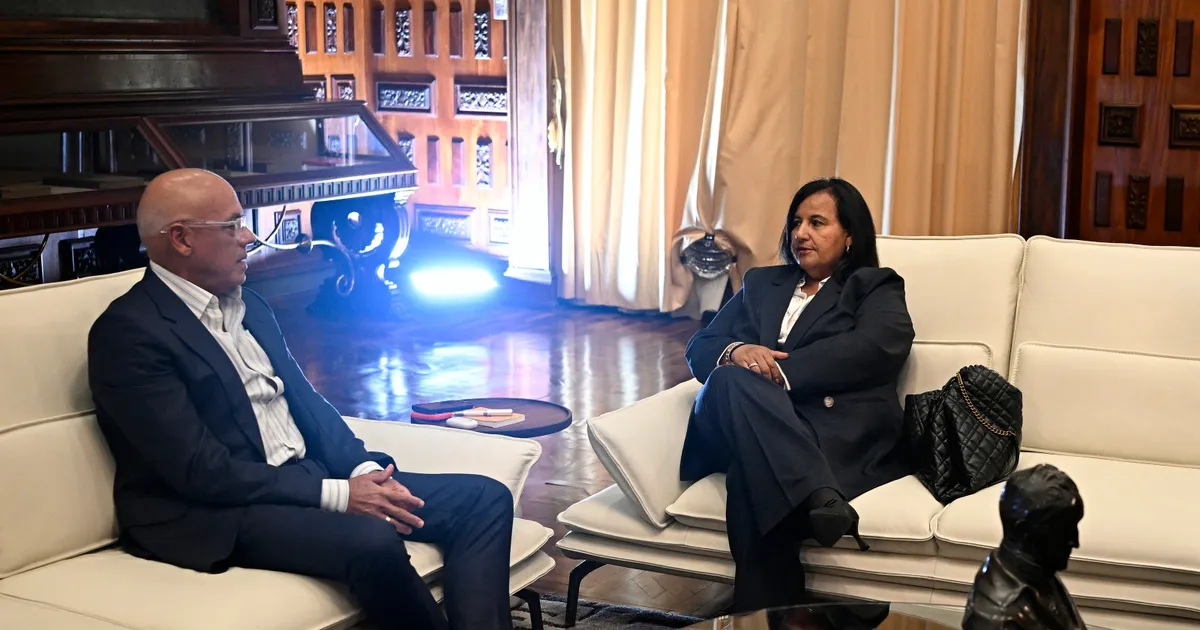
CARACAS. A call to civil society and the country’s jurists to join in supervising the Judicial Nominations Committee (CPJ) and to join the Independent Credentials Review Council (CIRC), was made by the opposition members who are at the dialogue table with Chavismo, a process supervised by the United States.
This Tuesday, the partial reform of the Organic Law of the Supreme Court of Justice (TSJ) was sanctioned, and that is why the call is made to comply with the steps established by the Constitution of Venezuela and the approved reform, with the aim of ensuring that the highest court of the Andean nation this time fulfills the role of being independent of political power.
Among the steps is the selection of the members of the Judicial Nominations Committee, the body that will be in charge of choosing in the first instance those aspiring judges, once they review the credentials.
The first is the designation by the National Assembly (AN) of the Preliminary Commission (CP) made up of 11 deputies who, in turn, will select 12 members of civil society to form this Nominations Committee. The CP deputies will later join the CPJ.
The call to civil society will be made through the AN website and through three national circulation newspapers. The norm and custom, which was distorted with the parliamentary majority of Chavismo, is that it was mainly the faculties of Legal and Political Sciences of the national universities that nominated candidates for both the CPJ and for magistrates, as well as NGOs that have to do with the legal field. Aspiring judges can also do so on their own initiative.
The reform of the TSJ Law focused on increasing the number of members of civil society in the CPJ, thus giving it greater weight and ensuring that the selection of the magistrates is made with people who know how to properly evaluate the credentials of the candidates to try to make them the most suitable possible and erase past failures such as: membership in a party, criminal records and other causes that led to having a high court in the South American country that responds to the ruling party.
An organization that is not in the Constitution or in the TSJ Law is the CIRC, but which was achieved through the political agreement at the Chavismo-opposition negotiation table and which will have the mission of reviewing the list of candidates prepared by the Judicial Nominations Committee.
The opposition that is at the dialogue table is trying to put a double lock on the first selection of the magistrates with these two bodies (CPJ and CIRC), which, in accordance with the constitutional mandate and the law, the final choice is made in the plenary session of Parliament, whose majority is pro-government.
Although it seems obvious that the participation of civil society and jurists is a must, during these years of Chavista rule this precept was “unfulfilled” in the sense that participation was always linked to Chavismo and the opposition refrained from fulfilling its role given that they knew in advance that by various means they would be prevented from participating, whether in the selection of the members of the CPJ or the magistrates.
In the end, in any case, the mathematical equation may prevail since Chavismo is the majority in the Legislative branch and that will influence when choosing the Preliminary Commission of the 11 deputies.
At the moment, the date for the selection of the two bodies has not been set; it is expected that it will be next week at the latest, if in reality the new TSJ is to be appointed in November. Time is short.
Opponents of the negotiating table apparently fear that well-known Venezuelan jurists will not participate in this process since they have rejected the composition of the CPJ because they demand that it only be members of civil society.
