
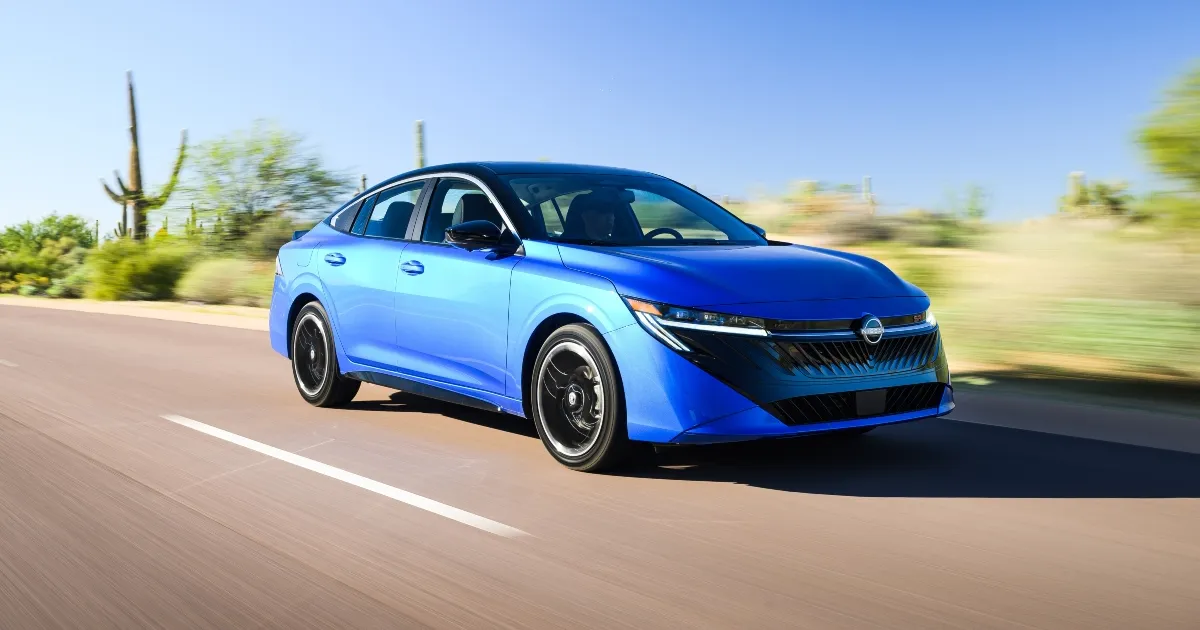
With a more aggressive image, renewed technology and a 149 horsepower engine, the Nissan Sentra SR demonstrates that compact sedans still have arguments to compete in the US market.
In a market dominated by sport utility vehicles, finding a manufacturer that continues to invest heavily in compact sedans is becoming less and less common. However, Nissan is keeping the Sentra as an important piece of its offering and, for 2026, has updated it with a formula that seeks to appeal to both those who need a practical everyday car, and those who still enjoy driving a sedan.
The Nissan Sentra, in its SR version, combines a sportier appearance with a good level of equipment and a price that remains relatively affordable. And although it doesn’t pretend to be a sports car in the traditional sense, the Sentra SR has enough arguments to be attractive. The first impression is probably one of the biggest advances of the 2026 Sentra. Nissan has especially worked on the exterior design to give the car a stronger personality.
The SR version features a black grille, sport-inspired exterior details and 18-inch aluminum wheels. The result is a sedan that looks much more dynamic than its features might suggest. It is an important change in a segment where appearance can be decisive. The buyer who does not need an SUV, but wants something that looks modern and youthful, finds the Sentra SR an interesting alternative.
Under the hood there are no surprises: the Sentra SR uses a 2.0-liter four-cylinder engine, capable of producing 149 horsepower and 146 pound-feet of torque. The transmission is a continuously variable automatic, known as Xtronic CVT, and the drive is front. These figures may not impress anyone looking for sporting accelerations. But that’s not the Sentra’s goal either. Nissan is betting here on a balance between everyday performance, smoothness and fuel economy.
In the city, the 149 horses are enough to get around with ease. The engine responds adequately when accelerating from a traffic light and allows you to enter fast lanes without major inconveniences. When you need to overtake on the highway, however, it is worth remembering that this is a compact sedan oriented primarily toward efficiency.
Independent testing puts 0-60 miles per hour acceleration at approximately 8.3 seconds. It is not a figure that places it among sports cars, but it is perfectly reasonable for a family car in this segment.
The continuously variable transmission is usually one of the elements that receives the most criticism in this type of vehicle. In the Sentra, however, its main virtue is precisely to go relatively unnoticed during normal driving. The CVT keeps the engine at the proper speed and promotes progressive power delivery. When you step on the accelerator more decisively, the revs increase noticeably, but the response is smooth enough for most situations.
Sport mode adds a bit more character to the car, modifying throttle response and other parameters to offer a more immediate feel. It doesn’t turn the Sentra into a sports car, but it does make the driver have a slightly more entertaining experience when leaving urban traffic.
If the exterior is one of the most visible new features, the interior is where the driver will probably perceive one of the most important improvements. The 2026 Nissan Sentra SR incorporates a more modern and technological presentation, with 12.3-inch screens for the instrumentation and the information and entertainment system.
The cabin maintains a simple and functional philosophy. The controls are designed so that the driver can use them without having to learn a complicated sequence of menus, something that is appreciated while driving. There is also enough space for four adults to travel comfortably and a trunk that allows the Sentra to be used as a family vehicle for everyday activities.
One of the defining characteristics of the Sentra SR is its balance. Although the 18-inch wheels and exterior details are intended to convey a sporty image, the car remains fundamentally a comfortable sedan. The suspension is designed to absorb much of the pavement’s irregularities, and on the road, the Sentra conveys a feeling of stability that inspires confidence.
The steering is predictable and the car is easy to maneuver in urban spaces. For those who spend a good part of the week traveling between work, home, supermarkets, schools and other activities, that drivability can be much more important than having a high-powered engine.
Efficiency is another of the Sentra’s strong arguments. Nissan estimates the SR up to 29 mpg in the city and 36 mpg on the highway. In practical terms, this means that the owner can travel long distances without visits to the gas station becoming too much of a part of the family budget. And here the Sentra has a conceptual advantage: It uses a conventional gasoline engine, without the complexity or upfront cost of a hybrid system.
The 2026 Nissan Sentra SR starts at a base price of $25,000. The one we drove, with a good dose of optional equipment, such as better quality upholstery, a premium Bose brand audio system and a sunroof, among others, reached $32,120.
At a time when American consumers are paying more and more for new vehicles and when SUVs dominate dealerships, the Sentra SR offers a traditional alternative: four doors, good space, reasonable consumption, modern technology and a relatively contained entry price.
Its sporty appearance provides the emotional appeal, while its mechanics and efficiency provide the rationality.
The result is a compact sedan that doesn’t need to be the fastest or most powerful to be a smart buy. The Sentra SR simply tries to do well what it was designed to do: offer comfortable, efficient transportation with enough style that the driver can still be proud to park it in front of their house.
