
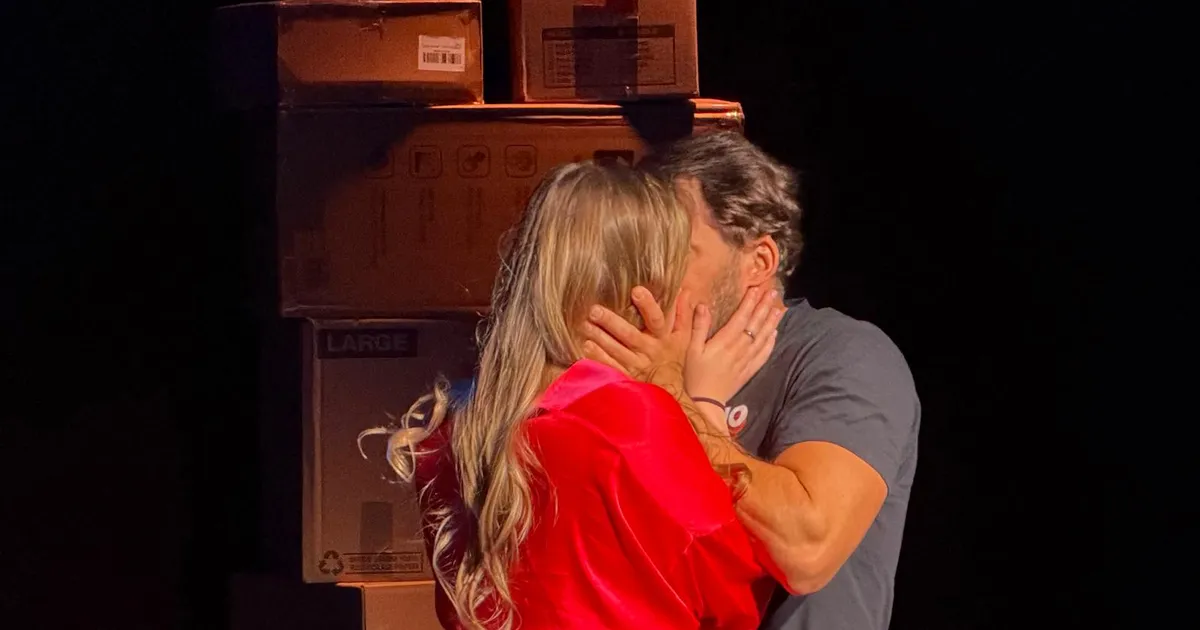
MIAMI. – There are functions that do not end when the curtain falls. The first presentation of My life for rentat Teatro Miami, this Friday, April 17, with performances throughout the month, left that feeling: full room, sustained laughter and an immediate identification with what is being told. It is not coincidental. The story, and the way it is told, dialogues directly with the lives of those who have had to start over.
Minutes after the final ovation, and with the energy of the public still present in the room, the space was opened for conversation. In exchange with DIARIO LAS AMÉRICAS, actors Chris Gómez and Omar Rolando shared impressions about a proposal that, beyond entertainment, is anchored in very close experiences.
Tonight they faced a story that challenges a large part of the immigrant community in Miami, especially Cubans. What did it mean for you to take on that challenge from the stage?
The answer did not take long to go to the root of the project.
“I think that was the first thing that made us fall in love with this play: the script. The fact that Mijail, who is a great actor and director, approached us and said ‘look at this text, mine,’ I felt that it was something very personal, and that he shared it with us was an honor.”
Directed by Mijail Mulkay, My life for rent It starts from a premise as simple as it is recognizable: a young couple who, unable to sustain a stable income, is forced to constantly move in search of more affordable options. From there, the story progresses between couple tensions, absurd situations and moments that provoke laughter, but with a deeply real basis.
“The truth is a true story. Many of the things that happen in the work are passages from his life and from people very close to him, they are experiences that most people have lived.”
That link with the everyday sustains the piece. In a city where the cost of living redefines personal and professional decisions, the setting works as a reflection.
The setting also refers to those first steps in Miami, to what it means to rebuild. How do you describe that beginning?
The memory appears without filters.
“When you are a professional in Cuba and you arrive here it is very difficult. I had to be a waiter; we did the same. She was a waitress. I worked as a plumber, as a carpenter, things that you always take advantage of because you learn from everything and try to keep the good stuff.”
In that transition, from what one was to what one has to be, a generation is taking shape. Young people who left everything on the island in search of opportunities and who today sustain their present between multiple jobs, uncertainty and constant adaptation.
“Maybe you get here and people tell you to forget acting, to forget art, because it’s very difficult… but that wouldn’t be the advice I would give to anyone.”
On stage, Gómez and Rolando lead the story with a sustained rhythm. The original music by Camila Bordon Arenal and the incorporation of contemporary codes, including nods to social networks, accompany a dynamic setting that does not lose lightness, even when it touches on sensitive topics.
The premiere confirmed that connection with the public.
After this first performance, with the room completely full, what feelings does this meeting leave you with?
“It feels very good, really. It feels spectacular. Premieres are always a little convulsive. We were a little nervous, but we always trust Mijail.”
The figure of the director emerges as the axis of the creative process.
“I admire him very much as an actor, and that was one of the things that made us do this play. He gave us all the confidence that we needed. All the tools were there… and now do it and make people see it.”
But the performance also had readings that transcend the stage. In one of the scenes, a visual element generated an immediate reaction: the name of Miguel Díaz-Canel, provocatively incorporated into a piece of clothing, functioned as a direct nod to Cuban reality. Added to this were expressions deeply rooted in exile, such as “Down with the political prisoners” or “It’s coming”, phrases that the audience not only recognized, but accompanied and repeated from the room.
“After a full theater, applause: a text that represents the reality of the Cuban people and shouts of ‘Down!’, ‘the political prisoners’, ‘Díaz-Canel’, ‘Freedom for Cuba!’”
Beyond humor, the work touches fibers linked to the situation in the country. What message do you feel you can convey from the stage?
“That is simply supporting everything that is happening, all the evil that is happening in our country, that we want a change. This is the way to raise our voice and let people know that we are always with the people.”
At that point, the theater takes on another dimension.
“The stage is the trench, it is the platform where we can say what we think and what we have not been allowed. It is a privilege.”
The closure returns to the viewer.
What do you expect from this production on its journey and what would you say to those who have not yet seen it?
“I hope it is on the billboard for a long time, that people feel it, experience it, enjoy it and recommend it… but above all that they enjoy it. We give a hundred.”
And an idea that summarizes the spirit of the proposal:
My life for rent transcends comedy. It is a portrait of a stage, a generation and a city where starting over is part of everyday life. Between laughs, he leaves one certainty: what happens on stage is not far away.
Performances are presented at Teatro Miami, located at 7265 NW 74 St, Unit 2, Medley, at 8:00 p.m.
The invitation is open from the stage, where each performance retells a story that many have already experienced:
“May everyone who comes have a good time… may they leave with a nice taste in their mouths. And may the word spread so that more people can identify with this story.”
