
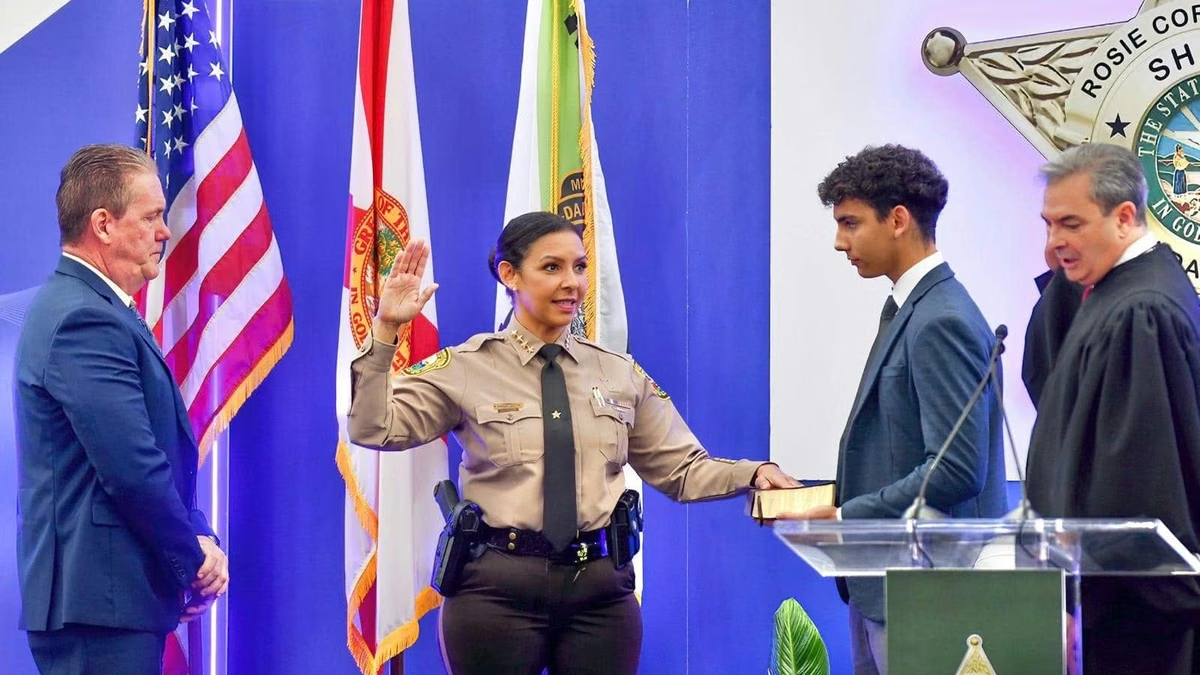
MIAMI.- The contract of the Miami-Dade sheriff, Rosie Cordero-Stutz, with a law firm that charges according to what is recovered in civil forfeitures faces an appeal promoted by companies that denounce possible conflicts of interest and impacts on their rights.
The Reyes Law Firm, PA, headed by former Judge Israel Reyes, represents the Miami-Dade Sheriff’s Office (MDSO) in the disputed matters. Their remuneration depends on the outcome of the procedures.
The companies object to a scale of fees that, according to their approaches, can reach 35% in certain cases, with additional percentages for appeals or procedures after a ruling. They maintain that linking the lawyer’s earnings to the value of the confiscated assets generates an incentive that is incompatible with the impartiality that, in their opinion, should govern these government actions.
The businesses involved distribute or market phones and other electronic products. Its representatives assure that the seizures exceeded 45 million dollars, of which more than 42 million correspond to SH Americas funds.
These figures describe seized or frozen resources and do not allow us to establish how much the office has actually collected.
In the first instance, Circuit Judge Ariana Fajardo Orshan rejected the request to remove him from the cases. The appeal briefs state that the decision considered MDSO’s controls on the initiation of legal actions and the approval of agreements to be relevant.
The resolution is challenged before the Court of Appeals for the Third District of Florida. The matter, identified with file 3D2026-1363 and other consolidated resources, remains pending.
The US Chamber of Commerce and the Florida Justice Reform Institute presented a joint brief in support of the companies. The Goldwater Institute also weighed in and argued that the oversight described does not eliminate the economic interest of the private attorney. These are arguments submitted to the court, not an appeal decision.
Cordero-Stutz defended the hiring in an explanation signed on November 11. He maintained that most seizures are handled by the lawyers in his office and that external assistance is decided according to the complexity of the matter and the resources available.
The sheriff noted that this case involves extensive financial operations and alleged money laundering through international trade. He stated that resorting to conditional remuneration makes it possible to obtain representation without committing public resources in continuous hourly payments, while the firm assumes the risk of working without pay if it does not achieve a recovery.
According to the official, MDSO retains authority over litigation and seized funds are not automatically available to pay attorneys. He also specified that judicial determinations of probable cause allow money to be retained while litigation is ongoing, but do not establish a definitive right to confiscate it.
DIARIO LAS AMÉRICAS requested statements from Cordero-Stutz and her office about the hiring criteria, the existence of a competitive process or an exception, the previous relationship between the sheriff and Reyes and the measures adopted to manage possible conflicts of interest.
The questions cover the scale of fees, payments actually made, funds received by MDSO, and controls for initiating or resolving proceedings. They include the status of the assets of SH Americas and other businesses, the evidence and resolutions that support their retention and the existence of related criminal charges.
To document those points, the newspaper requested copies of the contract and its modifications, the selection and approval records, the available ethics reviews or audits and the accounting of the seizures. He also proposed an interview with the sheriff or the corresponding spokesperson to incorporate his response into this coverage.
