
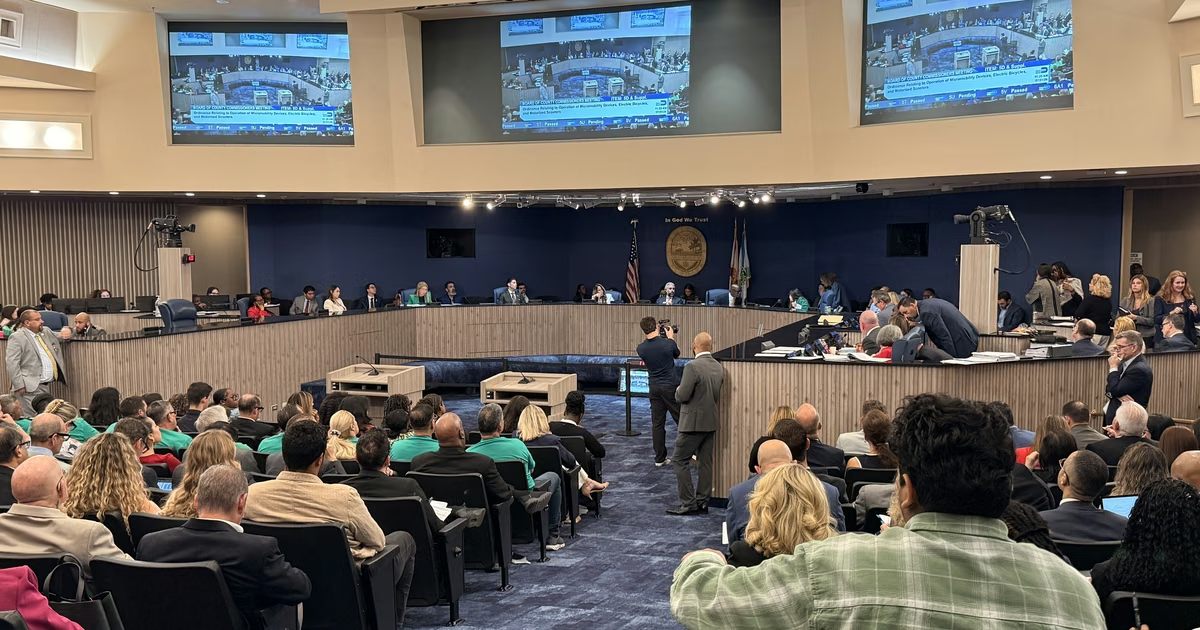
During the session, articles A, B, C, D and F were approved, related to tax rates, the general fund, unincorporated areas and the Fire and Rescue District. The Commission also advanced article E, corresponding to the budget of the Unincorporated Municipal Services Area, known as UMSA.
The new budget must go into effect on October 1, 2026 and will remain in effect until September 30, 2027. Before its final adoption, commissioners will hold a second public hearing on September 17, when they can introduce new changes.
Levine Cava’s proposal amounts to $14.2 billion, approximately $1 billion more than the current budget. However, the mayor maintained that this growth does not mean that the County has free money to expand programs, due to the increase in the cost of operations, the increase in labor costs and the reduction of some state and federal resources.
Citizen complaints
During the first three hours of the hearing, residents, activists and representatives of community organizations presented their concerns to the Commission.
Interventions addressed environmental protection, funding for arts and culture, support for nonprofit organizations, public safety, and, most importantly, the functioning of the transportation system.
Representatives of the County’s constitutional offices also appeared, defending their operational needs and requesting sufficient resources to fulfill their new responsibilities.
Much of the subsequent debate among commissioners focused on route cuts, the cost of service, the future of MetroConnect and the need to find a stable source of revenue for public transportation.
Fiscal discipline
Before beginning the discussion of the articles, Levine Cava explained that the budget was prepared at times of strong economic pressure for Miami-Dade families.
“Our families are struggling with the high cost of living and difficulty paying for their basic needs,” he said. “Just as residents are watching every dollar, so do we and we must.”
The mayor assured that her administration kept the millage rate at its historically low level, after reducing it for two consecutive years. As he explained, the rate is at its lowest point since 1982 and the proposal does not contemplate increasing it.
However, he warned that income from property growth has slowed, while government spending continues to increase above that pace.
As part of the “Wise 305” initiative, the administration identified $121 million in savings and eliminated more than 400 general fund-funded positions. Levine Cava said departments had to review their budgets three times to find reductions.
Despite these cuts, he maintained that the proposal avoids reducing resources allocated to parks, libraries, housing, cultural programs and community organizations.
public safety
Levine Cava affirmed that public safety was protected against the adjustments applied to the rest of the departments. While general fund agencies had to limit their growth to approximately 3%, public safety areas were authorized to grow up to 6%.
That category includes the Sheriff’s Office, Corrections and Rehabilitation, Fire, Emergency Management and the Medical Examiner’s Office.
The proposal calls for an additional $55 million for the Sheriff’s Office and nearly 200 new positions. According to the mayor, the allocation would raise police funding and staffing to the highest levels recorded by the County.
However, several commissioners considered the amount insufficient compared to the request presented by the sheriff. At the initiative of Commissioner Roberto González, the Commission ordered the administration to identify all legally available funds to meet that request and present different scenarios before the hearing on September 17.
González clarified that the administration will have to show where the money could be found and what programs would have to be reduced. The final decision on any cuts would be up to the Commission.
The mayor had previously warned that “every dollar in this budget is programmed” and that any increase for one agency would require identifying what other spending would be eliminated.
At this point, there was talk of allocating more funds from RedSpeed, the speeding cameras, to the Sheriff’s office. Some commissioners opposed the idea since some of this money goes to the 13 different commissioners’ offices.
Transport under discussion
The transportation system occupied a good part of the debate. Levine Cava explained that only about 12% of transportation costs are covered by the money collected from passengers. The rest depends mainly on public funds.
The County’s contribution would amount to $336 million, about $66 million more than the previous fiscal year. Still, the administration proposed route cuts and service changes due to the operating deficit.
“We need to increase the transportation rate. That’s really the bottom line,” Levine Cava said. The mayor acknowledged that additional savings can be found, but insisted that isolated measures will not solve a financial problem that she described as “systemic.”
Commissioner Raquel Regalado presented a proposal to reduce MetroConnect’s allocation from $4.5 million to $1 million, negotiate a contract modification and offer riders a credit of $3.75 per ride. The remaining 3.5 million would be used to restore bus services before 5:59 in the morning.
Regalado argued that the annual subsidy per MetroConnect user is close to $500, while the support for passengers affected by the reduction of buses in the early morning is equivalent to about $113 per person.
“I’m not asking to eliminate the service. I’m asking for continuity and equity,” said the commissioner.
The proposal generated reservations because MetroConnect serves about 8,000 passengers and its current contract pays the operator by the hour, not by each trip. Transportation officials indicated that it would be necessary to negotiate with the company and analyze whether their platform can apply the proposed credit.
Time for changes
Commissioner Eileen Higgins recognized the value of exploring new sources of income, but questioned that a transformation of that magnitude was proposed just two weeks before the final approval of the budget.
“I like the idea and support it, but I’m concerned about the timeline and whether anything can really be accomplished for this budget cycle,” Higgins said. Commissioner René García requested the same.
Transportation Director Stacy L. Miller explained that the department had conducted analysis on the potential impact of charging fares on certain services, but had not yet calculated all of the technological and operational costs of implementing those changes.
The president of the Commission, Anthony Rodríguez, also refused to rush a decision on MetroConnect without knowing the alternatives that passengers would have.
Rodriguez maintained that equality cannot be measured solely by the amount of the subsidy. In his opinion, it should also be considered whether users have a bus route, a trolley or another option to reach their destination.
“Eight thousand people are a lot of lives,” stressed the president, who declined to hold an informal vote on the proposal and asked to develop a more complete plan before deciding.
Although the MetroConnect funding change was not immediately successful, instructions were advanced for the administration to present detailed information on the operating and maintenance costs of the Metromover and to claim from the city of Miami or other entities the expenses assumed by the County during the FIFA Fan Festival in Bayfront Park.
At first hearing
Article A, approved by a vote of nine to four, established a rate of 4.5740 mills for the County’s general fund. Although it represents 5.63% more than the so-called reversal rate -rolled-back rate- calculated by the State, it does not represent an increase in the nominal rate with respect to the level proposed by the administration.
That is, the reversion rate indicates what the millage rate would have to be for a local government to collect approximately the same property tax as the previous year, excluding new construction among other factors. Because even if the County keeps the millage rate unchanged, it may collect more in property taxes and some homeowners may even pay a larger bill.
Article B, related to the payment of tax-backed debt, received 12 votes in favor and one against. It set a combined rate of 0.3937 mills for obligations such as the Building Better Communities program, Safe Neighborhood Parks and Jackson Health System projects.
Article C, corresponding to the general fund budget, was approved with the modifications incorporated by the administration and the amendments accepted during the hearing.
Article D set the rate for UMSA operations at 1.9090 mills and obtained 10 votes in favor and three against.
For its part, article F established the rate of the Miami-Dade Fire and Rescue District at 2.3965 mills. That component was approved unanimously.
These votes correspond to the first hearing. The rates and budget still require final approval by the Commission at the September 17 hearing.
Amendment 3
Levine Cava urged caution over the possibility that voters approve Amendment 3 in the November elections, a proposal that would reduce property tax revenues going to local governments.
According to the mayor, if the amendment is approved, the County would have to review its accounts again and make additional adjustments.
He also warned that Miami-Dade’s financial reserves are low and “not sustainable.” For this reason, he recommended that any unexpected surplus or unused money returned by the constitutional offices be allocated as a priority to strengthening those reserves.
“This is a fiscally prudent, responsible and transparent budget,” defended Levine Cava. “Prioritize public safety, preserve essential services and begin preparing the County for the financial challenges ahead.”
The discussion will continue on September 17, when the Commission must resolve differences over transportation, rates, the Sheriff’s Office budget and other important items before approving the final fiscal plan.
