
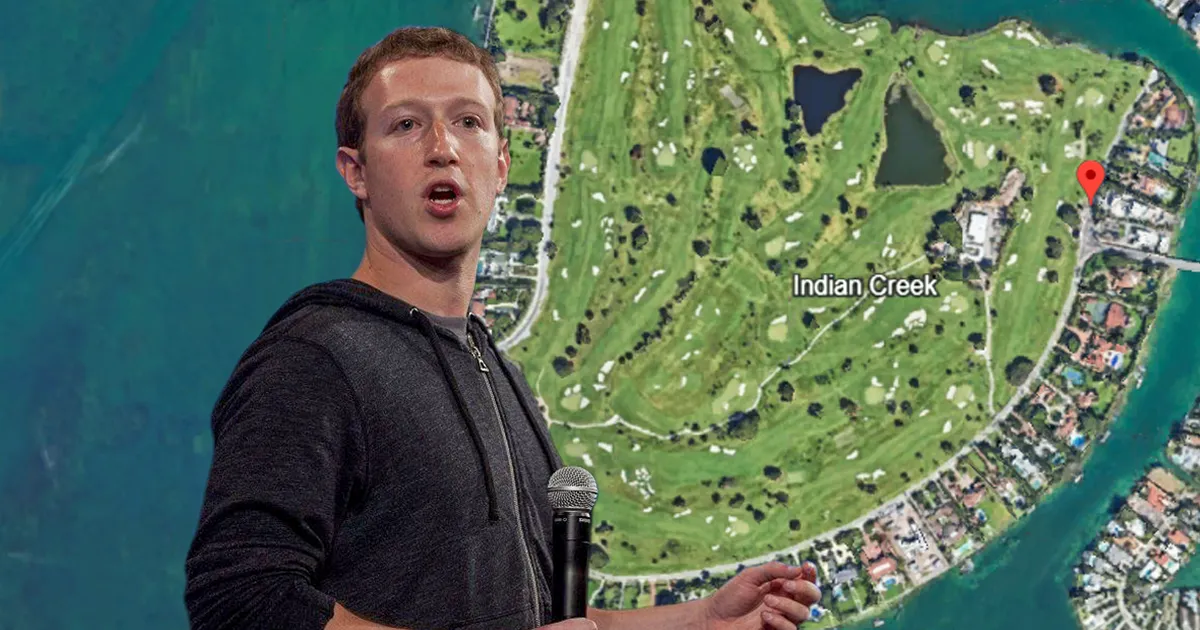
MIAMI.– The founder of Facebook, Mark Zuckerberg, and his wife, Priscilla Chan, purchased a mansion under construction for $170 million on the exclusive island of Indian Creek, in Miami.
The couple completed the purchase through a private transaction to add an exclusive enclave to their real estate empire, and with this they set the historical record for residential real estate in Miami-Dade County, according to the Wall Street Journal.
Architecture and eccentricities
The design of this limestone fortress fell to the famous architect Ferris Rafauli. Plastic surgeon Aaron Rollins and his wife Marine sold the nearly two-acre property after commissioning initial plans.
The house, with a surface area of approximately 2,780 square meters, stands out for its unusual architectural details. A 1,500-gallon water tank divides the living room from the dining room like a transparent wall, while a double-height bookcase hides a secret passage between its shelves.
The resort also incorporates a wellness centre, Himalayan salt saunas and a deep-water dock.
Billionaires Bunker Magnet
The main attraction of the artificial island of Indian Creek lies in its unmatched level of protection. An own police force and armed maritime patrols monitor the only access bridge 24 hours a day.
In this closed enclave of just 121 hectares in Biscayne Bay, the technology magnate will share the exclusive neighborhood of thirty houses with high-profile figures.
Personalities such as Jeff Bezos, Tom Brady and Ivanka Trump own large residences a few meters from the Zuckerbergs’ new home.
Expanding real estate empire
This new acquisition strengthens the American billionaire’s massive real estate portfolio.
Meta’s CEO already manages extensive private compounds in Hawaii, California and the Lake Tahoe area.
The partial move to South Florida confirms a clear trend among large technology entrepreneurs. These leaders seek to assimilate in impenetrable enclaves to protect their privacy and take advantage of corporate and personal tax benefits.
