
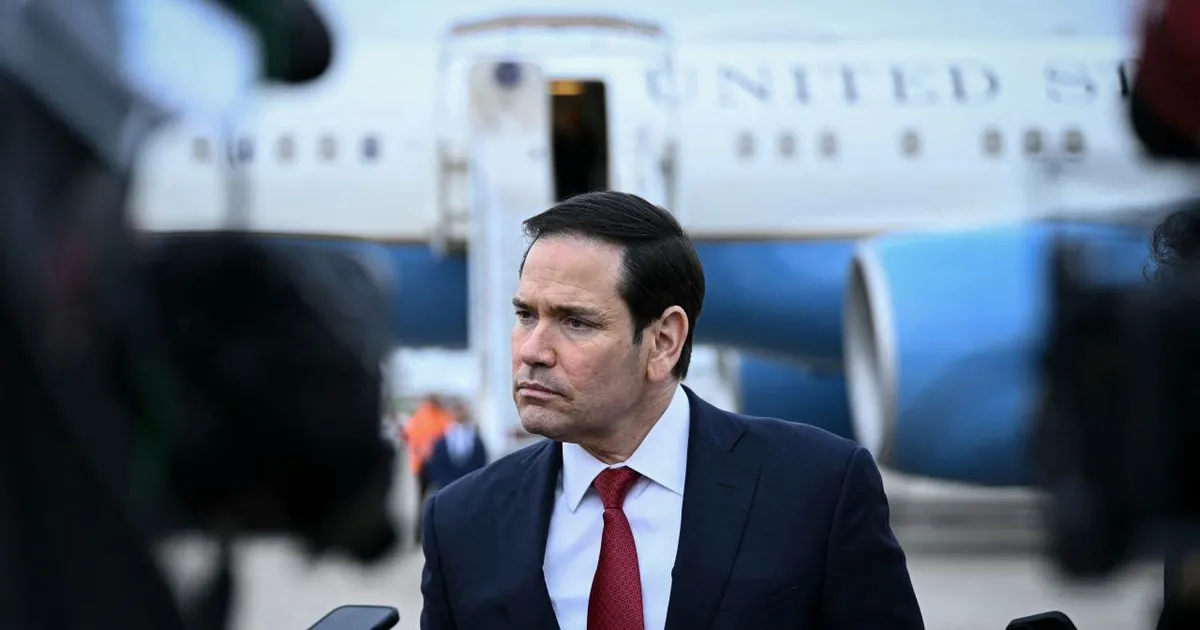
PARIS —The Secretary of State of the United States, Marco Rubioestimated this Friday that “perhaps now may be the time” for a change political in Cuba and insisted that its current government system impedes the country’s economic development.
“We need to change the system that runs the country, and it is necessary to change the economic model that it has. It is the only way to follow if people want a better future. We have expressed it clearly and repeatedly for many years, and perhaps now there is an opportunity to do it,” said Rubio, before boarding his plane from the outskirts of Paris after having participated in a G7 meeting.
The head of US diplomacy, who has Cuban parents who emigrated to the United States, attributed the shortages and blackouts in Cuba “to the infrastructure from the 50s and 60s that has not had any maintenance work.”
“We have objectives, we are very happy to be close to achieving them and very soon,” he stressed, without giving details because, as he said, it corresponds to the United States War Department.
The US Secretary of State, Marco Rubio, estimates that the war in Iran will be over “in a couple of weeks” with the result of an Islamic Republic “weaker than ever,” he informed his G7 counterparts during the meeting of foreign ministers that ended this Friday in France.
“When we are done with them in the next two weeks, they will be weaker than in all of their recent history and unable to hide behind their weapons, or to obtain a nuclear weapon,” he told the media before leaving French soil.
After insisting that the United States does not expect the war to become a “protracted conflict,” Rubio insisted that his country has made it “very clear from the beginning.” the objectives of the military operation: the destruction of Iran’s military potential, including its “missile, rocket and drone factories, as well as its Navy.”
Rubio stated that if Iran acquired a nuclear weapon, the first thing it would do would be launch it. “For these people to get nuclear weapons would be crazy. Look what they are willing to do with the weapons they have now. They attack embassies, they attack hotels. Imagine if these radical lunatics had a nuclear weapon to threaten the world,” he added.
What he did reveal, on another of the hottest geopolitical fronts, is that Iran has sent “messages” that demonstrate its interest in a diplomatic solution to the war it is waging with the United States and Israel, but has not responded to the plan proposed by Washington to end it.
“We have not received it yet. (…) We have exchanged messages and signals from the Iranian system, what is left of it, that indicate its willingness to dialogue on certain issues,” he said.
The Strait of Hormuz
Asked about the role his country will play in restoring the security of maritime traffic in the Strait of Hormuz, the US Secretary of State rejected that he will assume any leadership role.
“We do not have to lead that plan, we will be happy to participate in it. There are many countries, not only those of the G7, but also those of Asia, that risk a lot (with the closure of Hormuz) and should contribute more to that effort, to make the strait a safe passage,” Rubio said.
In this sense, the French Minister of Foreign Affairs, Jean-Noël Barrot, had assured shortly before in another press conference the existence of a broad consensus between the G7 countries and their partners to preserve freedom of navigation as a “common good” in the Strait of Hormuz.
In addition to the foreign ministers of the G7 member countries (Germany, Canada, the United States, France, Italy, the United Kingdom and Japan), those of Brazil, South Korea, India and Saudi Arabia, directly affected by the situation in the region, participated in the debates on the situation in the Strait of Hormuz; as well as the head of European diplomacy, Kaja Kallas.
Barrot recalled that for France, the reestablishment of maritime traffic in Hormuz will foreseeably involve an “escort” system for ships, in order to guarantee security and allow the resumption of trade as soon as possible “once the military objectives of the United States have been achieved.”
The Strait of Hormuz, located between Iran and Oman, is considered one of the nerve centers of global trade, and its stability is essential for international energy supplies, as well as for other essential products.
