
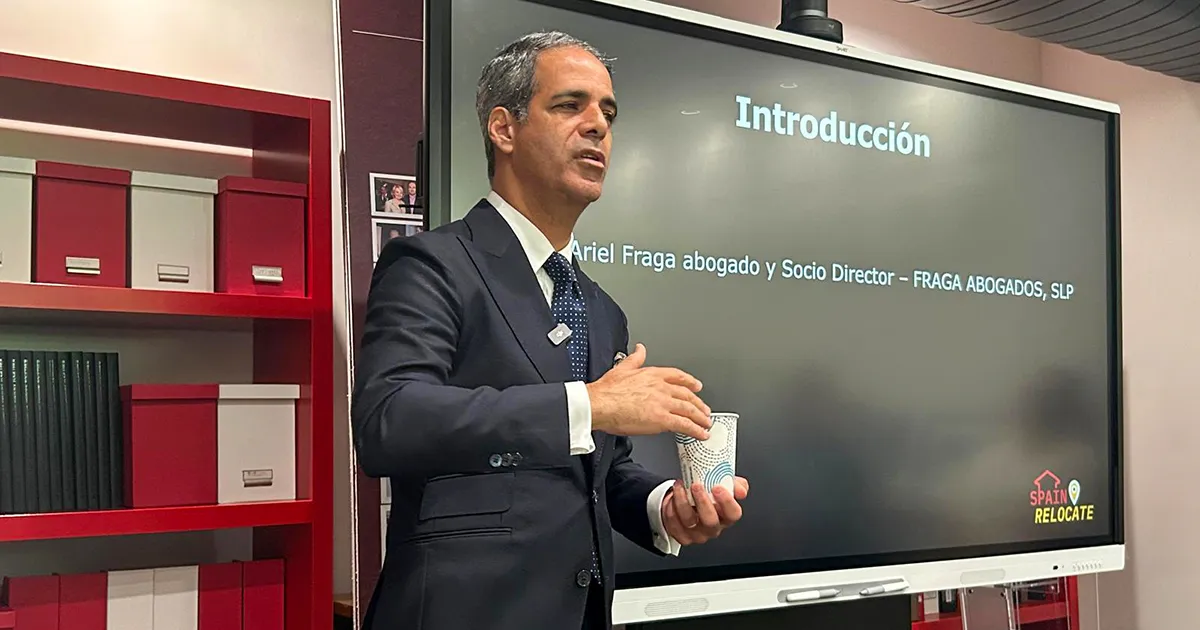
For this reason, the lawyer Ariel Fraga and the president of the Relocate Spain project, Manuel Vera, from the Fraga Abogados firm, based in Barcelona, propose to lead Spanish citizens and family members to process the necessary registrations and request public and basic services.
“After years of completing procedures for Spanish nationality and residence in Spain, I noticed that many arrived in Spain happy, but encountered the difficulties inherent to going to live in a country, such as finding housing and processing necessary records such as establishment of domicile, municipal registration, national identity document (DNI), banking, public and basic services,” argued lawyer Fraga during a conference at the Spanish Chamber of Commerce in Miami.
Starting with the transfer of belongings, obtaining a home, whether rented or purchased, and continuing with the essential requirement of registration in the municipal registry, which they call ‘registration’, the move (return for Spanish citizens according to Spanish law) could be tedious.
“The idea is to provide the procedures, take them by the hand to process each matter, not tell them to go to this place and make an appointment and do this or that. If not, take them by the hand,” he stressed.
In fact, having a long-term home, for at least one year, and registering in the municipal registry are two essential matters to obtain the DNI, unless the Spanish citizen already has it as a resident abroad. But, even so, you will have to update it because you have moved your residence to Spain.
“Here, in the United States, everything is done with the driver’s license. But in Spain everything is with the DNI,” the lawyer highlighted.
The idea is to cover the entire process “from Miami, New York or Los Angeles, wherever they live now, from moving furniture, arriving in Spain, housing, registration and obtaining basic and public services”, such as electricity, water, telephone, school as necessary.
“It means taking them by the hand, not telling them ‘this is the website’ and that’s it,” he stressed.
He then clarified that the move may be temporary, that is, a few months in Spain to, for example, find housing and carry out procedures, and return to the United States for another few months to attend to matters.
For those who are still processing Spanish nationality, there is also a solution. “There is really no need for them to wait until they are Spanish. But if they want to stay more than 90 days, they have to apply for a residency, which can be requested, it can be processed without any problem. And when Spanish nationality arrives, the DNI and passport are made in Spain,” he noted.
Those who know Spain know that it is a diverse and welcoming country, famous for its rich history, vibrant culture, excellent cuisine and varied landscapes ranging from Mediterranean coasts to snow-capped mountains.
“The person who has lived or knows in Spain knows that it is needed. Even here in Miami and other places they call it the motherland,” reflected lawyer Vera during the presentation.
Today Spain is the second most visited destination in the world. It has a high quality of life, a pleasant climate and a democratic parliamentary political system.
“It is a country where the language is the same as what we speak here at home, Spanish, where the idiosyncrasy is very similar, the way of communicating is practically the same. But the big difference is that there you do not live to work, but you work to live,” he highlighted.
Regarding the procedures to follow in Spain, Vera emphasized the process that documentation entails: “I don’t like to delegate, I like the person to talk to me and ask me everything. I’m not going to send him to go to different places. When we designed this project, we said we were going to do everything ourselves.”
The documentation process can be simple or intricate depending on each person’s needs, as well as the particular needs of each person: house or apartment, number of rooms, near or far from the center, etc.
“We want to do things in a personalized way. That is, point by point, because there are many things to do in Spain and we have to teach people how to navigate,” he remarked.
Vera highlighted the quality of life at the societal level: “For me, work-family balance is very important. In Spain, it is not only important to earn money, but also to have free time, contact with family beyond ‘hello, good morning, I’m going to work’. As a good Latin country, it is family-oriented. Grandparents matter, cousins matter, friends matter.”
But, starting a life in Spain requires following some steps like in any country in the world.
“It’s like I’m coming to live in Miami now. Well, where do I have to go? Where to rent? Where to buy? Where is the electric company? When you arrive in any country in the world, the first thing you have to do is get a place to live, whether purchased or rented. And that involves a process: demonstrate your ability to pay. You have to talk and review all the contracts,” he explained.
And he recalled that “If a person is not registered in Spain, registered, they cannot do anything. And to do so they have to have a long-term home. It cannot be a daily rental, and that is one of the mistakes that most people make due to ignorance.”
Then he reminded: “Anything you are thinking about, that you need in Spain and that you have doubts about, please ask, we are here for it.”
