
To know how many calories are in your favorite candy or prepared food, it turns out that you have to do a lot more estimating and a little bit of guessing.
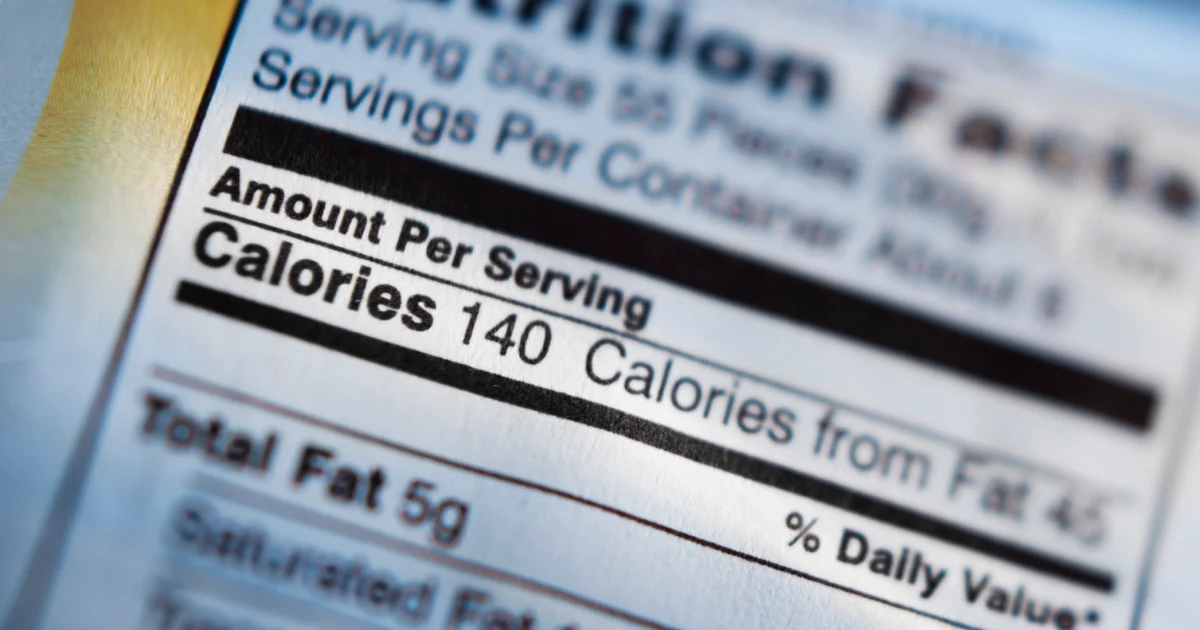
Since 1990, the Food and Drug Administration (FDA) has required standardized nutritional labels, which include the number of calories per serving. As obesity rates rose in the following years, in 2016 an adjustment was established so that the calorie figure was shown in large, bold text.
But it turns out those calorie figures aren’t as accurate as one might think.
(Ultra-processed foods account for more than half of the calories in the diet of children and adults in the US.)
A popular protein bar brand, David, is currently facing a lawsuit alleging that each bar contains twice the calories listed on the label based on independent analysis.
The company’s founder has responded by saying that the plaintiffs used an incorrect system to make the caloric calculation because the brand uses a fat substitute (or derived carbohydrate) that differs from the fat that would have been used by the plaintiffs to make their calculation.
If you are in the aisle where the peanut butter is and there is one that says it has 120 calories but the others say they have 180 per serving, then be careful with the one that says it has less.”
mari0n nestle, professor emeritus of nyu
Regardless, nutrition specialists indicate that there is a lot of variation in how each person absorbs nutrients and calories during digestion.
Such that FDA guidelines allow for a possible discrepancy of up to 20% in the calorie count that appears on the labels.
For example, If a frozen meal says on its label that it consists of 500 calories, it may have up to 600 calories. without breaking FDA regulations, according to Lindsay Moyer, a nutritionist at the Center for Science in the Public Interest.
Dr. Zhaoping Li, who heads the division of nutritional science at UCLA, said the How much energy we get from food is affected by many factorssuch as “how well your stomach digests it, how much your small intestine absorbs it, and how much of that energy can be harnessed after the gut microbiome has worked it over.”
Whole almonds, cashews, lentils and chickpeas have fewer calories to digest than their nutrition labels suggest, according to the USDA.
Together, these variables can generate inconsistencies regarding how many calories the food contains and how many appear on the nutritional label, even when a company has made the effort to calculate them as accurately as possible.
“There is some guessing involved,” Li said.
Or, in the words of Professor Emerita Marion Nestle, a nutrition and public health specialist at New York University: “The calorie thing is… complicated.”
How to measure calories in your food?
The most accurate way to do this is with a bomb calorimeter, a laboratory meter, according to Li. The process is based on the theory that when food emits heat, it is absorbed by whoever digests it in the form of energy.
(The Trump Administration announces new dietary guidelines that recommend more protein and less ultra-processed food)
To make the calculation, food scientists seal a portion of the food in question in a steel container filled with pressurized oxygen; that is, the “bomb”. That container is then placed in an insulated box filled with water.
Scientists set the food on fire so that it burns completely and then take the temperature of the water. They use a special equation to see roughly how much energy (that is, how many calories) was in that portion of food based on how much the temperature of the water rose when the food was burned.
However, Nestle, of New York University, points out that the counts made with the calorimeter become fallible.
“Not all components of a meal are absorbed and the only thing that counts for calories is what is absorbed through the intestinal walls. “So, for example, calories from fiber don’t really count,” he said.
Nestle said food manufacturers usually use another system to estimate calories, with something called Atwater factors. It is a mathematical equation that establishes a fixed number of calories per gram for macro nutrients (fats, carbohydrates and proteins).
Each gram of carbohydrate (which includes sugars) contains about 4 calories, the same as protein. Fat contains approximately 9 calories per gram. Food scientists can then estimate the number of calories in that food using the equation.
Not all components of a meal are absorbed and the only thing that counts for calories is what is absorbed through the intestinal walls.
Marion Nestle, nutrition and public health specialist
“And it’s close enough,” Nestle said. “You have to be comfortable that we will only have estimates.”
Some companies, as well as restaurants that offer calorie counts for their dishes, often use a Department of Agriculture (USDA) database that establishes an estimate for different foods, such as how much is in a single tomato or a single slice of white bread. Moyer, of the Center for Science in the Public Interest, said that is also sometimes supplemented with a database that is specific to which ingredients suppliers are for each restaurant.
Even so, estimates and approximations must be made.
“Let’s say they get their ingredients from a specific supplier that has already done a calorie count analysis, but then they cook or process it in a way that changes the nutrients in the ingredient,” Moyer said.
So there’s a human factor: Restaurants that prepare their dishes directly have a greater variation in calorie count than there is in a prepared meal like protein bars.
“If someone makes you a sandwich you may see that they take a slice of meat already pre-cut, so those calorie counts remain relatively standardized. But if they then add some sauce or seasoning to taste, then that already varies more,” Moyer said. “So calorie counts on a restaurant menu should not be thought of in the same way as packaged foods.”
(300 calorie burrito? Chipotle chain faces lawsuit for alleged false promotion)
Few calories from fiber
There are certain foods that are more difficult to digest completely, that is, the body does not absorb as many calories from them as the nutritional label says they contain.
That happens with, for example, plant-based foods that require more chewing, which makes estimating the calories they contain more difficult.
“People usually absorb fewer calories from those foods than the label says“said Moyer.
The same thing happens with almonds, according to the nutritionist: people absorb more calories when they consume almond cream than when they eat the split almonds directly because the spreadable cream is “as if someone had already chewed it for you.”
There are several studies conducted by the USDA that indicate that whole almonds, cashews, lentils, and chickpeas have fewer calories to digest than their nutritional labels suggest. Walnuts, which have more protein and omega-3 content, have 21% fewer calories than label estimates, according to the USDA.
Insoluble fiber is another nutrient that does not contribute much to the actual caloric content, because the body does not have the necessary enzymes to digest all the chemical components of the fibers: that is, they pass through the digestive system without being broken down to convert them into energy. There are insoluble fibers in foods such as whole grains, nuts, seeds, and the skin of fruits and vegetables.
“Fiber is typically a carbohydrate that we don’t break down as completely as we digest so that it has few, if any, digestible calories,” Moyer said.
The large intestine sometimes absorbs some calories from these foods, but not all; They are usually soluble fibers, such as those contained in oats, apples or avocado.
So is it worth trusting calorie content labels?
There is little research that measures how true and accurate labels are on packaged foods, and the FDA does not test every product on sale.
“It’s worth saying that the consumer should be careful if what the nutrition label promises sounds too good to be true,” Moyer said. “You have to compare it with similar products. For example, if you are in the aisle where the peanut butter is and there is one that says it has 120 calories but the others say they have 180 per serving, then be careful with the one that says it has less.”
So Moyer concludes that it is important to pay attention to the nutritional labels of foods, but we must take into account this caveat that no company that manufactures prepackaged foods is going to be able to say with absolute certainty that their pizza has exactly 352 calories.
