
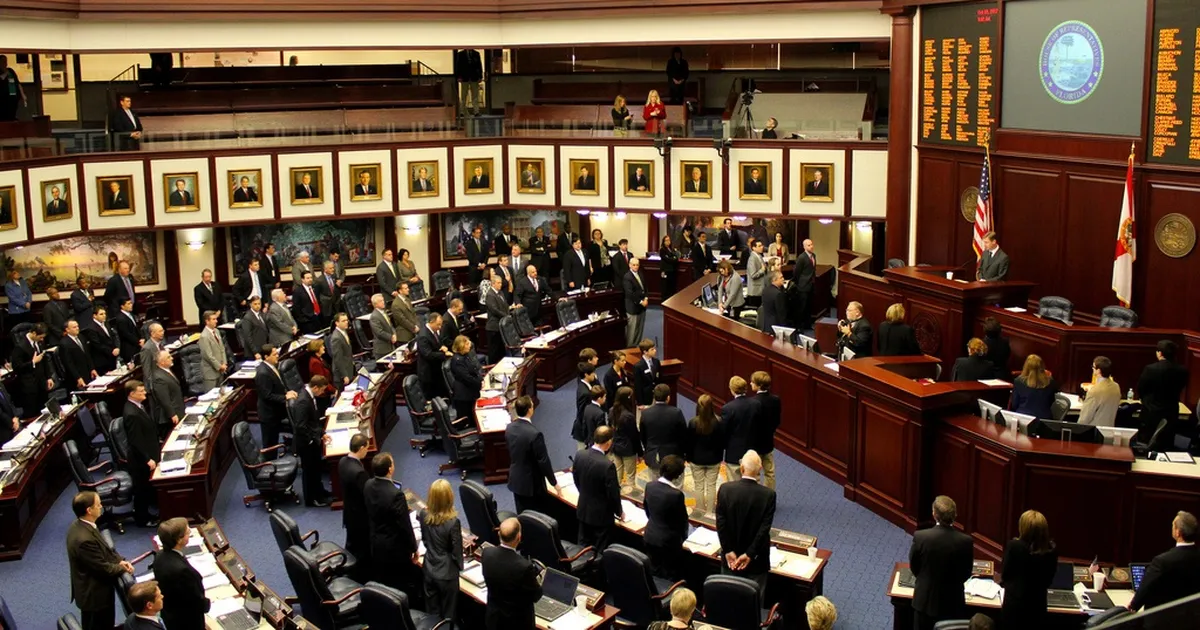
MIAMI.- The Florida Legislature, with a Republican majority, gave the green light this Wednesday to the new congressional map promoted by Governor Ron DeSantis, a redistribution that could give the Republican Party up to four new seats in the federal House of Representatives ahead of the November midterm elections, thus strengthening President Donald J. Trump’s national strategy to retain control of Congress.
Approval divided along party lines
The state House of Representatives approved HB1D by a vote of 83 to 28, strictly divided along party lines. Republicans voted in favor and Democrats against. Hours later, the Senate gave it final approval with 21 votes in favor and 17 against, although four Republican senators broke ranks and voted against.
The bill now awaits Governor DeSantis’ signature to become law.
The new design would eliminate four districts currently favorable to Democrats. One in Tampa, another in Orlando and two in the Fort Lauderdale area, practically halving the Democratic-leaning seats in a state that has 28 congressional districts. The result of this vote would a priori leave the Democrats with only four districts.
Why redraw the map now?
Historically, congressional maps are redrawn after each federal census, meaning every ten years. However, DeSantis pushed this review mid-decade, arguing that Florida’s rapid population growth requires new redistribution.
In addition, he maintained that some previous districts were designed with racial criteria to preserve the electoral power of minorities, something he considers incompatible with the Constitution.
The governor had anticipated that the United States Supreme Court would rule that would weaken the Voting Rights Act of 1965, and facilitate this process.
The influence of the Supreme Court
Precisely, hours before the vote, the Supreme Court issued a decision on Louisiana in which it considered unconstitutional the use of racial criteria to create a district with an African-American majority.
After the ruling was announced, DeSantis wrote in
Some lawyers for the president interpret that if that part of the amendment Fair Districts is weakened, the prohibition against gerrymandering partisan included in that same constitutional reform approved by voters in 2010.
Republicans defend the map
Republicans defended the proposal as “racially neutral” electoral mapping.
Jason Poreda, DeSantis’ top adviser and author of the map, said he used partisan criteria because, under the governor’s legal interpretation, it would no longer be mandatory to comply with all provisions of the amendment. Fair Districts.
“Not using race, and not having to adhere to the Fair District Amendment, allowed me to use the full set of redistricting criteria available in other states, including partisan data,” Poreda acknowledged.
For his part, Republican Senator Don Gaetz, sponsor of the project, acknowledged his legal reservations, although he defended putting it to a vote.
“I’m not persuaded that this map is necessarily beneficial to the Republican Party,” he said.
Democrats denounce electoral manipulation
For their part, Democrats described the redraw as a partisan power grab to favor Republicans and weaken the African-American and Puerto Rican vote.
During the House vote, Democratic Rep. Angie Nixon of Jacksonville, a U.S. Senate hopeful, stormed the floor with a megaphone to protest.
“It’s out of order! They’re violating the Constitution!” Nixon shouted as Republicans moved forward with approval.
Florida Democratic Party Chairwoman Nikki Fried called the argument that the court decision eliminates all Fair District protections “absurd”Fair Districts– under the Florida Voting Rights Act. He recalled that the Florida Supreme Court had the opportunity to invalidate the entire amendment and did not do so.
Even within the Republican Party there was resistance, with Republican Senators Jennifer Bradley, Ileana Garcia and Erin Grall voting against the map. After the vote Bradley declared. “I can’t do it. It’s just unconstitutional.”
Legal challenges and August primaries
Various voting rights groups have already announced lawsuits once DeSantis signs the law.
The legal challenges will primarily focus on the potential violation of the Florida Constitution, which prohibits gerrymandering partisan under the Fair Districts amendments of 2010.
The main problem will be the electoral calendar. Florida holds its primaries in August and several candidates have already begun to announce which new districts they will compete in. The Supreme Court generally does not intervene when an election is involved to avoid political interference.
If the justice system suspends or delays the implementation of the map, severe administrative and political chaos could be generated in the middle of the electoral year, affecting the organization of the midterm elections.
Vaccines and artificial intelligence are out
Although the special session called by DeSantis also included two other topics such as vaccine exemptions and the regulation of artificial intelligence, Florida House Speaker Daniel Pérez made it clear that those issues will not be addressed.
“In the call there are other issues to be addressed, but they will not be addressed in this special session,” Pérez said at the beginning of the legislative day.
The Republican leader explained that the only priority of the House would be the reconfiguration of congressional districts, leaving out of the debate the other two points originally included by the governor.
(email protected)
