
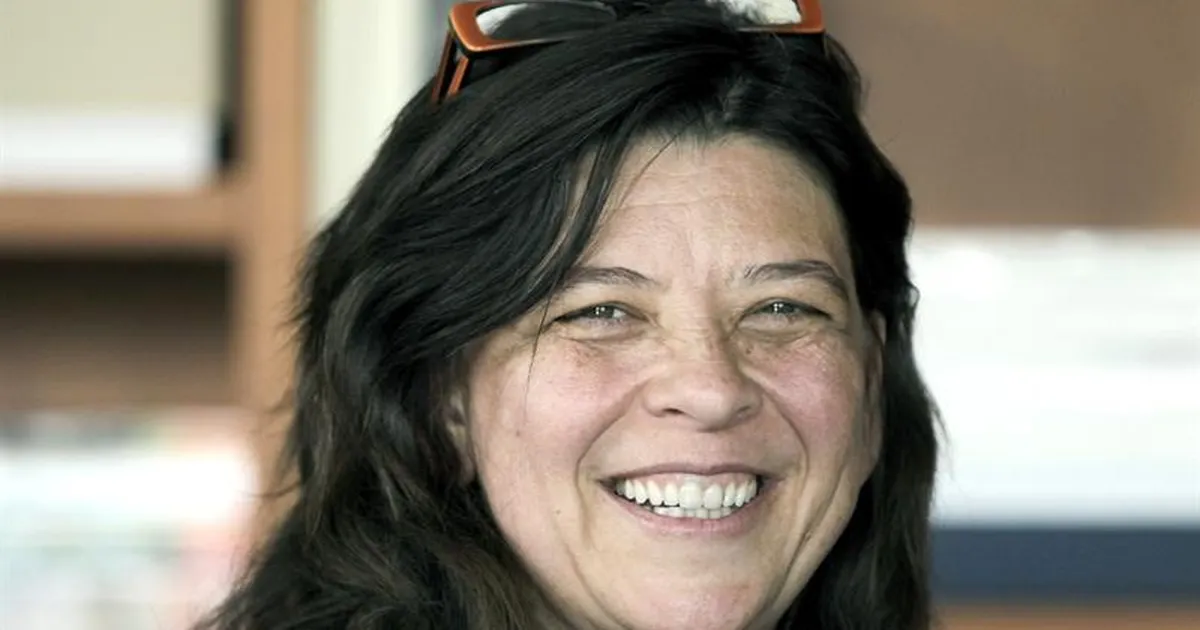
BOGOTA.- Venezuela was already devastated when the earthquakes hit. For the award-winning Venezuelan filmmaker Mariana Rondón “at this moment it is very difficult to talk about hope” because she feels that “there is no way out” for her country, she laments in an interview with AFP in Bogotá.
Winner of the Golden Shell at the San Sebastián Festival in 2013, she cannot hide a sad look when she talks about the double earthquake that shook the state of La Guaira a couple of weeks ago and left more than 3,500 dead.
Since then he has been sick, “like everyone else, watching those images non-stop” about the desperation and rescue of hundreds of residents under a blanket of ruins.
“It’s very difficult because no, there is no way out. What we are in is more and more hurt, more and more wounded and without prospects of where to go. There is no solution from the outside that can relieve us, but there is no solution from within either,” says the 60-year-old filmmaker within the framework of the Bogotá Audiovisual Market (BAM).
Co-directed with the Peruvian Marité Ugás, his latest film, It’s still night in Caracasaddresses a political collapse in the country and seems more relevant than ever, although it was conceived before the earthquakes and the fall of former president Nicolás Maduro in January.
“I think there is one thing (…) that was clear in the earthquake and that is clear in the film and that is that we are alone. We have to work together (…) to be able to survive, to be able to move this country forward,” says Rondón.
“Everything breaks”
Based on the novel The Spanish woman’s daughterby Venezuelan Karina Sainz Borgo, the film is a dystopian thriller about what loss means in a country that is falling apart.
The actors and crew behind the cameras participated in rehearsals to push them “to the limit” so that “the viewer who was not experiencing it could understand what it’s like for your daily life to break down,” explains Rondón, who lives between Mexico and Peru.
The film could not be released in theaters in Venezuela, as it does not have official approval, but part of the millions of migrants who fled the crisis have felt identified, he adds.
Shot entirely in Mexico and crossed by universal themes, it is a story that resonates outside of Venezuela.
He speaks of “a world where democracy is so fragile that at any moment everything breaks, where populism (…) can break the entire social fabric and begin to subject people to an extremely violent world,” he says.
“It no longer exists”
Daughter of former guerrillas of the Armed Forces of National Liberation (FALN) of Venezuela, her childhood was marked by clandestinity and family displacement.
He studied in Cuba and France, and assures that “the majority” of his films are political. Making films from exile has been both a driving force of inspiration and an ordeal when it becomes an uncomfortable mirror for the government in Venezuela.
He is particularly interested in “how the exercise of power” ends up affecting “the intimacy” and “everyday life” of his characters.
“I spent almost ten years without directing films,” after Bad Hairwinner of the Golden Shell, tells.
“You think that you don’t have a country, that you don’t have funds” and it is “terrible because you have to completely rethink your life.” “But on the other hand, you also get rid of a lot of superficial things that prevented you from making films,” he says.
Rondón will give a talk about “making dreams possible” in cinema, during the BAM.
But “I haven’t dreamed in a while,” he says as an opener.
Do you dream of returning to Venezuela?
“Yes, but we all know that the country we left no longer exists. That one no longer was or will be. I hope there is a better one,” he responds.
