
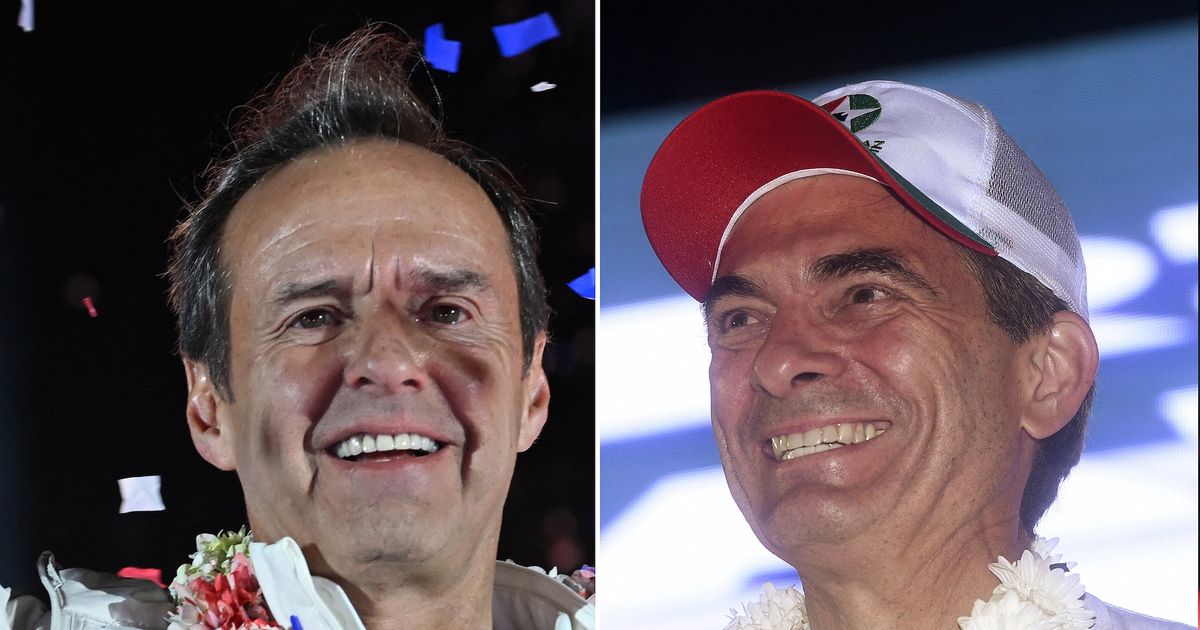
La Paz – The first data of the fast count of the Unitel network project that Rodrigo Pazcandidate of the Christian Democratic Party, leads the intention to vote with 31.6%, followed by Jorge Tuto Quirogaof Free Alliance, with 27.1%. According to these projections, both will compete in the second round to define the next president of Bolivia.
Samuel Doria Medina, of the Unit Party, was in third place with 19.5%, while Andrónico Rodríguez, from Alianza Popular, reached 8.2%. The Movement to Socialism (MAS), represented by Eduardo del Castillo, obtained 3.2% in this first estimate.
Ipsos-Ciesmori and Capture Consulting Surveys confirm the trend.
Doria Medina, considered until a week ago as a favorite, was relegated to third place with about 19%, showing a significant turn in the projection of the elections after 20 years of leftist government in Bolivia.
The null votes amounted to 1,175,907.
After the first projections, the candidate Samuel Doria Medina, spoke to give his support to Rodrigo Paz.
“I said that if we did not win, I was going to do to whom it was first if it was not the most (movement to socialism). That candidate is Rodrigo Paz and I maintain my word,” said the candidate for Unity Alliance.
“Dear companions of the Unit Alliance, we can go to sleep quietly. We have given everything on our part, I wanted to serve Bolivia as president and it has not been possible,” he concluded.
Paz, 57, son of former president Rodrigo Paz Zamora (1989-1993), broke all forecasts by imposing himself in the first round.
“Bolivia needs stability, governance and generating a change in the economy that is not an economy for the state, but an economy for people,” said peace after voting in the city of Tarija, in southern Bolivia.
“Without incident”
The elections in Bolivia developed without significant incidents, according to the observation missions of the Organization of American States (OAS) and the European Union (EU)which positively valued the electoral day.
In their first reports, both missions highlighted the climate of tranquillity in which the elections were carried out, as well as the “Democratic vocation” demonstrated by Bolivian citizens throughout the day.
These elections confirmed the punishment of the socialism movement, which ruled for 20 years, first with Evo Morales and then with Luis Arce, today adversaries.
The Bolivians voted in the middle of a severe economic crisis due to the shortage of dollars and fuels and with an year -on -year inflation of almost 25%, the largest in 17 years.
